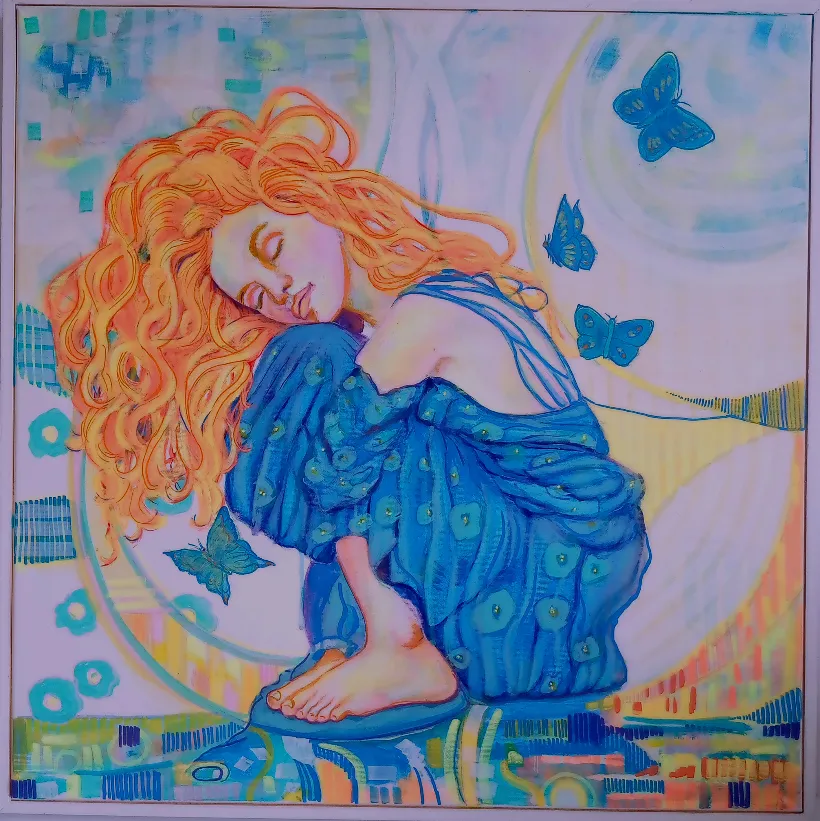
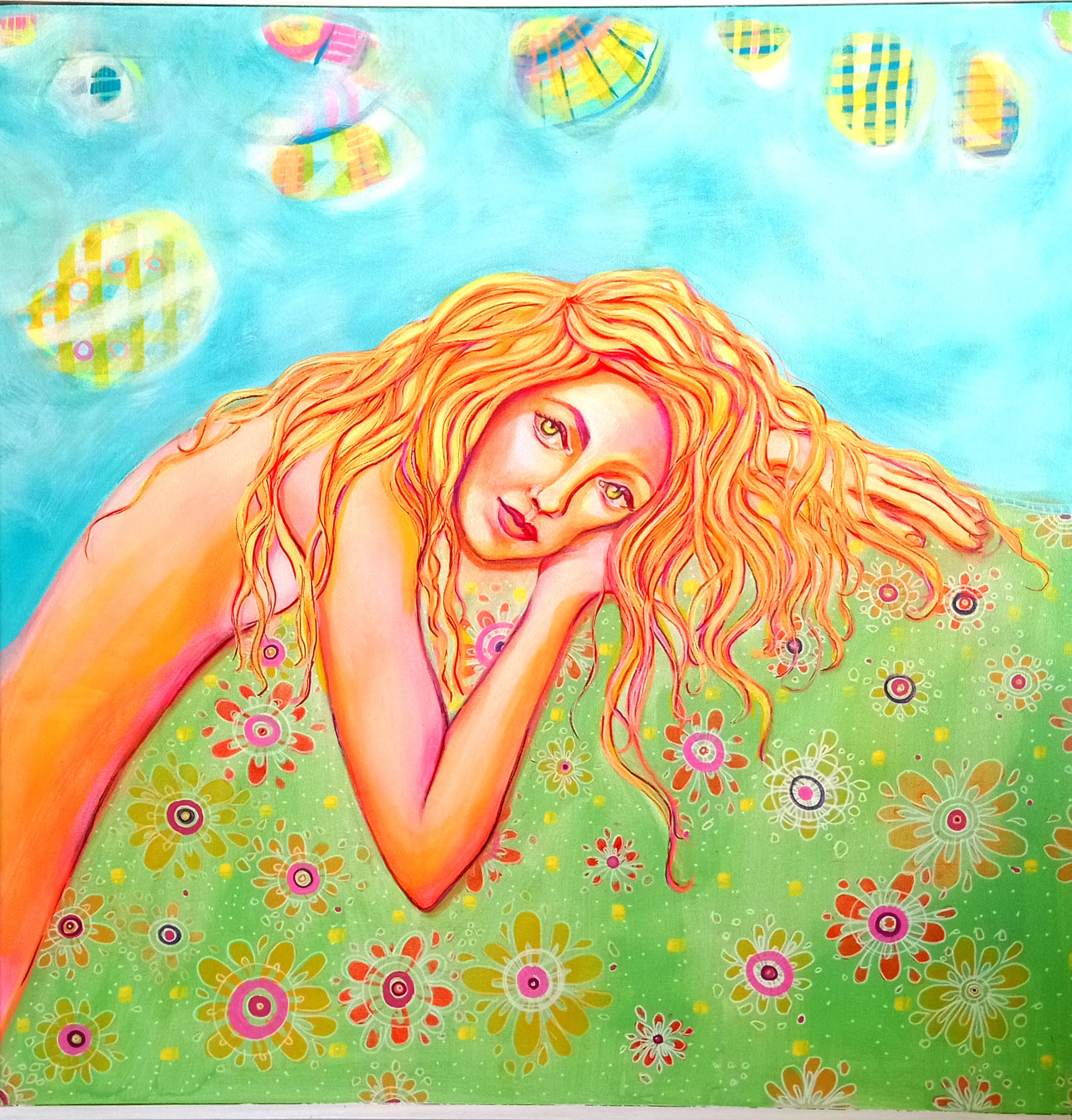
Entre los brazos de los sueñosÁlmok ölelésébenIn the Embrace of Dreams
La misma mujer que se atreve a sentirse reina se recoge ahora en su mundo interior. Acurrucada, descansa entre los brazos de sus sueños mientras los colores, las flores, las mariposas y la luz crean el universo que ella imagina. No huye de la realidad; se alimenta de la imaginación que le ofrece esperanza, belleza y futuro. Toda mujer guarda sueños en su interior, y son ellos los que le permiten descubrir una y otra vez la belleza del mundo.
Ugyanaz a nő, aki királynőnek meri érezni magát, most csendesen saját belső világába húzódik vissza. Összegömbölyödve, álmai ölelésében pihen, miközben a körülötte kibontakozó színek, virágok, pillangók és fények egy általa teremtett világot idéznek. Nem a valóságból menekül, hanem abból a képzeletből táplálkozik, amely reményt, szépséget és jövőt ad. Minden nő őriz magában álmokat – néha csendesen, néha bátran –, és ezek az álmok segítenek újra és újra felfedezni a világ szépségét.
The same woman who dares to feel like a queen now withdraws into her inner world. Curled up in peace, she rests in the embrace of her dreams, surrounded by colours, flowers, butterflies and light that form a world of her own creation. She is not escaping reality; she is nourished by imagination, hope and beauty. Every woman carries dreams within her, and those dreams help her rediscover the beauty of the world again and again.
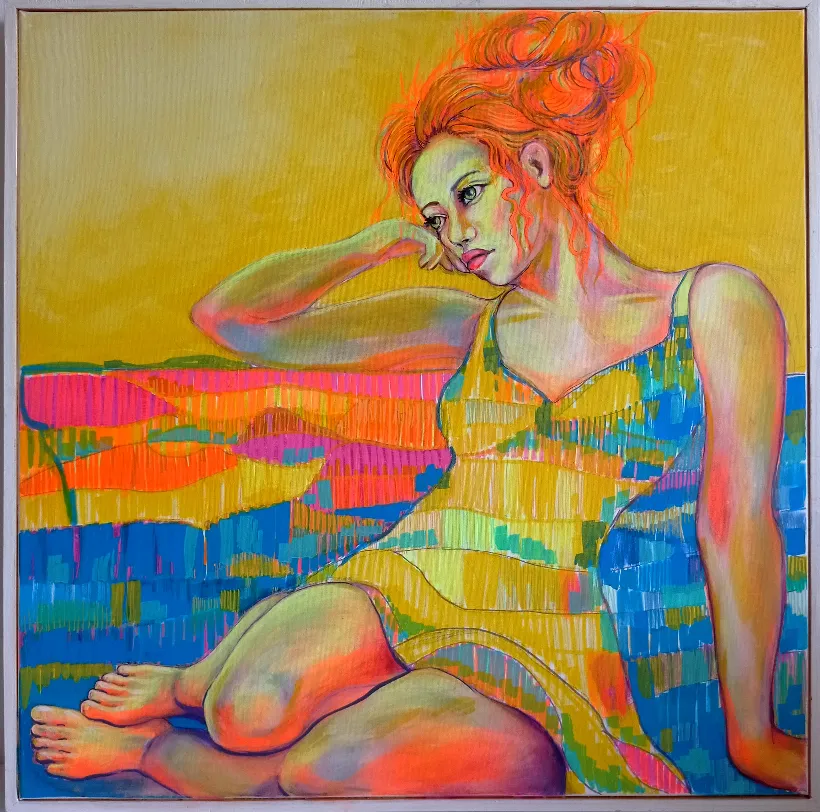
Aquí… y, sin embargo, en otra parte.Itt… és mégis máshol.Here… and yet elsewhere.
La obra muestra un estado interior de calma. El cuerpo de la mujer permanece presente, mientras su mirada viaja lejos. Exteriormente hay armonía, belleza y serenidad; interiormente vive un deseo silencioso de algo o de alguien que trasciende el momento presente. No habla de ausencia, sino del viaje íntimo del alma. Cada espectador puede imaginar hacia dónde se dirige su pensamiento.
A kép egy csendes belső állapotot jelenít meg. A nő teste nyugalomban van, tekintete azonban messzire vezet. Kívül harmónia, biztonság és szépség látható, belül mégis egy kimondhatatlan vágy él: valami vagy valaki után, ami túlmutat a jelen pillanaton. Nem a hiányról szól, hanem a lélek csendes utazásáról. A néző maga döntheti el, hogy emlékek, álmok vagy remények felé indul-e a tekintet.
This painting portrays a quiet inner state. The woman's body is fully present, yet her gaze drifts far away. Outwardly there is harmony, beauty and calm; inwardly there is a silent longing for something—or someone—beyond the present moment. It is not about absence, but about the soul's quiet journey. The viewer is invited to imagine where her thoughts have gone.
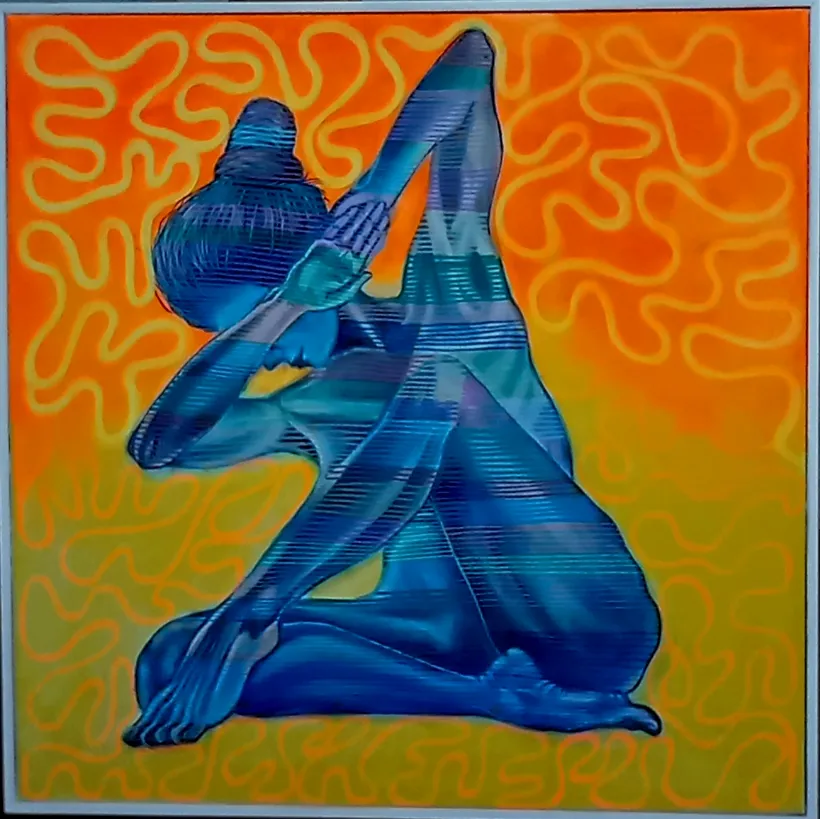
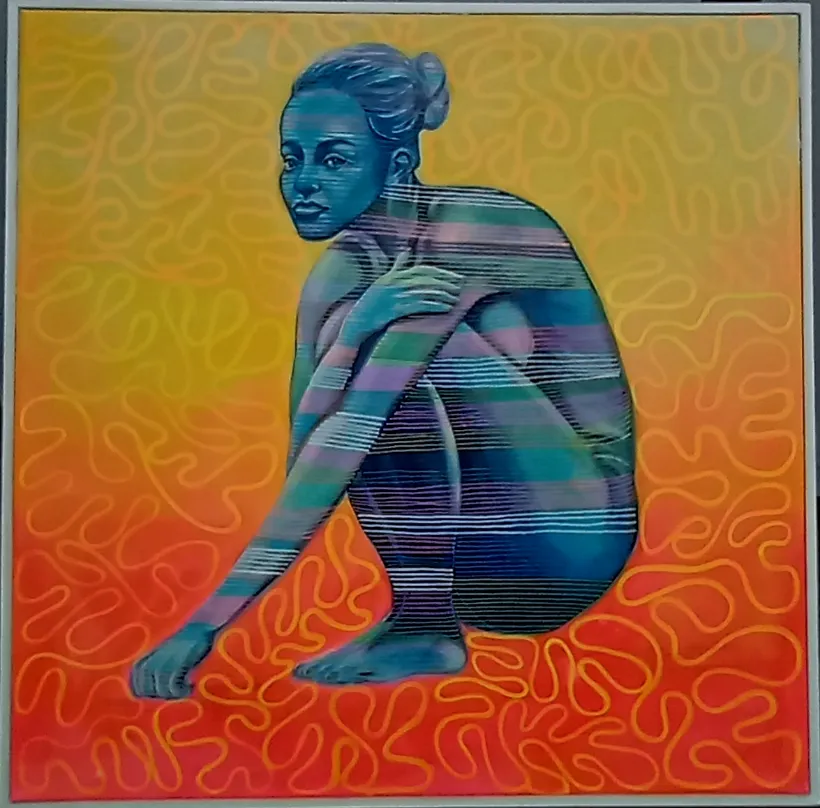
Copia defectuosa I, II, III, IV.Hibás másolat I, II, III, IV.Defective copy , II, III, IV.
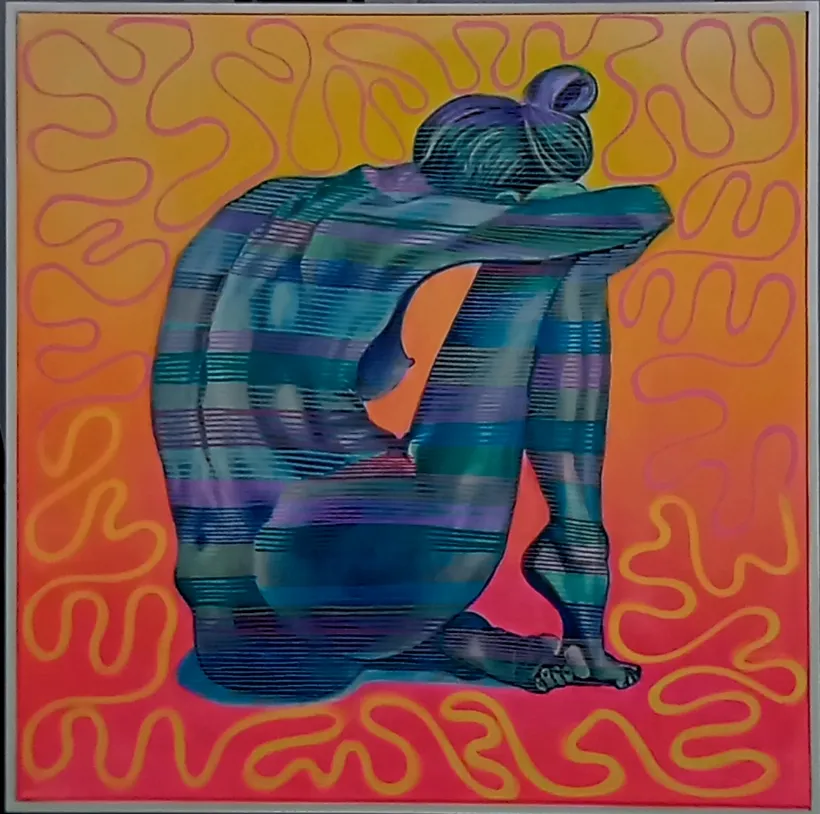
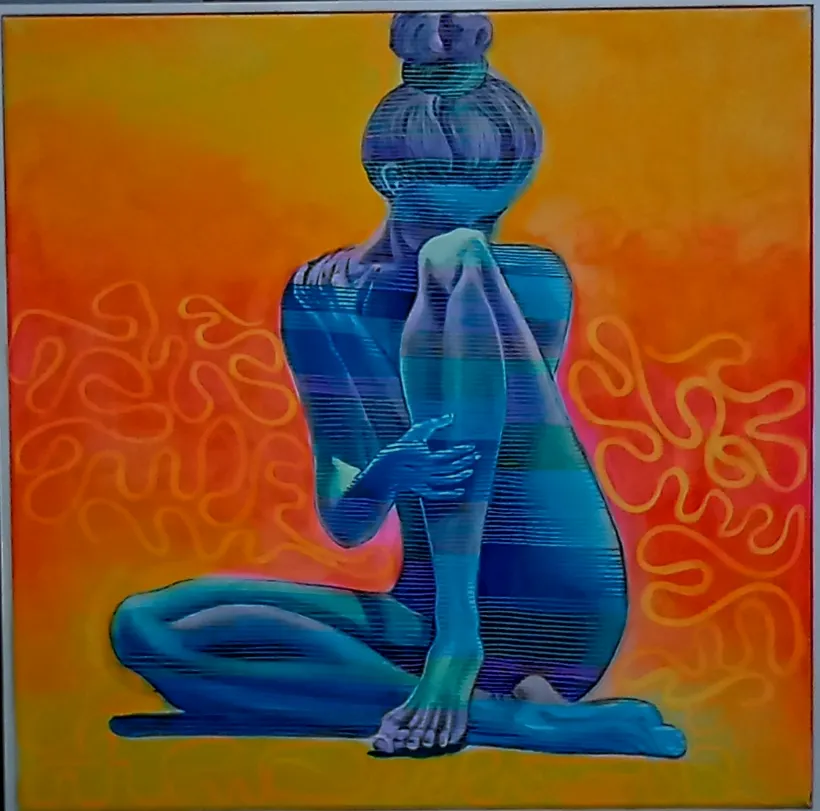
Serie – 4 obras
Las cuatro figuras femeninas son cuatro manifestaciones diferentes de una misma idea. Sus cuerpos son serenos y armoniosos, y su mirada se dirige hacia su interior. No buscan el contacto con el espectador, sino que permanecen en su propio mundo interior. El énfasis no recae en la corporalidad, sino en la presencia interior del ser humano. El fondo no es una mera superficie de color. Las líneas onduladas, que se extienden a lo largo de tonos amarillos, naranjas y rojos incandescentes y parecen infinitas, evocan un potente campo de energía. Simbolizan las vibraciones constantes, el ruido, el torrente de información y la presión del mundo que nos rodea. Este entorno puede resultar a la vez atractivo e inquietante: brilla, pero quema. Un entorno que nos influye constantemente, nos moldea y hace cada vez más difícil mantener nuestro equilibrio interior. Los cuerpos pintados de azul crean un marcado contraste con ello. Para mí, el azul no es el color de la frialdad, sino el de la dimensión espiritual: simboliza a esa persona interior que, a pesar de las influencias externas, desea seguir siendo ella misma. Las franjas de color que recorren los cuerpos dan la sensación de un error de impresión o de una distorsión digital. Su significado se deja deliberadamente abierto. Pueden aludir a un fallo técnico, a fallos del sistema o a esa época en la que la tecnología ya no solo fija, sino que también transforma la imagen del ser humano. Es capaz de corregir, embellecer y perfeccionar, al tiempo que nos aleja, sin que nos demos cuenta, de nuestra propia realidad. «La copia defectuosa» no afirma que la tecnología sea buena o mala. Más bien llama la atención sobre el hecho de que, en nuestra época, la frontera entre el original y la copia se vuelve cada vez más difusa. ¿Vemos quiénes somos realmente o solo la imagen que el mundo —o nosotros mismos— creamos de nosotros mismos? La respuesta puede ser diferente para cada espectador.
Sorozat – 4 alkotás
A négy nőalak ugyanannak a gondolatnak négy különböző megjelenése. Testük nyugodt és harmonikus, tekintetük befelé fordul. Nem keresik a nézővel a kapcsolatot, hanem saját belső világukban maradnak. A hangsúly nem a testiségen, hanem az ember belső jelenlétén van. A háttér nem pusztán színes felület. Az izzó sárga, narancs és vörös árnyalatokon végighúzódó, végtelennek tűnő hullámvonalak egy erőteljes energiamezőt idéznek. A körülöttünk lévő világ folyamatos rezgéseit, zaját, információáradatát és nyomását jelképezik. Ez a közeg egyszerre lehet vonzó és nyugtalanító: ragyog, mégis éget. Olyan környezet, amely állandóan hat ránk, formál bennünket, és egyre nehezebbé teszi, hogy megőrizzük belső egyensúlyunkat. A kékre festett testek ezzel éles ellentétet alkotnak. A kék számomra nem a hidegség, hanem a lelki dimenzió színe: azt a belső embert jelképezi, aki a külső hatások ellenére is önmaga szeretne maradni. A testeken végighúzódó színes sávok egy hibás nyomtatás vagy digitális torzulás érzetét keltik. Jelentésük szándékosan nyitott. Utalhatnak technikai hibára, a rendszer zavaraira, vagy arra a korszakra, amelyben a technológia már nemcsak rögzíti, hanem át is alakítja az ember képét. Képes javítani, szépíteni és tökéletesíteni, miközben észrevétlenül eltávolíthat bennünket saját valóságunktól. A Hibás másolat nem azt állítja, hogy a technológia jó vagy rossz. Inkább arra hívja fel a figyelmet, hogy korunkban az eredeti és a másolat közötti határ egyre bizonytalanabbá válik. Vajon azt látjuk, akik valóban vagyunk, vagy már csak azt a képet, amelyet a világ – vagy mi magunk – létrehozunk önmagunkról? A válasz minden néző számára más lehet.
Series – 4 works
The four female figures are four different manifestations of the same idea. Their bodies are calm and harmonious; their gaze is turned inwards. They do not seek connection with the viewer, but remain within their own inner worlds. The emphasis is not on physicality, but on the human inner presence. The background is not merely a coloured surface. The seemingly endless wavy lines, stretching across glowing shades of yellow, orange and red, evoke a powerful energy field. They symbolise the constant vibrations, noise, flood of information and pressure of the world around us. This environment can be both alluring and unsettling: it glows, yet it burns. It is an environment that constantly affects us, shapes us, and makes it increasingly difficult to maintain our inner balance. The bodies painted blue stand in sharp contrast to this. For me, blue is not the colour of coldness, but of the spiritual dimension: it symbolises the inner self that wishes to remain true to itself despite external influences. The coloured stripes running across the bodies give the impression of a printing error or digital distortion. Their meaning is deliberately open to interpretation. They may allude to a technical fault, system malfunctions, or to an era in which technology no longer merely records but also transforms the human image. It is capable of correcting, embellishing and perfecting, whilst imperceptibly distancing us from our own reality. *The Flawed Copy* does not claim that technology is good or bad. Rather, it draws attention to the fact that, in our time, the boundary between the original and the copy is becoming increasingly blurred. Do we see who we truly are, or merely the image that the world – or we ourselves – create of ourselves? The answer may be different for every viewer.
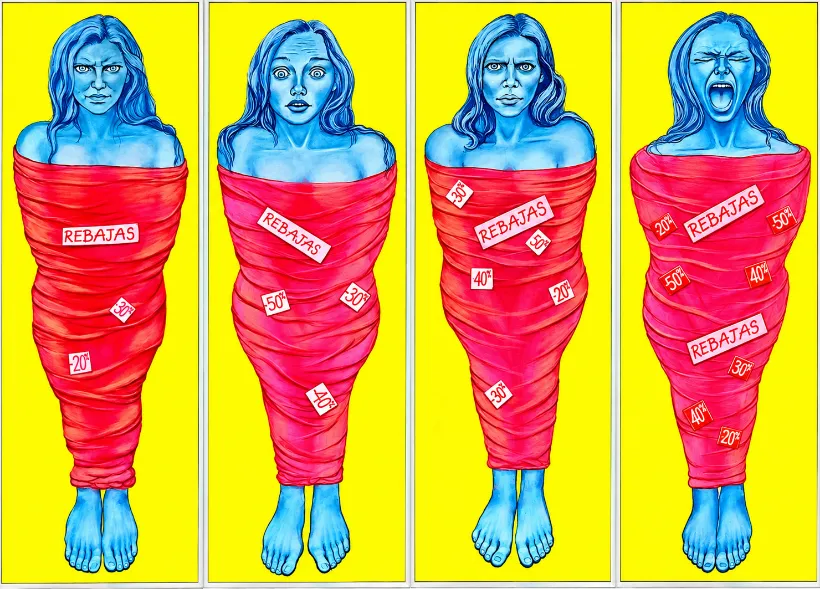
DesvalorizaciónLeértékelődésDevaluation
Desvalorización no habla del verdadero valor de la mujer, sino de cómo la sociedad, en ocasiones, la trata como si fuera un producto rebajado. Este políptico traza un recorrido emocional: desde el desconcierto hasta la incertidumbre, la resistencia y un grito silencioso. La obra invita a reflexionar sobre el hecho de que el valor no reside en la juventud, la belleza ni en responder a las expectativas externas. No es la mujer quien pierde su valor, sino la mirada que juzga únicamente por la apariencia. Desvalorización es, por tanto, una crítica social y también un recordatorio: la dignidad humana no puede rebajarse.
A Leértékelődés nem a nő valódi értékéről szól, hanem arról, ahogyan a társadalom időnként úgy bánik vele, mintha egy leárazott termék lenne. A négyrészes kompozíció érzelmi utat rajzol: a döbbenettől a bizonytalanságon és az ellenálláson át a néma kiáltásig. A mű arra hívja fel a figyelmet, hogy az érték nem a fiatalságban, a szépségben vagy a külső elvárásoknak való megfelelésben rejlik. Nem a nő veszít az értékéből – hanem az a tekintet értéktelenedik el, amely kizárólag a külsőségek alapján ítél. A Leértékelődés így nemcsak társadalomkritika, hanem emlékeztető is: az emberi méltóság nem leárazható.
Devaluation is not about a woman's true worth, but about the way society sometimes treats her as if she were a discounted product. This polyptych traces an emotional journey from shock through uncertainty and resistance to a silent cry. The work reminds us that human value does not lie in youth, beauty, or conformity to external expectations. It is not the woman who loses her value; it is the gaze that judges only appearances.
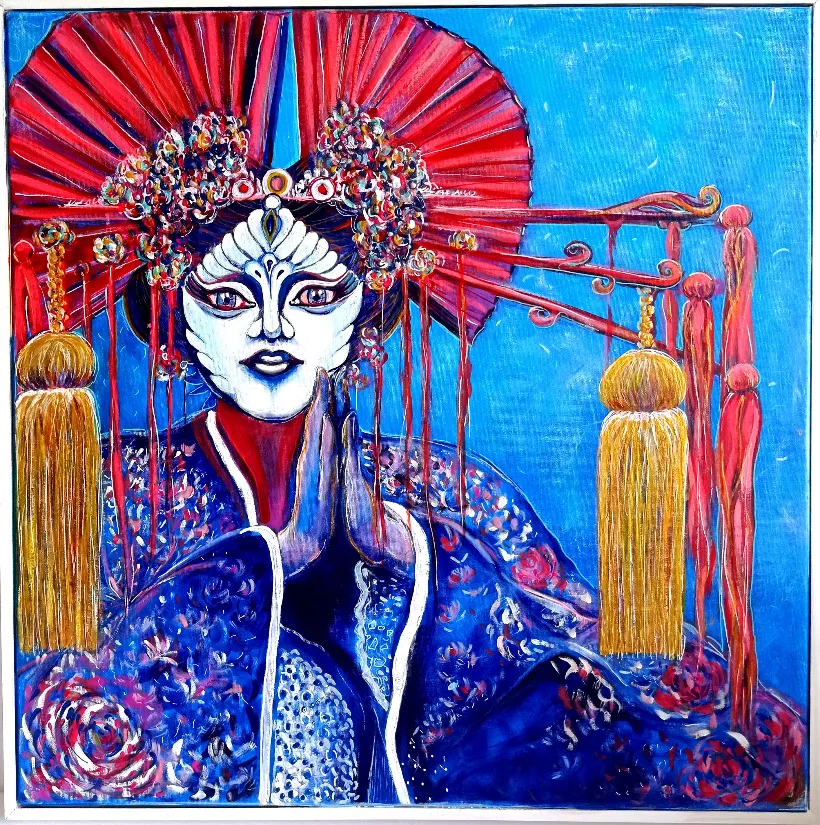
Detrás de la máscaraMaszk mögöttBehind the mask
La figura de la geisha que aparece en esta imagen no representa a una persona concreta, sino un papel. Una apariencia que la persona se pone para cumplir con una expectativa, una tradición o un momento. A lo largo de nuestra vida, todos llevamos diferentes máscaras. Asumimos roles en la familia, en el trabajo y en nuestras comunidades. Estos roles nos ayudan a orientarnos en el mundo, pero al mismo tiempo pueden ocultar nuestro verdadero yo. La imagen no pregunta quién está delante de la máscara, sino quién hay detrás de ella. ¿Qué queda de esa persona cuando se desprenden las capas de los roles, las expectativas y la apariencia exterior? «Detrás de la máscara» no trata de las apariencias, sino del mundo interior oculto. De esa persona a la que el mundo exterior a menudo ya no ve, pero que, sin embargo, es quien permanece inmutable detrás de cada papel.
A gésa alakja ezen a képen nem egy konkrét személyt ábrázol, hanem egy szerepet. Egy olyan külsőt, amelyet az ember magára ölt, hogy megfeleljen egy elvárásnak, egy hagyománynak vagy egy pillanatnak. Életünk során mindannyian különböző maszkokat viselünk. Szerepeket vállalunk a családban, a munkában, a közösségeinkben. Ezek a szerepek segítenek eligazodni a világban, ugyanakkor el is takarhatják valódi önmagunkat. A kép nem azt kérdezi, hogy ki áll a maszk előtt, hanem azt, hogy ki van mögötte. Mi marad abból az emberből, amikor a szerepek, az elvárások és a külső megjelenés rétegei lehullanak? A Maszk mögött nem a látszatról, hanem a rejtett belső világról szól. Arról az emberről, akit a külvilág sokszor már nem lát, mégis ő az, aki minden szerep mögött változatlanul jelen van.
The figure of the geisha in this picture does not depict a specific person, but rather a role. An appearance that one adopts in order to conform to an expectation, a tradition or a moment in time. Throughout our lives, we all wear different masks. We take on roles within our families, at work and in our communities. These roles help us find our way in the world, yet they can also conceal our true selves. The picture does not ask who stands in front of the mask, but who is behind it. What remains of a person when the layers of roles, expectations and outward appearances fall away? *Behind the Mask* is not about appearances, but about the hidden inner world. It is about the person whom the outside world often no longer sees, yet who remains ever-present behind every role.
El descanso del almaA lélek pihenőjeThe Soul's Rest
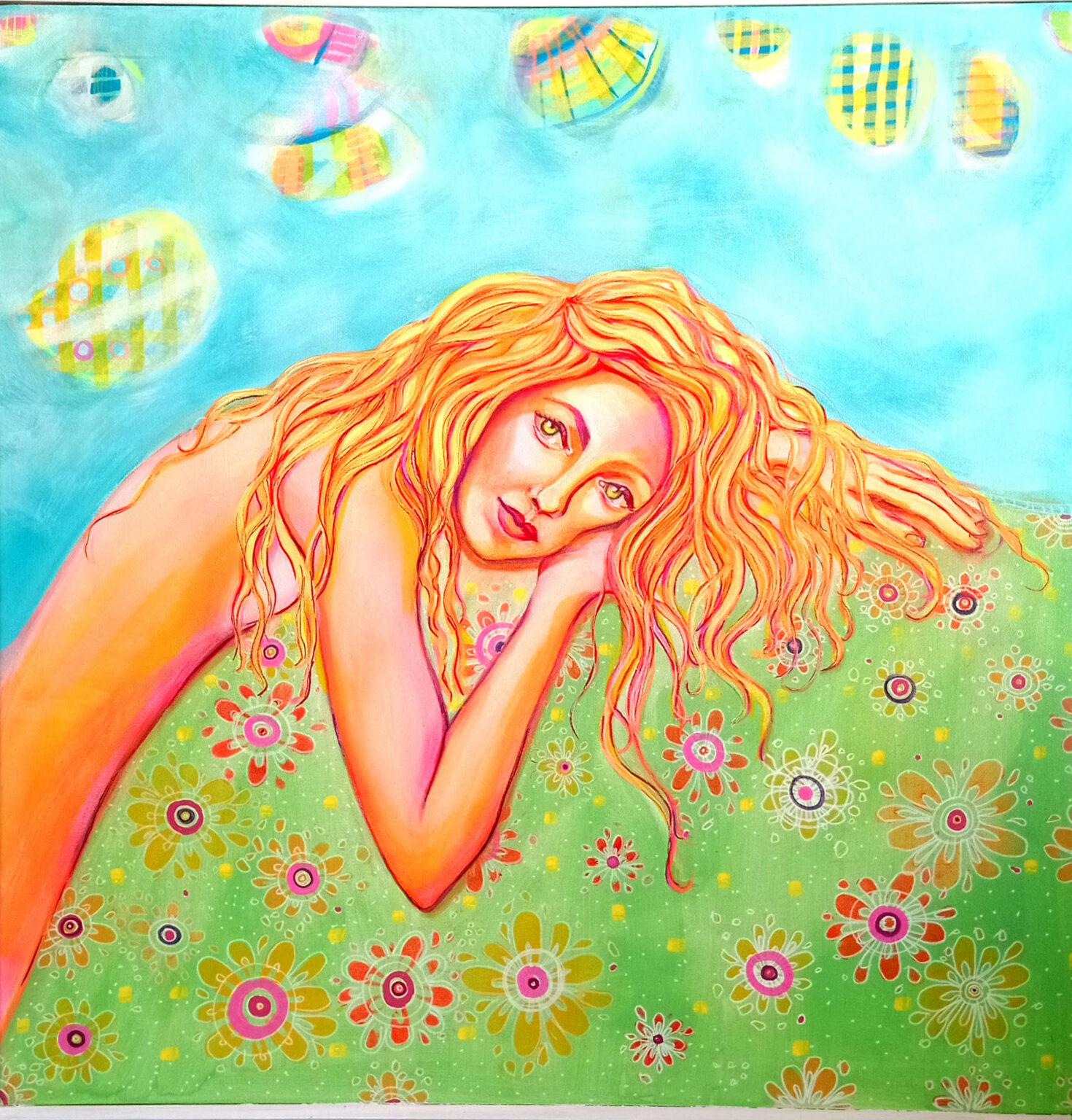
Hay momentos en los que el cuerpo y el alma se agotan al mismo tiempo, no por un solo acontecimiento, sino por el peso de todo lo vivido. Los movimientos se vuelven lentos y la mirada se dirige hacia el interior. La figura no representa debilidad, sino la necesidad humana de descansar. La obra no revela si el agotamiento es físico o emocional, y precisamente por ello resulta universal. El descanso del alma rinde homenaje al instante en que dejamos por un momento el peso del mundo para recuperar la fuerza y seguir adelante.
Vannak pillanatok, amikor a test és a lélek egyszerre fárad el. Nem egyetlen eseménytől, hanem mindattól, amit hosszú ideje magunkban hordozunk. A mozdulatok lelassulnak, a tekintet befelé fordul. A képen látható alak nem a gyengeséget, hanem a pihenés emberi szükségletét jeleníti meg. Nem tudjuk, testi vagy lelki kimerülésről van-e szó, ezért válik mindenki számára ismerőssé. A lélek pihenője annak a csendes pillanatnak állít emléket, amikor letesszük a világ súlyát, hogy új erővel indulhassunk tovább.
There are moments when body and soul become tired together—not from one event, but from everything carried for too long. Movements slow, the gaze turns inward, and the world grows quiet. The figure does not portray weakness but a deeply human need for rest. The work never tells us whether the exhaustion is physical or emotional, making it universal. The Soul's Rest honors the moment when we lay down the weight of the world, not in surrender, but to regain the strength to continue.
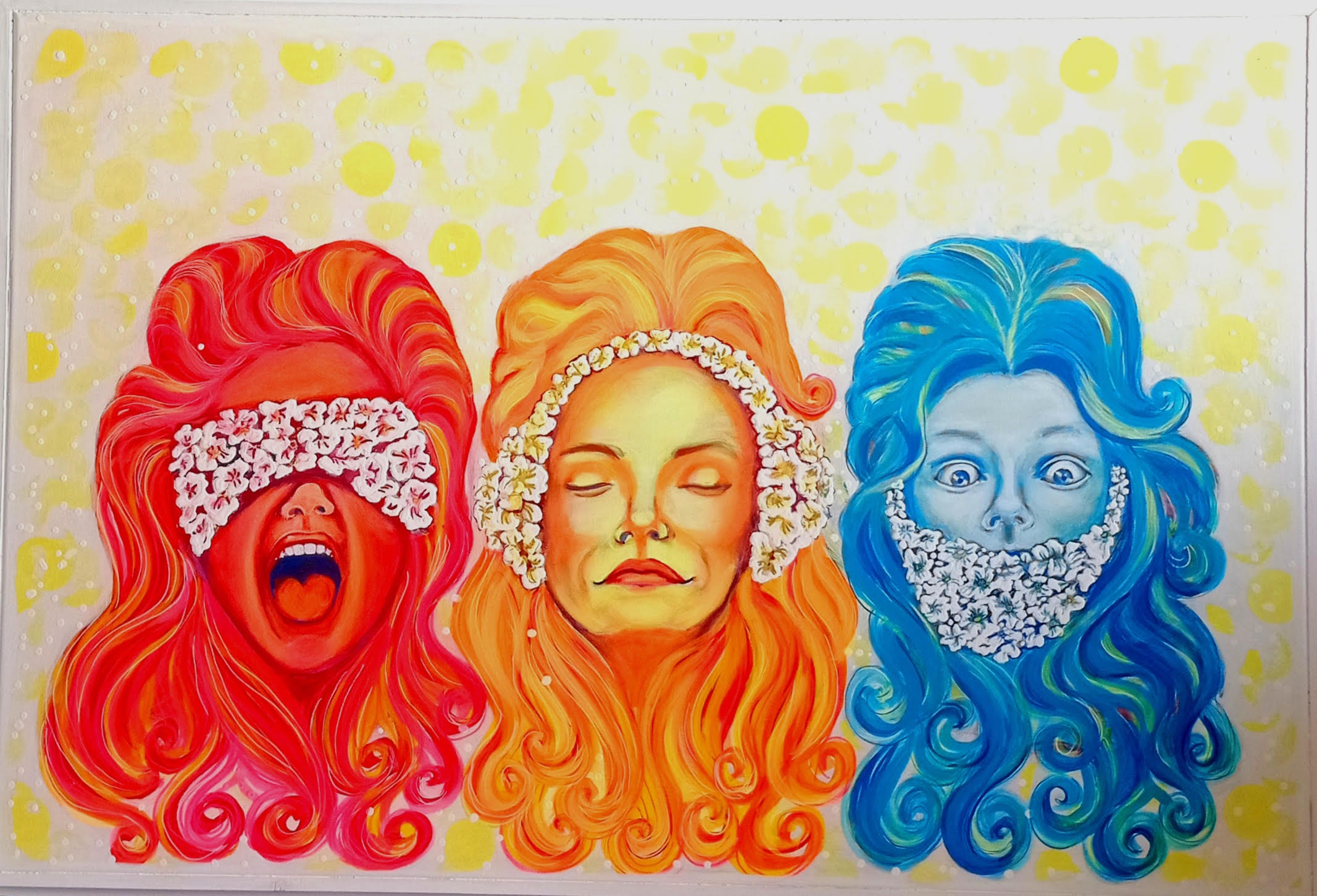
En voz alta-Absorta-SilenciadaHangosan – Elmélyülve – ElnémítvaLoudly – Deeply – Muted
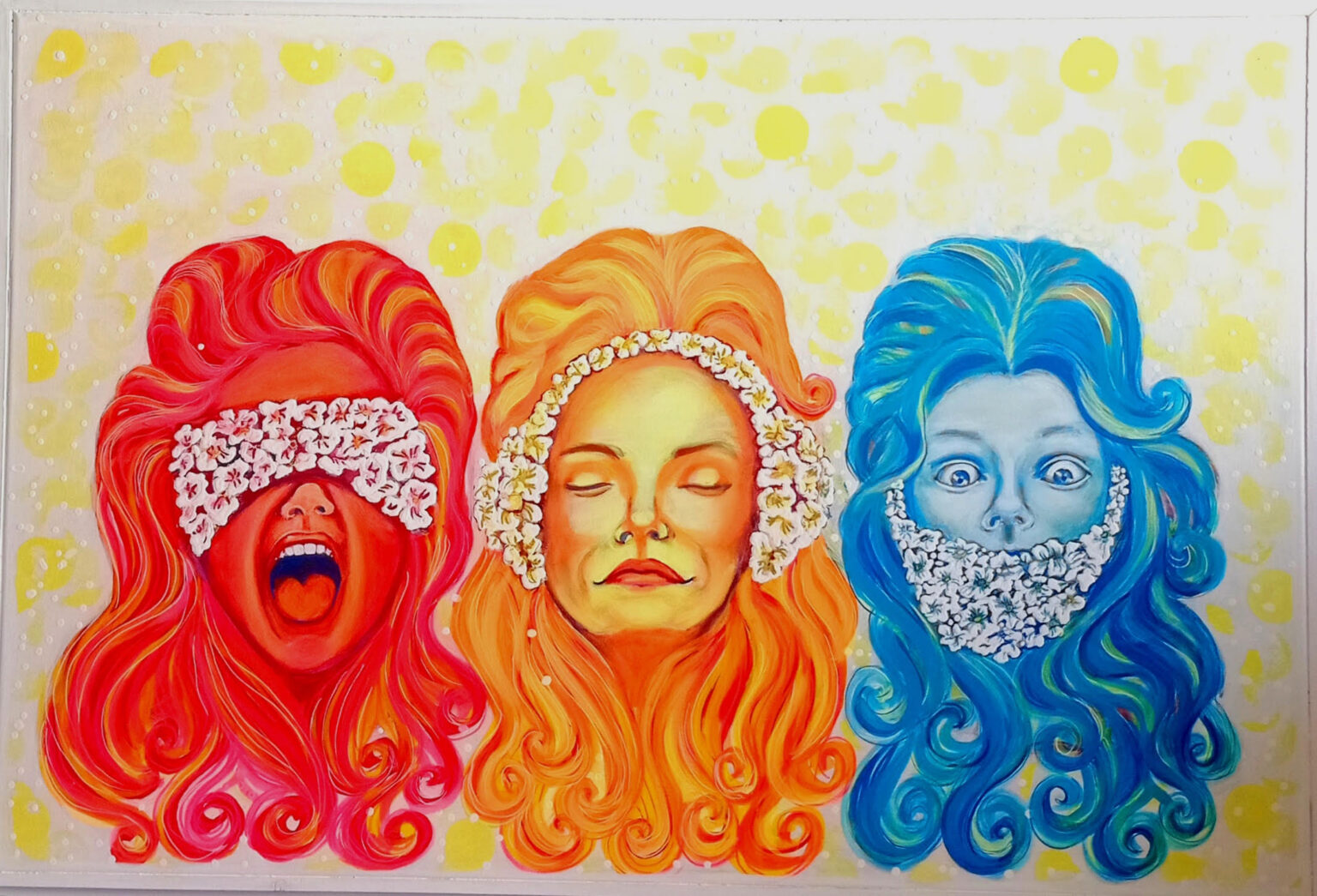
Tres rostros femeninos, tres maneras distintas de relacionarse con un mismo mundo. Una reacciona en voz alta. Otra se vuelve hacia su mundo interior y encuentra allí serenidad. La tercera desearía hablar, pero algo o alguien la silencia. La obra no juzga ni ofrece respuestas cerradas. Invita al espectador a reflexionar sobre las distintas formas en que nos relacionamos con el mundo y sobre cómo la comunicación, el silencio y la escucha interior modelan nuestra personalidad.
Három női arc, három különböző viselkedésmód, három eltérő válasz ugyanarra a világra. Az egyik hangosan reagál. A másik tudatosan befelé fordul, és a saját belső világában talál nyugalmat. A harmadik megszólalna, de valami vagy valaki elnémítja. A festmény nem ítélkezik, és nem kínál kész válaszokat. Inkább párbeszédet kezdeményez arról, hogyan viszonyulunk a körülöttünk lévő világhoz, és hogyan formálja személyiségünket a kommunikáció, a csend és a belső figyelem.
Three female faces, three different ways of responding to the same world. One reacts loudly. Another turns inward and finds peace in her inner world. The third would speak, yet something—or someone—silences her. The painting does not judge or provide definitive answers. Instead, it invites the viewer to reflect on the many ways we relate to the world, and on how communication, silence, and the inner voice shape who we are.
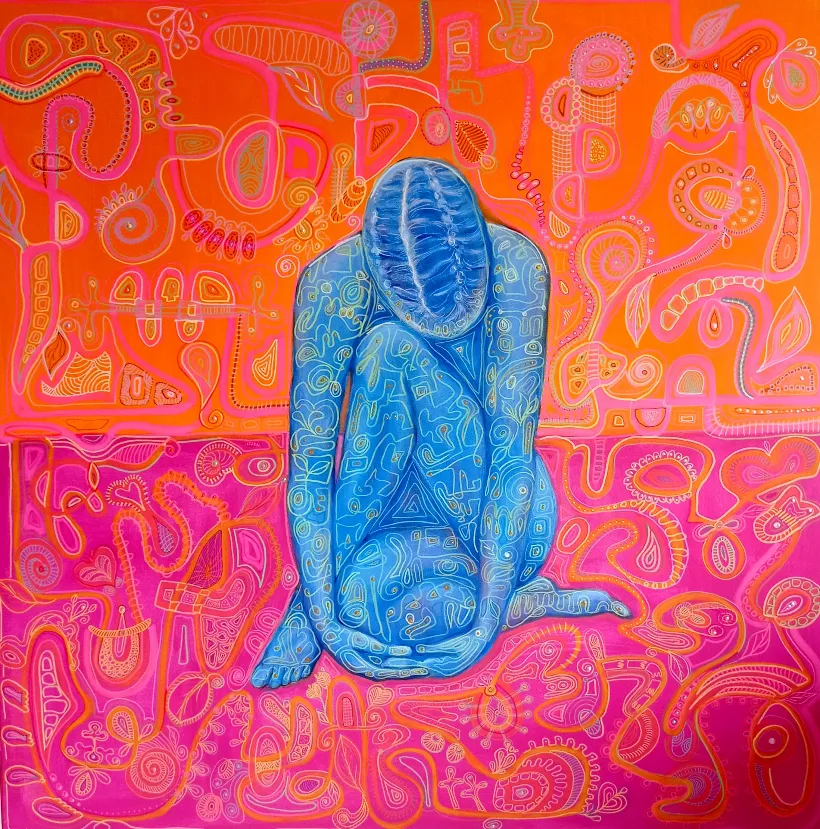
Entre ondas y circuitosHullámok és áramkörök közöttBetween waves and circuits
Normalmente consideramos el cuerpo humano como un ser biológico. Sin embargo, esta obra ofrece otro punto de vista: evoca un mundo en el que el ser humano ya no se compone únicamente de células y órganos, sino que existe en una red de energías, información y conexiones invisibles. El sistema de líneas infinitas que recorre el cuerpo femenino, y que recuerda a un circuito impreso, no es una ilustración técnica, sino un símbolo. Las influencias, los recuerdos, las decisiones y los impulsos externos que nos afectan a lo largo de la vida conforman una red invisible que moldea continuamente nuestra personalidad. Los nodos, que recuerdan a puntos de soldadura, son símbolos de estos encuentros y conexiones. El rostro de la mujer permanece oculto. No vemos la historia de una persona concreta, sino una condición humana universal. El espectador puede proyectar sus propios sentimientos y experiencias en esta figura silenciosa e introspectiva. Una característica especial de la imagen es que, bajo la luz ultravioleta, el sistema de líneas que recorre el cuerpo cobra vida, mientras que el fondo casi desaparece. La estructura que resplandece bajo la luz ultravioleta es una metáfora de que gran parte de nuestro funcionamiento real es invisible: nos rodean fuerzas, ondas, información y relaciones que moldean constantemente nuestras vidas. «Entre ondas y circuitos» es la imagen de ese espacio limítrofe donde se encuentran la existencia humana orgánica y el mundo tecnológico. La cuestión no es si somos humanos o máquinas, sino cómo podemos conservar nuestra esencia humana en una época cada vez más entretejida por redes invisibles y conexiones constantes.
Az emberi testet többnyire biológiai lényként szemléljük. Ez a mű azonban egy másik nézőpontot kínál: azt a világot idézi meg, ahol az ember már nemcsak sejtekből és szervekből áll, hanem láthatatlan energiák, információk és kapcsolódások hálózatában létezik. A női testet bejáró, nyomtatott áramkörre emlékeztető végtelen vonalrendszer nem technikai illusztráció, hanem szimbólum. Az élet során bennünket érő hatások, emlékek, döntések és külső impulzusok olyan láthatatlan hálózatot alkotnak, amely folyamatosan formálja személyiségünket. A forrasztási pontokra emlékeztető csomópontok ezeknek a találkozásoknak és kapcsolódásoknak a jelképei. A nő arca rejtve marad. Nem egy konkrét személy történetét látjuk, hanem egy egyetemes emberi állapotot. A néző saját érzéseit és tapasztalatait vetítheti bele ebbe a csendes, befelé forduló alakba. A kép különleges sajátossága, hogy ultraviola fényben a testet bejáró vonalrendszer életre kel, miközben a háttér szinte eltűnik. Az UV-fényben felragyogó szerkezet annak metaforája, hogy a valódi működésünk nagy része láthatatlan: olyan erők, hullámok, információk és kapcsolatok vesznek körül bennünket, amelyek folyamatosan alakítják életünket. Entre ondas y circuitos annak a határterületnek a képe, ahol az organikus emberi lét és a technológiai világ találkozik. A kérdés nem az, hogy ember vagy gép vagyunk-e, hanem az, hogyan őrizhetjük meg emberi lényegünket egy olyan korban, amelyet egyre inkább láthatatlan hálózatok és folyamatos kapcsolódások szőnek át.
We generally view the human body as a biological entity. This work, however, offers a different perspective: it evokes a world in which human beings are no longer merely composed of cells and organs, but exist within a network of invisible energies, information and connections. The endless system of lines running through the female body, reminiscent of a printed circuit board, is not a technical illustration but a symbol. The influences, memories, decisions and external impulses that affect us throughout our lives form an invisible network that constantly shapes our personalities. The junctions, reminiscent of solder joints, are symbols of these encounters and connections. The woman’s face remains concealed. We are not seeing the story of a specific person, but a universal human condition. The viewer can project their own feelings and experiences onto this quiet, introspective figure. A unique feature of the image is that, under ultraviolet light, the network of lines criss-crossing the body comes to life, whilst the background almost disappears. The structure that glows under UV light is a metaphor for the fact that much of our true functioning is invisible: we are surrounded by forces, waves, information and connections that are constantly shaping our lives. *Entre ondas y circuitos* is an image of the borderland where organic human existence and the technological world meet. The question is not whether we are human or machine, but how we can preserve our human essence in an age increasingly interwoven by invisible networks and constant connections.
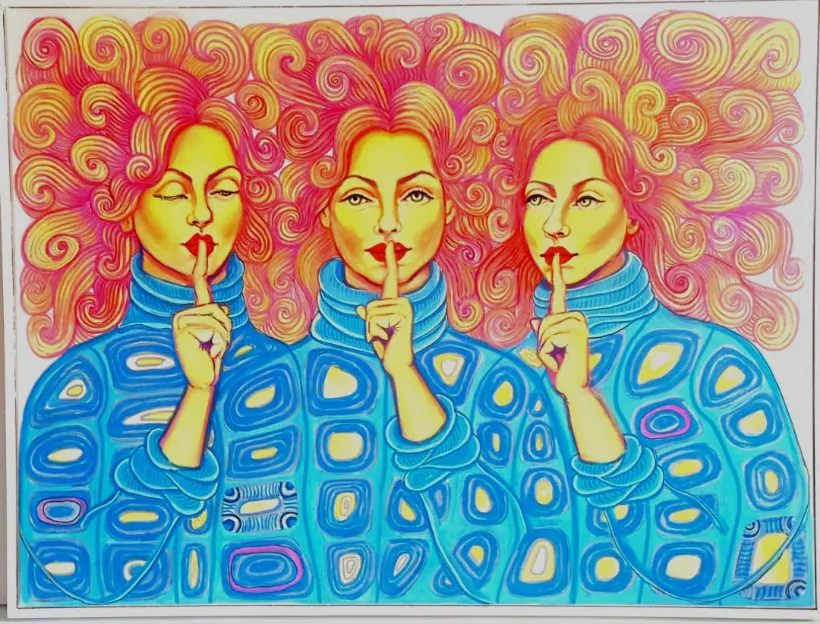
Guarda silencioMaradj csendbenKeep silent
Tres mujeres repiten el mismo gesto: levantan un dedo frente a sus labios. A primera vista parece un gesto sencillo, pero admite muchas interpretaciones. ¿Se dirige al espectador, entre ellas mismas o hacia su propio mundo interior? Guarda silencio no es solo una orden de callar. También sugiere que existen pensamientos, sentimientos y secretos que no necesitan convertirse en palabras. A veces el silencio protege mejor aquello que tiene verdadero valor. El parecido entre las tres figuras habla de los vínculos que compartimos, mientras que la inmensa cabellera roja simboliza la energía interior, la sensibilidad y la fuerza de lo no dicho. La interpretación queda abierta a cada espectador.
A három nő ugyanazt a mozdulatot ismétli: ujjukat az ajkuk elé emelik. A gesztus első pillantásra egyszerűnek tűnik, mégis számtalan jelentést hordoz. Vajon a nézőhöz szólnak, egymást figyelmeztetik, vagy saját belső világukat őrzik? A Guarda silencio itt nem pusztán azt jelenti, hogy „maradj csendben”. Arra is utal, hogy vannak gondolatok, érzések és titkok, amelyeket nem kell kimondani. Néha a hallgatás őrzi meg leginkább azt, ami igazán fontos. A három alak hasonlósága a közösségre utal, miközben mindegyikük önálló személyiség. A hatalmas vörös haj a belső energia, az érzékenység és a kimondatlan szavak erejének jelképe. A kép nem ad végleges választ: minden néző maga dönti el, hogy kérésként, figyelmeztetésként, bizalomként vagy titoktartásként értelmezi ezt a mozdulatot.
Three women repeat the same gesture, raising a finger to their lips. At first it seems simple, yet it can be understood in many different ways. Is it addressed to the viewer, to one another, or to themselves? In this painting, Guarda silencio is not merely a command to be quiet. It also suggests that some thoughts, emotions and secrets do not need to become words. Sometimes silence protects what matters most. The similarity of the three figures evokes human connection, while the immense red hair symbolizes inner energy, sensitivity and the strength of the unspoken. The final meaning belongs to the viewer.
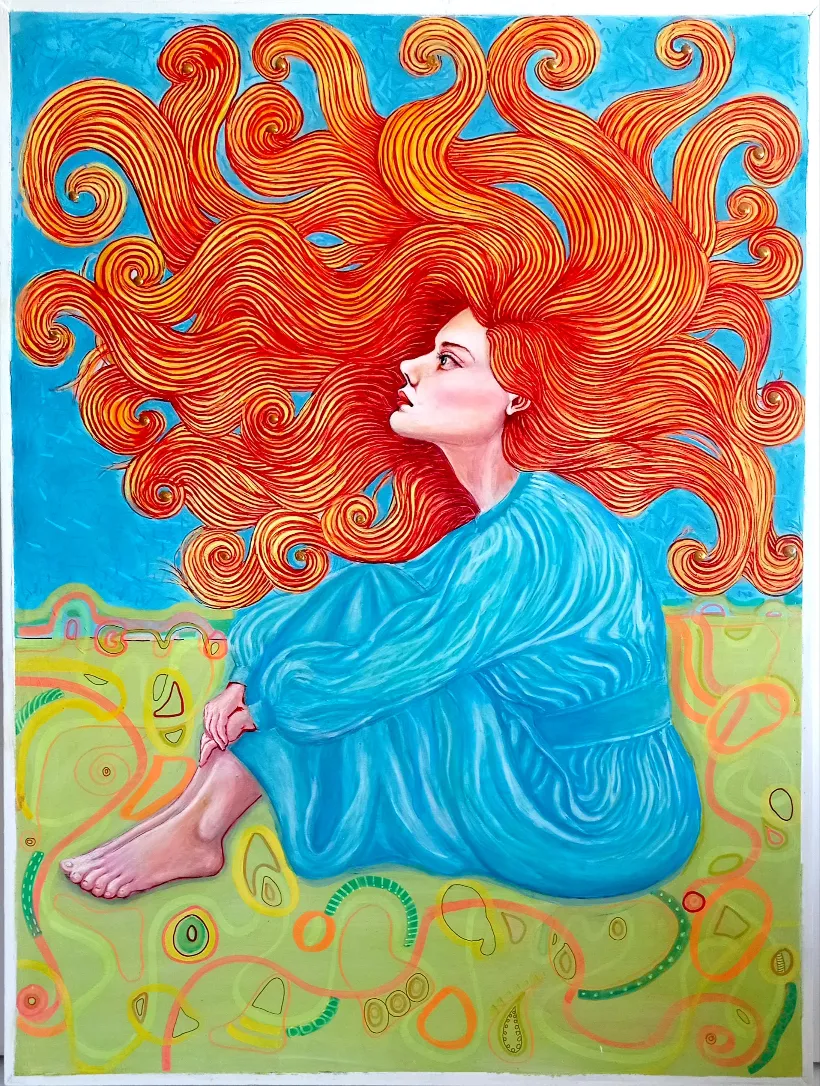
La fuerza de la visiónA látás erejeThe Power of Vision
La fuerza de la visión El cabello rojo no es un simple rasgo exterior, sino el símbolo visible de una energía interior. Representa la individualidad y la capacidad de percibir el mundo de una manera diferente. La figura femenina permanece sentada entre la tierra y el cielo. Su cuerpo transmite calma, mientras su mirada se dirige hacia la distancia. No anuncia el futuro; expresa una sensibilidad capaz de percibir posibilidades que otros aún no ven. La inmensa cabellera roja se convierte en una imagen de la fuerza interior, la sensibilidad y la libertad de pensamiento. Esta obra habla de quienes se atreven a ser ellos mismos y a mirar el mundo con una visión más profunda.
A látás ereje A vörös haj ebben a műben nem egyszerű külső jegy, hanem a belső energia látható szimbóluma. Nem a különbséget, hanem az egyéniséget jelképezi: azt a képességet, hogy valaki a megszokottól eltérően érzékeli és értelmezi a világot. A nyugodtan ülő nő alakja a föld és az ég között helyezkedik el. Testtartása csendes és kiegyensúlyozott, tekintete a távolba emelkedik. Nem a jövőt jósolja, hanem nyitott arra, amit mások talán még nem vesznek észre. A hatalmas vörös hajkorona a belső erő, az érzékenység és a szabad gondolkodás képi megfogalmazása. Ez a festmény azoknak állít emléket, akik mernek önmaguk maradni, és akik a világot nemcsak nézik, hanem mélyebben is látják.
The Power of Vision The red hair is not merely a physical feature but the visible expression of inner energy. It symbolizes individuality and the ability to perceive the world beyond familiar patterns. The seated woman rests between earth and sky. Her posture is calm, yet her gaze rises into the distance. She does not predict the future; she embodies the sensitivity to perceive possibilities that others may not yet recognize. Her immense red hair becomes a metaphor for inner strength, awareness, and freedom of thought. This painting is dedicated to those who remain true to themselves and who see the world with deeper vision.
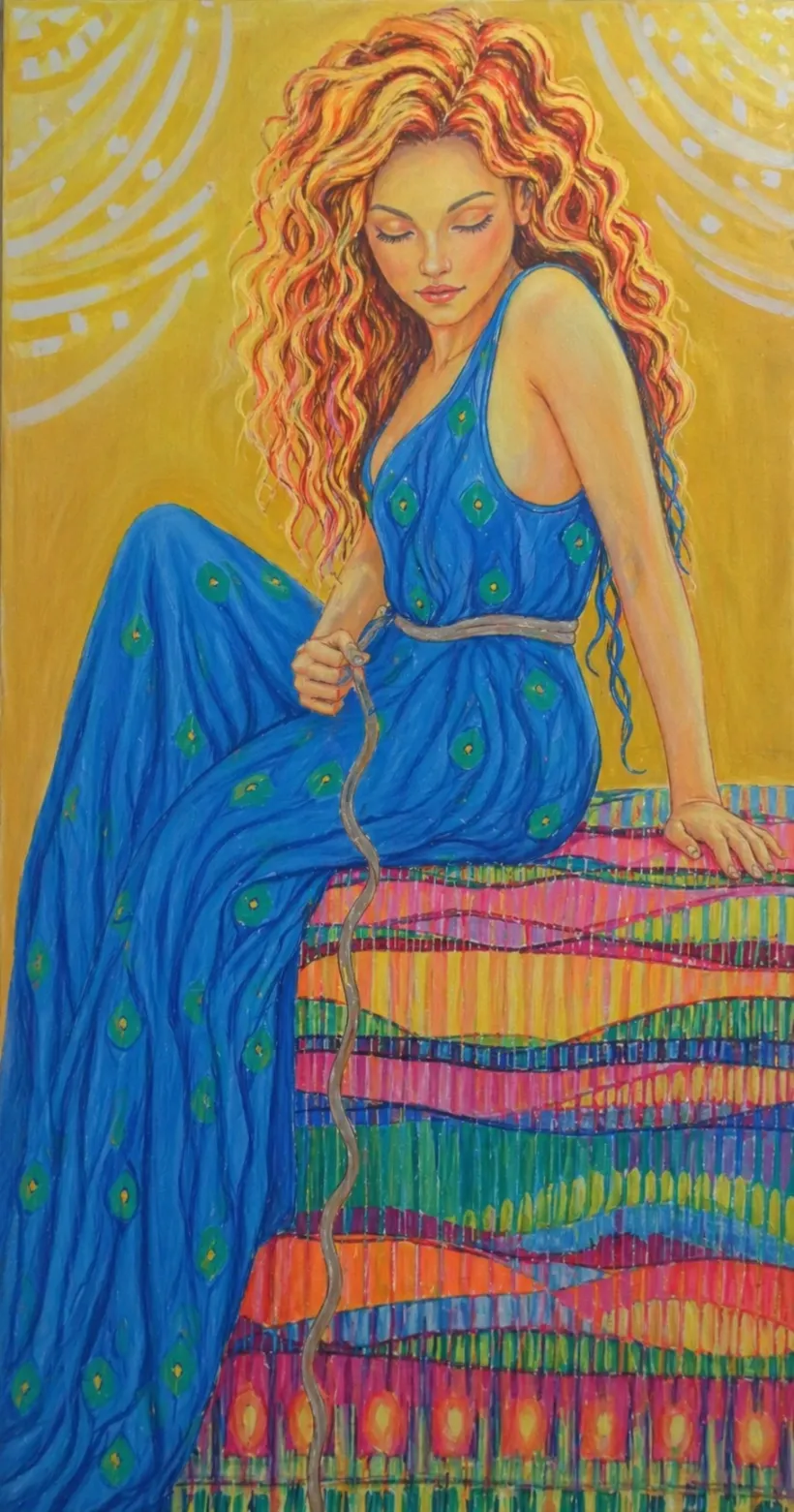
No hace falta nacer reinaNem kell királynőnek születniYou Don't Have to Be Born a Queen
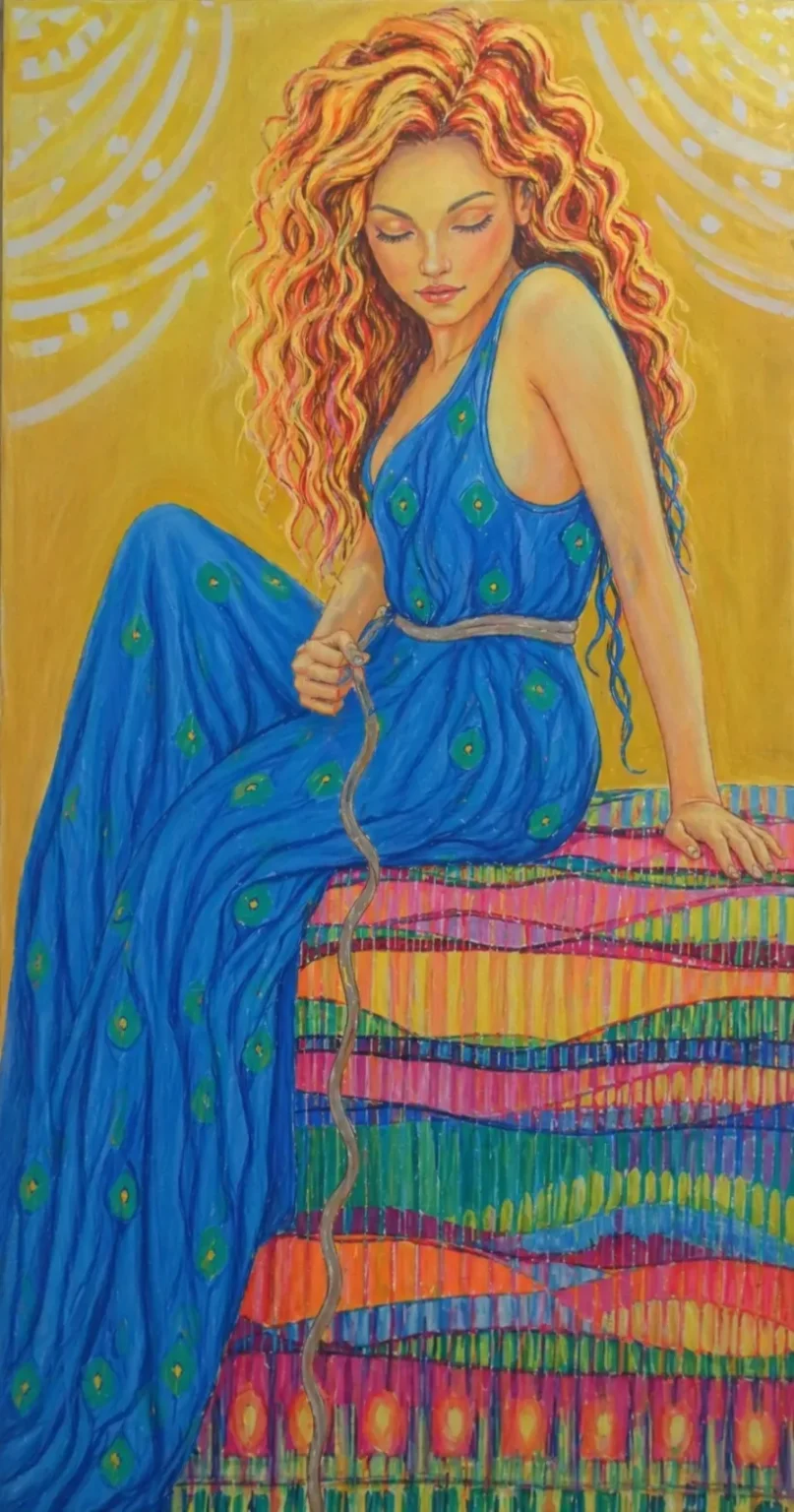
This painting is not about rank or privilege, but about inner dignity. The stacked cushions are not a real throne but a symbolic place built from self-respect and identity. The woman does not seek the viewer's gaze; instead, she quietly plays with her belt while looking down. She wears no crown, yet she radiates the presence of a queen. The work reminds us that true dignity is not determined by birth, social status, or external recognition. Some people carry their nobility within and hope to be treated with the same respect with which they value themselves.
A festmény nem a rangról vagy a kiváltságokról szól, hanem a belső méltóságról. A párnákból épített emelvény nem valódi trón, hanem egy belső világ jelképe, ahol az önbecsülés és az önazonosság kap helyet. A nő nem a nézőt keresi, tekintete befelé fordul, miközben játékosan az övével játszik. Nem koronát visel, mégis királynői tartás sugárzik belőle. A mű arra emlékeztet, hogy a méltóság nem a születéstől, a társadalmi helyzettől vagy a külső elismeréstől függ. Vannak emberek, akik természetes eleganciával és belső tartással élik az életüket, és azt remélik, hogy a világ is ezzel a tisztelettel fordul feléjük.
La obra no habla del rango ni de los privilegios, sino de la dignidad interior. El conjunto de cojines no representa un trono real, sino un espacio simbólico construido desde la autoestima y la identidad. La mujer no busca la mirada del espectador; con los ojos bajos juega suavemente con su cinturón. No lleva corona y, sin embargo, transmite una presencia de reina. La pintura recuerda que la verdadera dignidad no depende del nacimiento, de la posición social ni del reconocimiento exterior. Hay personas que llevan esa nobleza dentro de sí y esperan que el mundo las trate con el mismo respeto con el que ellas se valoran.
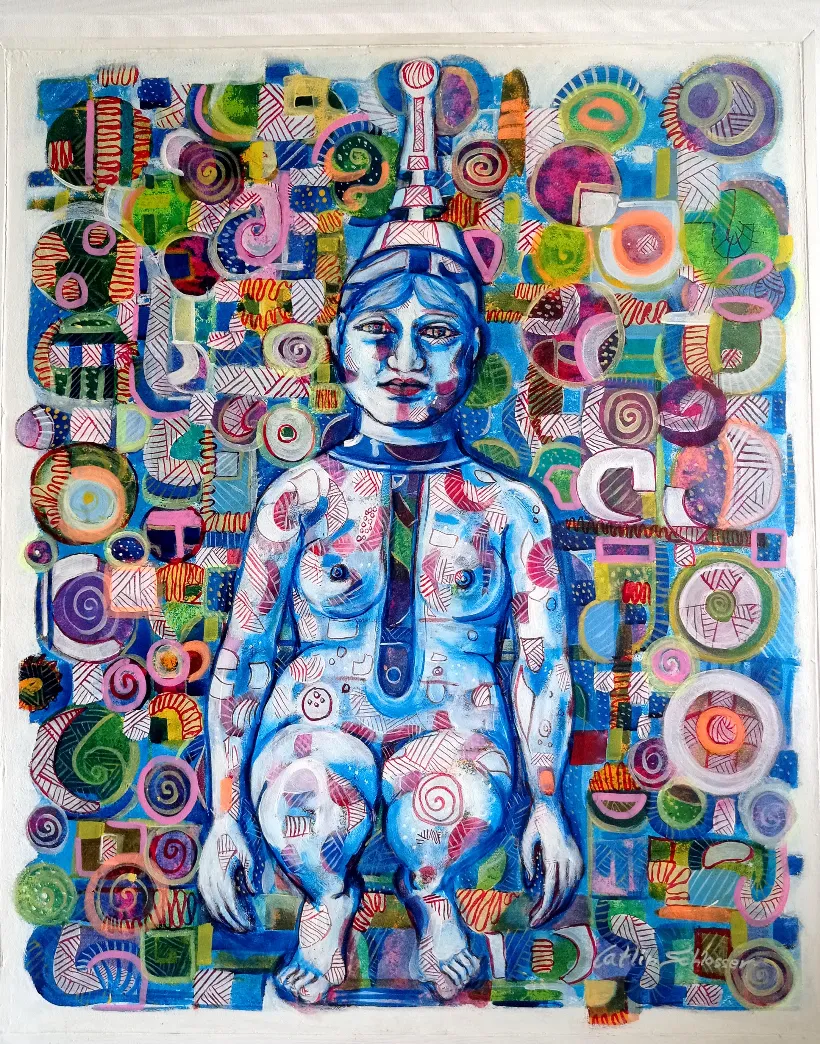
Silencio ancestralŐsi csendAncient silence
«El silencio ancestral» evoca una figura femenina atemporal, vinculada a la naturaleza y a los recuerdos más antiguos de la humanidad. Los símbolos que cubren el cuerpo y el espacio que lo rodea no representan una cultura concreta, sino un mundo interior en el que el ser humano aún vive en estrecha unión con su entorno. La inmovilidad, la postura cercana al suelo y la mirada serena constituyen el verdadero centro de la imagen. Las formas y los signos que aparecen a su alrededor no explican, sino que insinúan: evocan un silencio ancestral que trasciende las palabras y el tiempo. Esta obra no pretende representar un momento histórico ni a un pueblo concreto, sino esa condición humana universal en la que el ser humano aún vive en armonía interior con la naturaleza y consigo mismo.
Az Ősi csend egy időtlen nőalakot idéz meg, aki a természethez és az emberiség legrégebbi emlékeihez kapcsolódik. A testet és a körülötte lévő teret beborító jelek nem egy konkrét kultúrát ábrázolnak, hanem egy belső világot, ahol az ember még szoros egységben él a környezetével. A mozdulatlanság, a földközeli testtartás és a nyugodt tekintet a kép valódi középpontja. A körülötte megjelenő formák és jelek nem magyaráznak, hanem sejtetnek: egy olyan ősi csendet idéznek fel, amely túlmutat a szavakon és az időn. Ez a mű nem egy történelmi pillanatot vagy egy meghatározott népet kíván bemutatni, hanem azt az egyetemes emberi állapotot, amikor az ember még belső harmóniában él a természettel és önmagával.
‘Ancient Silence’ evokes a timeless female figure connected to nature and the oldest memories of humanity. The symbols covering her body and the space around her do not represent any specific culture, but rather an inner world where humankind still lives in close harmony with its environment. The stillness, the posture close to the ground and the serene gaze form the true centre of the image. The forms and symbols appearing around him do not explain, but rather suggest: they evoke an ancient silence that transcends words and time. This work does not seek to depict a historical moment or a specific people, but rather that universal human condition in which a person still lives in inner harmony with nature and with themselves.
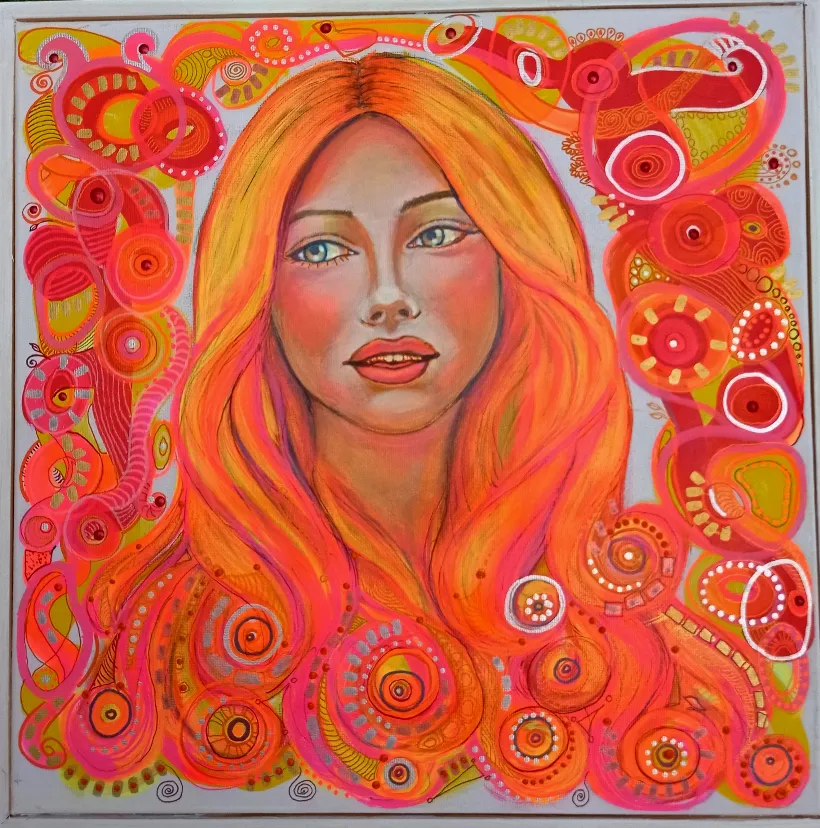
Tres mujeres, tres almas, tres tiemposHárom nő, három lélek, három időThree Women, Three Souls, Three Times
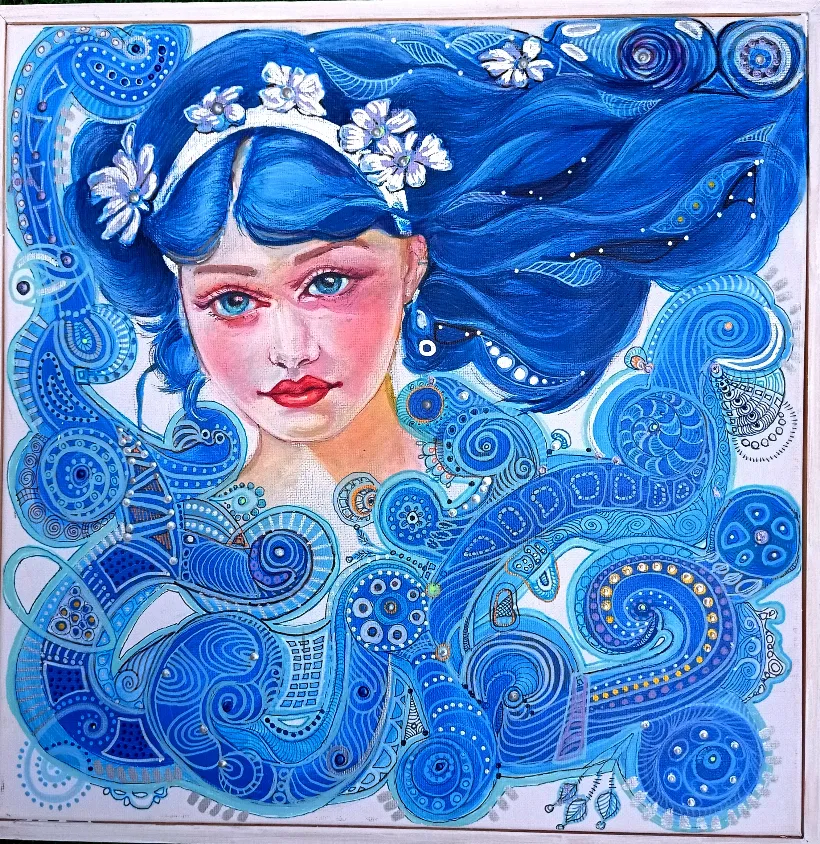
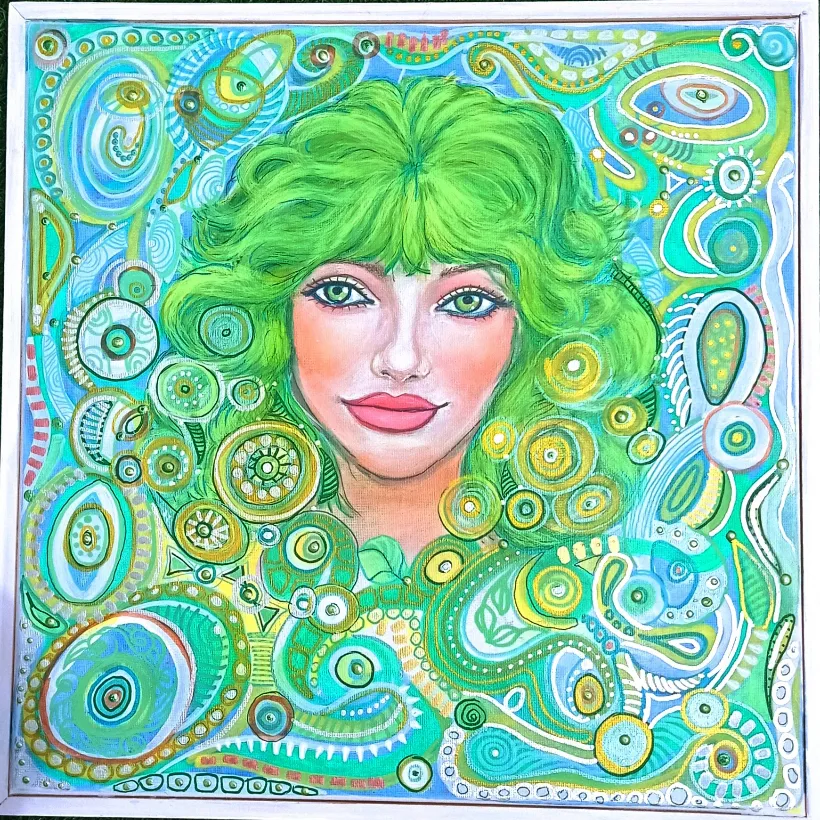
Este tríptico no representa a la misma mujer en tres edades distintas, sino a tres personalidades femeninas diferentes que, juntas, dibujan el recorrido interior de la vida. La figura azul evoca el comienzo, la roja simboliza la fuerza y la pasión de la plenitud, mientras que la verde transmite la serenidad y el equilibrio que nacen de la experiencia. Los motivos inspirados en engranajes y mecanismos de relojería simbolizan el tiempo, el cambio y la transformación constante de la personalidad. Aunque las tres mujeres son distintas, juntas cuentan una misma historia: la diversidad del universo femenino, la evolución del alma y el poder transformador del tiempo. La obra invita al espectador a descubrir las historias ocultas detrás de cada mirada.
Ez a triptichon nem ugyanannak a nőnek három életkorát ábrázolja, hanem három különböző női személyiséget, amelyek együtt rajzolják ki az emberi élet belső ívét. A kék alak a kezdetet, a piros az élet erejét és szenvedélyét, a zöld pedig a tapasztalatból születő belső egyensúlyt idézi. A fogaskerék- és óraszerkezeteket idéző motívumok az idő, a változás és a személyiség folyamatos alakulásának jelképei. A három alak önálló személyiség, mégis közös történetet mesél: a női lét sokféleségéről, a lélek fejlődéséről és az idő formáló erejéről. A mű arra hívja a nézőt, hogy a tekintetek mögött rejlő történeteket fedezze fel.
This triptych does not portray the same woman at three different ages, but three distinct female personalities that together trace the inner journey of life. The blue figure represents beginnings, the red embodies vitality and passion, while the green reflects the serenity and balance born of experience. The motifs inspired by gears and clockwork symbolize time, change, and the continuous shaping of human identity. Although each woman is unique, together they tell a shared story about the diversity of womanhood, the evolution of the soul, and the transformative power of time. The work invites viewers to look beyond the faces and discover the stories hidden within their gaze.
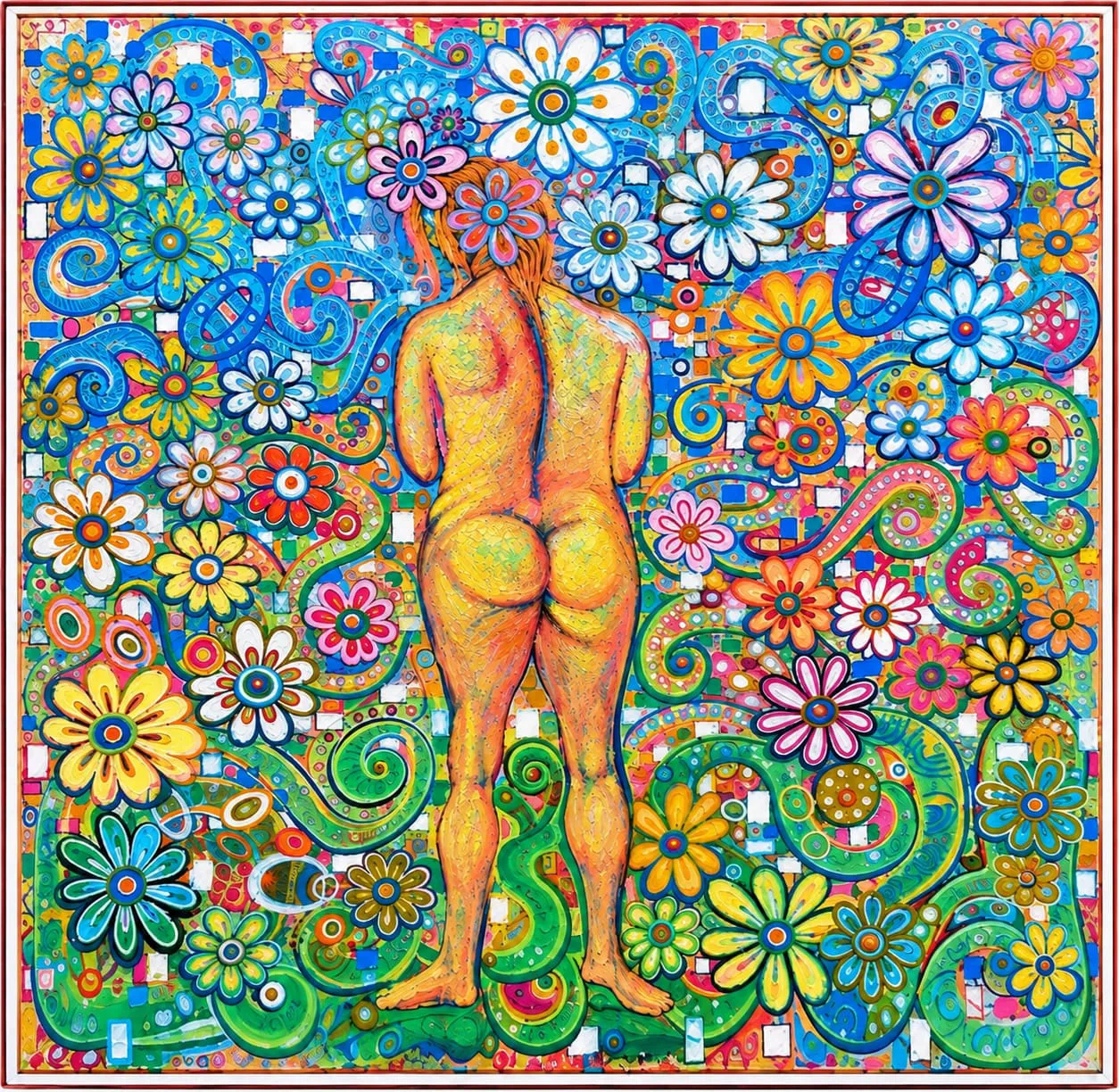
Cautiva por la bellzaA szépség rabul ejtiCaptivated by beauty
La figura femenina, de espaldas ante un muro cubierto de flores, parece quedar atrapada en la belleza que la rodea. El título juega con un doble sentido: la belleza como fascinación y, al mismo tiempo, como una forma de cautiverio.
A hátulról látható nőalak egy virágokkal borított fal előtt áll, mintha az őt körülvevő szépség fogságába kerülne. A cím kettős értelmű: a szépség egyszerre jelent vonzerőt és egyfajta fogságot.
Seen from behind, the female figure stands before a wall covered in flowers, seemingly trapped by the beauty surrounding her. The title carries a double meaning: beauty as fascination, but also as a form of captivity.

La «evolución» de la mujerA nő „fejlődése”The ‘evolution’ of women
Entre los brazos de los sueñosÁlmok ölelésébenIn the Embrace of Dreams
Aquí… y, sin embargo, en otra parte.Itt… és mégis máshol.Here… and yet elsewhere.
Copia defectuosa I, II, III, IV.Hibás másolat I, II, III, IV.Defective copy , II, III, IV.
DesvalorizaciónLeértékelődésDevaluation
Detrás de la máscaraMaszk mögöttBehind the mask
El descanso del almaA lélek pihenőjeThe Soul's Rest
En voz alta-Absorta-SilenciadaHangosan – Elmélyülve – ElnémítvaLoudly – Deeply – Muted
Entre ondas y circuitosHullámok és áramkörök közöttBetween waves and circuits
Guarda silencioMaradj csendbenKeep silent
La fuerza de la visiónA látás erejeThe Power of Vision
No hace falta nacer reinaNem kell királynőnek születniYou Don't Have to Be Born a Queen
Silencio ancestralŐsi csendAncient silence
Tres mujeres, tres almas, tres tiemposHárom nő, három lélek, három időThree Women, Three Souls, Three Times
Cautiva por la bellzaA szépség rabul ejtiCaptivated by beauty
La «evolución» de la mujerA nő „evolúciója”The “Evolution” of Woman
El segundo capítulo de la exposición examina la existencia femenina desde una perspectiva psicológica, filosófica y social. No presenta la historia de una sola mujer, sino el proceso en el que las expectativas sociales, el paso del tiempo y la experiencia personal modelan continuamente la imagen que el ser humano tiene de sí mismo. El elemento central del capítulo es una serie de cuatro obras que también puede interpretarse como una línea temporal y que representa la transformación gradual de la mujer, su devaluación o los cambios en su valoración social. La complementa otro grupo de obras en el que las «interferencias» que interrumpen los desnudos femeninos aluden a la fragilidad y a las heridas interiores que se esconden tras una superficie aparentemente perfecta. Las figuras femeninas con referencias históricas, la geisha oculta tras una máscara, el retrato atravesado por motivos tecnológicos y las figuras de mujeres pelirrojas son distintas aproximaciones a una misma pregunta: ¿cómo puede el ser humano preservar su verdadera identidad en un mundo en constante transformación? Este capítulo no ofrece respuestas, sino que sostiene un espejo. Invita al visitante a reflexionar, a través de sus propias experiencias, sobre la existencia femenina, la dignidad humana y la identidad.
A kiállítás második fejezete a női létet pszichológiai, filozófiai és társadalmi nézőpontból vizsgálja. Nem egyetlen nő történetét mutatja be, hanem azt a folyamatot, amelyben a társadalmi elvárások, az idő és a személyes tapasztalat folyamatosan formálják az ember önképét. A fejezet központi eleme egy idővonalként is értelmezhető négyes sorozat, amely a nő fokozatos átalakulását, leértékelődését vagy változó társadalmi megítélését jeleníti meg. Ezt egészíti ki egy másik képcsoport, ahol a női aktokat megszakító „hibajelenségek” a látszólag tökéletes felszín mögött rejlő törékenységre és belső sérülésekre utalnak. A történelmi utalásokat hordozó nőalakok, a maszk mögé rejtőző gésa, a technológiai motívumokkal átszőtt portré és a vörös hajú nőalakok ugyanannak a kérdésnek különböző megközelítései: miként őrizhető meg az ember valódi identitása egy folyamatosan változó világban? Ez a fejezet nem válaszokat ad, hanem tükröt tart. A látogatót arra hívja, hogy saját tapasztalatain keresztül gondolja végig a női lét, az emberi méltóság és az önazonosság kérdéseit.
The second chapter of the exhibition examines female existence from psychological, philosophical and social perspectives. It does not tell the story of a single woman, but rather explores the process through which social expectations, the passage of time and personal experience continuously shape a person’s self-image. At the centre of the chapter is a series of four works that can also be read as a timeline, presenting the gradual transformation of woman, her devaluation, or the changing ways in which society perceives her. This is complemented by another group of works in which “glitches” interrupting the female nudes point to the fragility and inner wounds hidden beneath an apparently perfect surface. The female figures carrying historical references, the geisha concealed behind a mask, the portrait interwoven with technological motifs, and the red-haired women are different approaches to the same question: how can a person preserve their true identity in a constantly changing world? This chapter does not provide answers; it holds up a mirror. It invites visitors to reflect, through their own experiences, on female existence, human dignity and the question of identity.
Entre los brazos de los sueñosÁlmok ölelésébenIn the Embrace of Dreams
La misma mujer que se atreve a sentirse reina se recoge ahora en su mundo interior. Acurrucada, descansa entre los brazos de sus sueños mientras los colores, las flores, las mariposas y la luz crean el universo que ella imagina. No huye de la realidad; se alimenta de la imaginación que le ofrece esperanza, belleza y futuro. Toda mujer guarda sueños en su interior, y son ellos los que le permiten descubrir una y otra vez la belleza del mundo.
Ugyanaz a nő, aki királynőnek meri érezni magát, most csendesen saját belső világába húzódik vissza. Összegömbölyödve, álmai ölelésében pihen, miközben a körülötte kibontakozó színek, virágok, pillangók és fények egy általa teremtett világot idéznek. Nem a valóságból menekül, hanem abból a képzeletből táplálkozik, amely reményt, szépséget és jövőt ad. Minden nő őriz magában álmokat – néha csendesen, néha bátran –, és ezek az álmok segítenek újra és újra felfedezni a világ szépségét.
The same woman who dares to feel like a queen now withdraws into her inner world. Curled up in peace, she rests in the embrace of her dreams, surrounded by colours, flowers, butterflies and light that form a world of her own creation. She is not escaping reality; she is nourished by imagination, hope and beauty. Every woman carries dreams within her, and those dreams help her rediscover the beauty of the world again and again.
Aquí… y, sin embargo, en otra parte.Itt… és mégis máshol.Here… and yet elsewhere.
La obra muestra un estado interior de calma. El cuerpo de la mujer permanece presente, mientras su mirada viaja lejos. Exteriormente hay armonía, belleza y serenidad; interiormente vive un deseo silencioso de algo o de alguien que trasciende el momento presente. No habla de ausencia, sino del viaje íntimo del alma. Cada espectador puede imaginar hacia dónde se dirige su pensamiento.
A kép egy csendes belső állapotot jelenít meg. A nő teste nyugalomban van, tekintete azonban messzire vezet. Kívül harmónia, biztonság és szépség látható, belül mégis egy kimondhatatlan vágy él: valami vagy valaki után, ami túlmutat a jelen pillanaton. Nem a hiányról szól, hanem a lélek csendes utazásáról. A néző maga döntheti el, hogy emlékek, álmok vagy remények felé indul-e a tekintet.
This painting portrays a quiet inner state. The woman's body is fully present, yet her gaze drifts far away. Outwardly there is harmony, beauty and calm; inwardly there is a silent longing for something—or someone—beyond the present moment. It is not about absence, but about the soul's quiet journey. The viewer is invited to imagine where her thoughts have gone.
Copia defectuosa I, II, III, IV.Hibás másolat I, II, III, IV.Defective copy , II, III, IV.
Serie – 4 obras
Las cuatro figuras femeninas son cuatro manifestaciones diferentes de una misma idea. Sus cuerpos son serenos y armoniosos, y su mirada se dirige hacia su interior. No buscan el contacto con el espectador, sino que permanecen en su propio mundo interior. El énfasis no recae en la corporalidad, sino en la presencia interior del ser humano. El fondo no es una mera superficie de color. Las líneas onduladas, que se extienden a lo largo de tonos amarillos, naranjas y rojos incandescentes y parecen infinitas, evocan un potente campo de energía. Simbolizan las vibraciones constantes, el ruido, el torrente de información y la presión del mundo que nos rodea. Este entorno puede resultar a la vez atractivo e inquietante: brilla, pero quema. Un entorno que nos influye constantemente, nos moldea y hace cada vez más difícil mantener nuestro equilibrio interior. Los cuerpos pintados de azul crean un marcado contraste con ello. Para mí, el azul no es el color de la frialdad, sino el de la dimensión espiritual: simboliza a esa persona interior que, a pesar de las influencias externas, desea seguir siendo ella misma. Las franjas de color que recorren los cuerpos dan la sensación de un error de impresión o de una distorsión digital. Su significado se deja deliberadamente abierto. Pueden aludir a un fallo técnico, a fallos del sistema o a esa época en la que la tecnología ya no solo fija, sino que también transforma la imagen del ser humano. Es capaz de corregir, embellecer y perfeccionar, al tiempo que nos aleja, sin que nos demos cuenta, de nuestra propia realidad. «La copia defectuosa» no afirma que la tecnología sea buena o mala. Más bien llama la atención sobre el hecho de que, en nuestra época, la frontera entre el original y la copia se vuelve cada vez más difusa. ¿Vemos quiénes somos realmente o solo la imagen que el mundo —o nosotros mismos— creamos de nosotros mismos? La respuesta puede ser diferente para cada espectador.
Sorozat – 4 alkotás
A négy nőalak ugyanannak a gondolatnak négy különböző megjelenése. Testük nyugodt és harmonikus, tekintetük befelé fordul. Nem keresik a nézővel a kapcsolatot, hanem saját belső világukban maradnak. A hangsúly nem a testiségen, hanem az ember belső jelenlétén van. A háttér nem pusztán színes felület. Az izzó sárga, narancs és vörös árnyalatokon végighúzódó, végtelennek tűnő hullámvonalak egy erőteljes energiamezőt idéznek. A körülöttünk lévő világ folyamatos rezgéseit, zaját, információáradatát és nyomását jelképezik. Ez a közeg egyszerre lehet vonzó és nyugtalanító: ragyog, mégis éget. Olyan környezet, amely állandóan hat ránk, formál bennünket, és egyre nehezebbé teszi, hogy megőrizzük belső egyensúlyunkat. A kékre festett testek ezzel éles ellentétet alkotnak. A kék számomra nem a hidegség, hanem a lelki dimenzió színe: azt a belső embert jelképezi, aki a külső hatások ellenére is önmaga szeretne maradni. A testeken végighúzódó színes sávok egy hibás nyomtatás vagy digitális torzulás érzetét keltik. Jelentésük szándékosan nyitott. Utalhatnak technikai hibára, a rendszer zavaraira, vagy arra a korszakra, amelyben a technológia már nemcsak rögzíti, hanem át is alakítja az ember képét. Képes javítani, szépíteni és tökéletesíteni, miközben észrevétlenül eltávolíthat bennünket saját valóságunktól. A Hibás másolat nem azt állítja, hogy a technológia jó vagy rossz. Inkább arra hívja fel a figyelmet, hogy korunkban az eredeti és a másolat közötti határ egyre bizonytalanabbá válik. Vajon azt látjuk, akik valóban vagyunk, vagy már csak azt a képet, amelyet a világ – vagy mi magunk – létrehozunk önmagunkról? A válasz minden néző számára más lehet.
Series – 4 works
The four female figures are four different manifestations of the same idea. Their bodies are calm and harmonious; their gaze is turned inwards. They do not seek connection with the viewer, but remain within their own inner worlds. The emphasis is not on physicality, but on the human inner presence. The background is not merely a coloured surface. The seemingly endless wavy lines, stretching across glowing shades of yellow, orange and red, evoke a powerful energy field. They symbolise the constant vibrations, noise, flood of information and pressure of the world around us. This environment can be both alluring and unsettling: it glows, yet it burns. It is an environment that constantly affects us, shapes us, and makes it increasingly difficult to maintain our inner balance. The bodies painted blue stand in sharp contrast to this. For me, blue is not the colour of coldness, but of the spiritual dimension: it symbolises the inner self that wishes to remain true to itself despite external influences. The coloured stripes running across the bodies give the impression of a printing error or digital distortion. Their meaning is deliberately open to interpretation. They may allude to a technical fault, system malfunctions, or to an era in which technology no longer merely records but also transforms the human image. It is capable of correcting, embellishing and perfecting, whilst imperceptibly distancing us from our own reality. *The Flawed Copy* does not claim that technology is good or bad. Rather, it draws attention to the fact that, in our time, the boundary between the original and the copy is becoming increasingly blurred. Do we see who we truly are, or merely the image that the world – or we ourselves – create of ourselves? The answer may be different for every viewer.
DesvalorizaciónLeértékelődésDevaluation
Desvalorización no habla del verdadero valor de la mujer, sino de cómo la sociedad, en ocasiones, la trata como si fuera un producto rebajado. Este políptico traza un recorrido emocional: desde el desconcierto hasta la incertidumbre, la resistencia y un grito silencioso. La obra invita a reflexionar sobre el hecho de que el valor no reside en la juventud, la belleza ni en responder a las expectativas externas. No es la mujer quien pierde su valor, sino la mirada que juzga únicamente por la apariencia. Desvalorización es, por tanto, una crítica social y también un recordatorio: la dignidad humana no puede rebajarse.
A Leértékelődés nem a nő valódi értékéről szól, hanem arról, ahogyan a társadalom időnként úgy bánik vele, mintha egy leárazott termék lenne. A négyrészes kompozíció érzelmi utat rajzol: a döbbenettől a bizonytalanságon és az ellenálláson át a néma kiáltásig. A mű arra hívja fel a figyelmet, hogy az érték nem a fiatalságban, a szépségben vagy a külső elvárásoknak való megfelelésben rejlik. Nem a nő veszít az értékéből – hanem az a tekintet értéktelenedik el, amely kizárólag a külsőségek alapján ítél. A Leértékelődés így nemcsak társadalomkritika, hanem emlékeztető is: az emberi méltóság nem leárazható.
Devaluation is not about a woman's true worth, but about the way society sometimes treats her as if she were a discounted product. This polyptych traces an emotional journey from shock through uncertainty and resistance to a silent cry. The work reminds us that human value does not lie in youth, beauty, or conformity to external expectations. It is not the woman who loses her value; it is the gaze that judges only appearances.
Detrás de la máscaraMaszk mögöttBehind the mask
La figura de la geisha que aparece en esta imagen no representa a una persona concreta, sino un papel. Una apariencia que la persona se pone para cumplir con una expectativa, una tradición o un momento. A lo largo de nuestra vida, todos llevamos diferentes máscaras. Asumimos roles en la familia, en el trabajo y en nuestras comunidades. Estos roles nos ayudan a orientarnos en el mundo, pero al mismo tiempo pueden ocultar nuestro verdadero yo. La imagen no pregunta quién está delante de la máscara, sino quién hay detrás de ella. ¿Qué queda de esa persona cuando se desprenden las capas de los roles, las expectativas y la apariencia exterior? «Detrás de la máscara» no trata de las apariencias, sino del mundo interior oculto. De esa persona a la que el mundo exterior a menudo ya no ve, pero que, sin embargo, es quien permanece inmutable detrás de cada papel.
A gésa alakja ezen a képen nem egy konkrét személyt ábrázol, hanem egy szerepet. Egy olyan külsőt, amelyet az ember magára ölt, hogy megfeleljen egy elvárásnak, egy hagyománynak vagy egy pillanatnak. Életünk során mindannyian különböző maszkokat viselünk. Szerepeket vállalunk a családban, a munkában, a közösségeinkben. Ezek a szerepek segítenek eligazodni a világban, ugyanakkor el is takarhatják valódi önmagunkat. A kép nem azt kérdezi, hogy ki áll a maszk előtt, hanem azt, hogy ki van mögötte. Mi marad abból az emberből, amikor a szerepek, az elvárások és a külső megjelenés rétegei lehullanak? A Maszk mögött nem a látszatról, hanem a rejtett belső világról szól. Arról az emberről, akit a külvilág sokszor már nem lát, mégis ő az, aki minden szerep mögött változatlanul jelen van.
The figure of the geisha in this picture does not depict a specific person, but rather a role. An appearance that one adopts in order to conform to an expectation, a tradition or a moment in time. Throughout our lives, we all wear different masks. We take on roles within our families, at work and in our communities. These roles help us find our way in the world, yet they can also conceal our true selves. The picture does not ask who stands in front of the mask, but who is behind it. What remains of a person when the layers of roles, expectations and outward appearances fall away? *Behind the Mask* is not about appearances, but about the hidden inner world. It is about the person whom the outside world often no longer sees, yet who remains ever-present behind every role.
El descanso del almaA lélek pihenőjeThe Soul's Rest
Hay momentos en los que el cuerpo y el alma se agotan al mismo tiempo, no por un solo acontecimiento, sino por el peso de todo lo vivido. Los movimientos se vuelven lentos y la mirada se dirige hacia el interior. La figura no representa debilidad, sino la necesidad humana de descansar. La obra no revela si el agotamiento es físico o emocional, y precisamente por ello resulta universal. El descanso del alma rinde homenaje al instante en que dejamos por un momento el peso del mundo para recuperar la fuerza y seguir adelante.
Vannak pillanatok, amikor a test és a lélek egyszerre fárad el. Nem egyetlen eseménytől, hanem mindattól, amit hosszú ideje magunkban hordozunk. A mozdulatok lelassulnak, a tekintet befelé fordul. A képen látható alak nem a gyengeséget, hanem a pihenés emberi szükségletét jeleníti meg. Nem tudjuk, testi vagy lelki kimerülésről van-e szó, ezért válik mindenki számára ismerőssé. A lélek pihenője annak a csendes pillanatnak állít emléket, amikor letesszük a világ súlyát, hogy új erővel indulhassunk tovább.
There are moments when body and soul become tired together—not from one event, but from everything carried for too long. Movements slow, the gaze turns inward, and the world grows quiet. The figure does not portray weakness but a deeply human need for rest. The work never tells us whether the exhaustion is physical or emotional, making it universal. The Soul's Rest honors the moment when we lay down the weight of the world, not in surrender, but to regain the strength to continue.
En voz alta-Absorta-SilenciadaHangosan – Elmélyülve – ElnémítvaLoudly – Deeply – Muted
Tres rostros femeninos, tres maneras distintas de relacionarse con un mismo mundo. Una reacciona en voz alta. Otra se vuelve hacia su mundo interior y encuentra allí serenidad. La tercera desearía hablar, pero algo o alguien la silencia. La obra no juzga ni ofrece respuestas cerradas. Invita al espectador a reflexionar sobre las distintas formas en que nos relacionamos con el mundo y sobre cómo la comunicación, el silencio y la escucha interior modelan nuestra personalidad.
Három női arc, három különböző viselkedésmód, három eltérő válasz ugyanarra a világra. Az egyik hangosan reagál. A másik tudatosan befelé fordul, és a saját belső világában talál nyugalmat. A harmadik megszólalna, de valami vagy valaki elnémítja. A festmény nem ítélkezik, és nem kínál kész válaszokat. Inkább párbeszédet kezdeményez arról, hogyan viszonyulunk a körülöttünk lévő világhoz, és hogyan formálja személyiségünket a kommunikáció, a csend és a belső figyelem.
Three female faces, three different ways of responding to the same world. One reacts loudly. Another turns inward and finds peace in her inner world. The third would speak, yet something—or someone—silences her. The painting does not judge or provide definitive answers. Instead, it invites the viewer to reflect on the many ways we relate to the world, and on how communication, silence, and the inner voice shape who we are.
Entre ondas y circuitosHullámok és áramkörök közöttBetween waves and circuits
Normalmente consideramos el cuerpo humano como un ser biológico. Sin embargo, esta obra ofrece otro punto de vista: evoca un mundo en el que el ser humano ya no se compone únicamente de células y órganos, sino que existe en una red de energías, información y conexiones invisibles. El sistema de líneas infinitas que recorre el cuerpo femenino, y que recuerda a un circuito impreso, no es una ilustración técnica, sino un símbolo. Las influencias, los recuerdos, las decisiones y los impulsos externos que nos afectan a lo largo de la vida conforman una red invisible que moldea continuamente nuestra personalidad. Los nodos, que recuerdan a puntos de soldadura, son símbolos de estos encuentros y conexiones. El rostro de la mujer permanece oculto. No vemos la historia de una persona concreta, sino una condición humana universal. El espectador puede proyectar sus propios sentimientos y experiencias en esta figura silenciosa e introspectiva. Una característica especial de la imagen es que, bajo la luz ultravioleta, el sistema de líneas que recorre el cuerpo cobra vida, mientras que el fondo casi desaparece. La estructura que resplandece bajo la luz ultravioleta es una metáfora de que gran parte de nuestro funcionamiento real es invisible: nos rodean fuerzas, ondas, información y relaciones que moldean constantemente nuestras vidas. «Entre ondas y circuitos» es la imagen de ese espacio limítrofe donde se encuentran la existencia humana orgánica y el mundo tecnológico. La cuestión no es si somos humanos o máquinas, sino cómo podemos conservar nuestra esencia humana en una época cada vez más entretejida por redes invisibles y conexiones constantes.
Az emberi testet többnyire biológiai lényként szemléljük. Ez a mű azonban egy másik nézőpontot kínál: azt a világot idézi meg, ahol az ember már nemcsak sejtekből és szervekből áll, hanem láthatatlan energiák, információk és kapcsolódások hálózatában létezik. A női testet bejáró, nyomtatott áramkörre emlékeztető végtelen vonalrendszer nem technikai illusztráció, hanem szimbólum. Az élet során bennünket érő hatások, emlékek, döntések és külső impulzusok olyan láthatatlan hálózatot alkotnak, amely folyamatosan formálja személyiségünket. A forrasztási pontokra emlékeztető csomópontok ezeknek a találkozásoknak és kapcsolódásoknak a jelképei. A nő arca rejtve marad. Nem egy konkrét személy történetét látjuk, hanem egy egyetemes emberi állapotot. A néző saját érzéseit és tapasztalatait vetítheti bele ebbe a csendes, befelé forduló alakba. A kép különleges sajátossága, hogy ultraviola fényben a testet bejáró vonalrendszer életre kel, miközben a háttér szinte eltűnik. Az UV-fényben felragyogó szerkezet annak metaforája, hogy a valódi működésünk nagy része láthatatlan: olyan erők, hullámok, információk és kapcsolatok vesznek körül bennünket, amelyek folyamatosan alakítják életünket. Entre ondas y circuitos annak a határterületnek a képe, ahol az organikus emberi lét és a technológiai világ találkozik. A kérdés nem az, hogy ember vagy gép vagyunk-e, hanem az, hogyan őrizhetjük meg emberi lényegünket egy olyan korban, amelyet egyre inkább láthatatlan hálózatok és folyamatos kapcsolódások szőnek át.
We generally view the human body as a biological entity. This work, however, offers a different perspective: it evokes a world in which human beings are no longer merely composed of cells and organs, but exist within a network of invisible energies, information and connections. The endless system of lines running through the female body, reminiscent of a printed circuit board, is not a technical illustration but a symbol. The influences, memories, decisions and external impulses that affect us throughout our lives form an invisible network that constantly shapes our personalities. The junctions, reminiscent of solder joints, are symbols of these encounters and connections. The woman’s face remains concealed. We are not seeing the story of a specific person, but a universal human condition. The viewer can project their own feelings and experiences onto this quiet, introspective figure. A unique feature of the image is that, under ultraviolet light, the network of lines criss-crossing the body comes to life, whilst the background almost disappears. The structure that glows under UV light is a metaphor for the fact that much of our true functioning is invisible: we are surrounded by forces, waves, information and connections that are constantly shaping our lives. *Entre ondas y circuitos* is an image of the borderland where organic human existence and the technological world meet. The question is not whether we are human or machine, but how we can preserve our human essence in an age increasingly interwoven by invisible networks and constant connections.
Guarda silencioMaradj csendbenKeep silent
Tres mujeres repiten el mismo gesto: levantan un dedo frente a sus labios. A primera vista parece un gesto sencillo, pero admite muchas interpretaciones. ¿Se dirige al espectador, entre ellas mismas o hacia su propio mundo interior? Guarda silencio no es solo una orden de callar. También sugiere que existen pensamientos, sentimientos y secretos que no necesitan convertirse en palabras. A veces el silencio protege mejor aquello que tiene verdadero valor. El parecido entre las tres figuras habla de los vínculos que compartimos, mientras que la inmensa cabellera roja simboliza la energía interior, la sensibilidad y la fuerza de lo no dicho. La interpretación queda abierta a cada espectador.
A három nő ugyanazt a mozdulatot ismétli: ujjukat az ajkuk elé emelik. A gesztus első pillantásra egyszerűnek tűnik, mégis számtalan jelentést hordoz. Vajon a nézőhöz szólnak, egymást figyelmeztetik, vagy saját belső világukat őrzik? A Guarda silencio itt nem pusztán azt jelenti, hogy „maradj csendben”. Arra is utal, hogy vannak gondolatok, érzések és titkok, amelyeket nem kell kimondani. Néha a hallgatás őrzi meg leginkább azt, ami igazán fontos. A három alak hasonlósága a közösségre utal, miközben mindegyikük önálló személyiség. A hatalmas vörös haj a belső energia, az érzékenység és a kimondatlan szavak erejének jelképe. A kép nem ad végleges választ: minden néző maga dönti el, hogy kérésként, figyelmeztetésként, bizalomként vagy titoktartásként értelmezi ezt a mozdulatot.
Three women repeat the same gesture, raising a finger to their lips. At first it seems simple, yet it can be understood in many different ways. Is it addressed to the viewer, to one another, or to themselves? In this painting, Guarda silencio is not merely a command to be quiet. It also suggests that some thoughts, emotions and secrets do not need to become words. Sometimes silence protects what matters most. The similarity of the three figures evokes human connection, while the immense red hair symbolizes inner energy, sensitivity and the strength of the unspoken. The final meaning belongs to the viewer.
La fuerza de la visiónA látás erejeThe Power of Vision
La fuerza de la visión El cabello rojo no es un simple rasgo exterior, sino el símbolo visible de una energía interior. Representa la individualidad y la capacidad de percibir el mundo de una manera diferente. La figura femenina permanece sentada entre la tierra y el cielo. Su cuerpo transmite calma, mientras su mirada se dirige hacia la distancia. No anuncia el futuro; expresa una sensibilidad capaz de percibir posibilidades que otros aún no ven. La inmensa cabellera roja se convierte en una imagen de la fuerza interior, la sensibilidad y la libertad de pensamiento. Esta obra habla de quienes se atreven a ser ellos mismos y a mirar el mundo con una visión más profunda.
A látás ereje A vörös haj ebben a műben nem egyszerű külső jegy, hanem a belső energia látható szimbóluma. Nem a különbséget, hanem az egyéniséget jelképezi: azt a képességet, hogy valaki a megszokottól eltérően érzékeli és értelmezi a világot. A nyugodtan ülő nő alakja a föld és az ég között helyezkedik el. Testtartása csendes és kiegyensúlyozott, tekintete a távolba emelkedik. Nem a jövőt jósolja, hanem nyitott arra, amit mások talán még nem vesznek észre. A hatalmas vörös hajkorona a belső erő, az érzékenység és a szabad gondolkodás képi megfogalmazása. Ez a festmény azoknak állít emléket, akik mernek önmaguk maradni, és akik a világot nemcsak nézik, hanem mélyebben is látják.
The Power of Vision The red hair is not merely a physical feature but the visible expression of inner energy. It symbolizes individuality and the ability to perceive the world beyond familiar patterns. The seated woman rests between earth and sky. Her posture is calm, yet her gaze rises into the distance. She does not predict the future; she embodies the sensitivity to perceive possibilities that others may not yet recognize. Her immense red hair becomes a metaphor for inner strength, awareness, and freedom of thought. This painting is dedicated to those who remain true to themselves and who see the world with deeper vision.
No hace falta nacer reinaNem kell királynőnek születniYou Don't Have to Be Born a Queen
This painting is not about rank or privilege, but about inner dignity. The stacked cushions are not a real throne but a symbolic place built from self-respect and identity. The woman does not seek the viewer's gaze; instead, she quietly plays with her belt while looking down. She wears no crown, yet she radiates the presence of a queen. The work reminds us that true dignity is not determined by birth, social status, or external recognition. Some people carry their nobility within and hope to be treated with the same respect with which they value themselves.
A festmény nem a rangról vagy a kiváltságokról szól, hanem a belső méltóságról. A párnákból épített emelvény nem valódi trón, hanem egy belső világ jelképe, ahol az önbecsülés és az önazonosság kap helyet. A nő nem a nézőt keresi, tekintete befelé fordul, miközben játékosan az övével játszik. Nem koronát visel, mégis királynői tartás sugárzik belőle. A mű arra emlékeztet, hogy a méltóság nem a születéstől, a társadalmi helyzettől vagy a külső elismeréstől függ. Vannak emberek, akik természetes eleganciával és belső tartással élik az életüket, és azt remélik, hogy a világ is ezzel a tisztelettel fordul feléjük.
La obra no habla del rango ni de los privilegios, sino de la dignidad interior. El conjunto de cojines no representa un trono real, sino un espacio simbólico construido desde la autoestima y la identidad. La mujer no busca la mirada del espectador; con los ojos bajos juega suavemente con su cinturón. No lleva corona y, sin embargo, transmite una presencia de reina. La pintura recuerda que la verdadera dignidad no depende del nacimiento, de la posición social ni del reconocimiento exterior. Hay personas que llevan esa nobleza dentro de sí y esperan que el mundo las trate con el mismo respeto con el que ellas se valoran.
Silencio ancestralŐsi csendAncient silence
«El silencio ancestral» evoca una figura femenina atemporal, vinculada a la naturaleza y a los recuerdos más antiguos de la humanidad. Los símbolos que cubren el cuerpo y el espacio que lo rodea no representan una cultura concreta, sino un mundo interior en el que el ser humano aún vive en estrecha unión con su entorno. La inmovilidad, la postura cercana al suelo y la mirada serena constituyen el verdadero centro de la imagen. Las formas y los signos que aparecen a su alrededor no explican, sino que insinúan: evocan un silencio ancestral que trasciende las palabras y el tiempo. Esta obra no pretende representar un momento histórico ni a un pueblo concreto, sino esa condición humana universal en la que el ser humano aún vive en armonía interior con la naturaleza y consigo mismo.
Az Ősi csend egy időtlen nőalakot idéz meg, aki a természethez és az emberiség legrégebbi emlékeihez kapcsolódik. A testet és a körülötte lévő teret beborító jelek nem egy konkrét kultúrát ábrázolnak, hanem egy belső világot, ahol az ember még szoros egységben él a környezetével. A mozdulatlanság, a földközeli testtartás és a nyugodt tekintet a kép valódi középpontja. A körülötte megjelenő formák és jelek nem magyaráznak, hanem sejtetnek: egy olyan ősi csendet idéznek fel, amely túlmutat a szavakon és az időn. Ez a mű nem egy történelmi pillanatot vagy egy meghatározott népet kíván bemutatni, hanem azt az egyetemes emberi állapotot, amikor az ember még belső harmóniában él a természettel és önmagával.
‘Ancient Silence’ evokes a timeless female figure connected to nature and the oldest memories of humanity. The symbols covering her body and the space around her do not represent any specific culture, but rather an inner world where humankind still lives in close harmony with its environment. The stillness, the posture close to the ground and the serene gaze form the true centre of the image. The forms and symbols appearing around him do not explain, but rather suggest: they evoke an ancient silence that transcends words and time. This work does not seek to depict a historical moment or a specific people, but rather that universal human condition in which a person still lives in inner harmony with nature and with themselves.
Tres mujeres, tres almas, tres tiemposHárom nő, három lélek, három időThree Women, Three Souls, Three Times
Este tríptico no representa a la misma mujer en tres edades distintas, sino a tres personalidades femeninas diferentes que, juntas, dibujan el recorrido interior de la vida. La figura azul evoca el comienzo, la roja simboliza la fuerza y la pasión de la plenitud, mientras que la verde transmite la serenidad y el equilibrio que nacen de la experiencia. Los motivos inspirados en engranajes y mecanismos de relojería simbolizan el tiempo, el cambio y la transformación constante de la personalidad. Aunque las tres mujeres son distintas, juntas cuentan una misma historia: la diversidad del universo femenino, la evolución del alma y el poder transformador del tiempo. La obra invita al espectador a descubrir las historias ocultas detrás de cada mirada.
Ez a triptichon nem ugyanannak a nőnek három életkorát ábrázolja, hanem három különböző női személyiséget, amelyek együtt rajzolják ki az emberi élet belső ívét. A kék alak a kezdetet, a piros az élet erejét és szenvedélyét, a zöld pedig a tapasztalatból születő belső egyensúlyt idézi. A fogaskerék- és óraszerkezeteket idéző motívumok az idő, a változás és a személyiség folyamatos alakulásának jelképei. A három alak önálló személyiség, mégis közös történetet mesél: a női lét sokféleségéről, a lélek fejlődéséről és az idő formáló erejéről. A mű arra hívja a nézőt, hogy a tekintetek mögött rejlő történeteket fedezze fel.
This triptych does not portray the same woman at three different ages, but three distinct female personalities that together trace the inner journey of life. The blue figure represents beginnings, the red embodies vitality and passion, while the green reflects the serenity and balance born of experience. The motifs inspired by gears and clockwork symbolize time, change, and the continuous shaping of human identity. Although each woman is unique, together they tell a shared story about the diversity of womanhood, the evolution of the soul, and the transformative power of time. The work invites viewers to look beyond the faces and discover the stories hidden within their gaze.
Cautiva por la bellzaA szépség rabul ejtiCaptivated by beauty
La figura femenina, de espaldas ante un muro cubierto de flores, parece quedar atrapada en la belleza que la rodea. El título juega con un doble sentido: la belleza como fascinación y, al mismo tiempo, como una forma de cautiverio.
A hátulról látható nőalak egy virágokkal borított fal előtt áll, mintha az őt körülvevő szépség fogságába kerülne. A cím kettős értelmű: a szépség egyszerre jelent vonzerőt és egyfajta fogságot.
Seen from behind, the female figure stands before a wall covered in flowers, seemingly trapped by the beauty surrounding her. The title carries a double meaning: beauty as fascination, but also as a form of captivity.