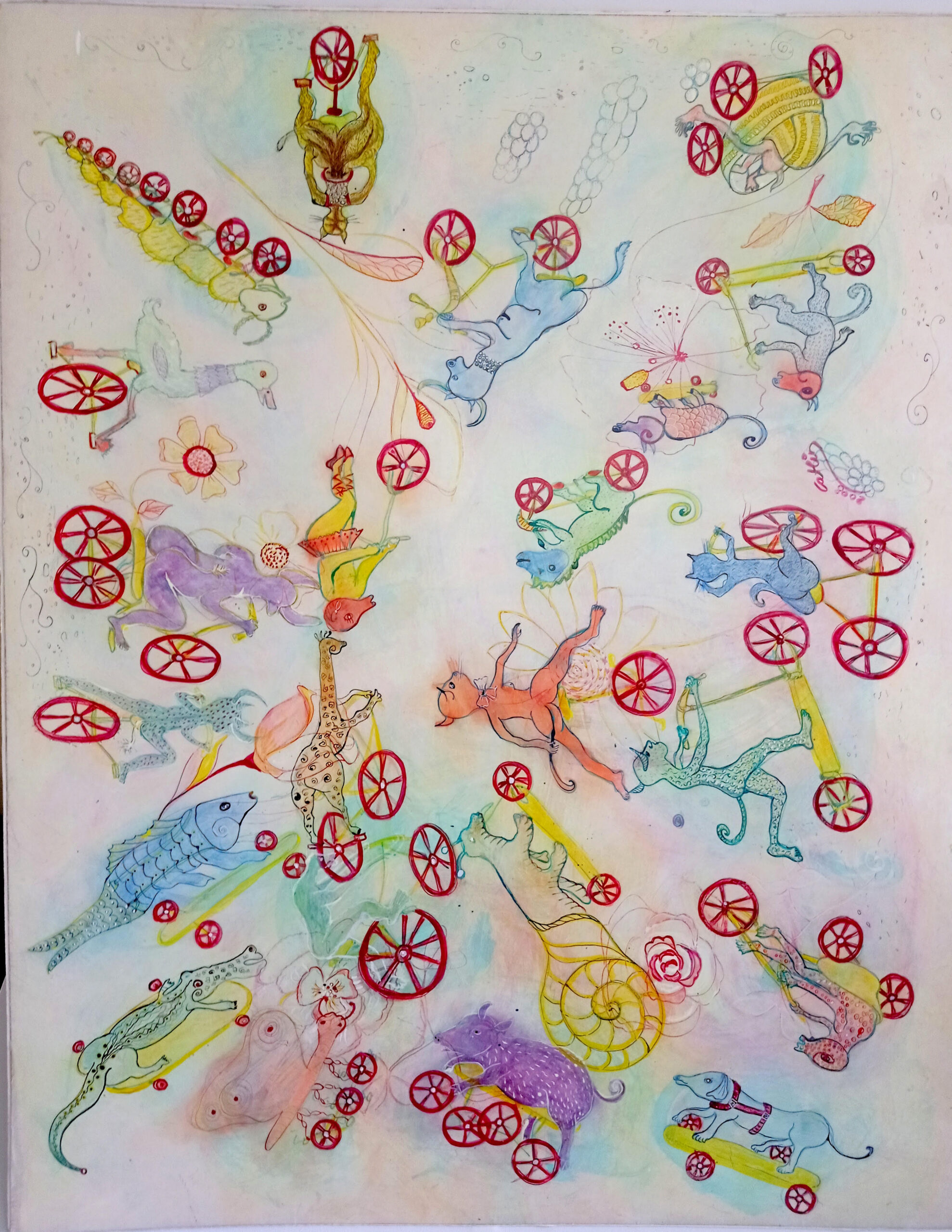
Viaje a toda velocidad sobre ruedas rojasSzáguldás piros kerekekenRacing on red wheels
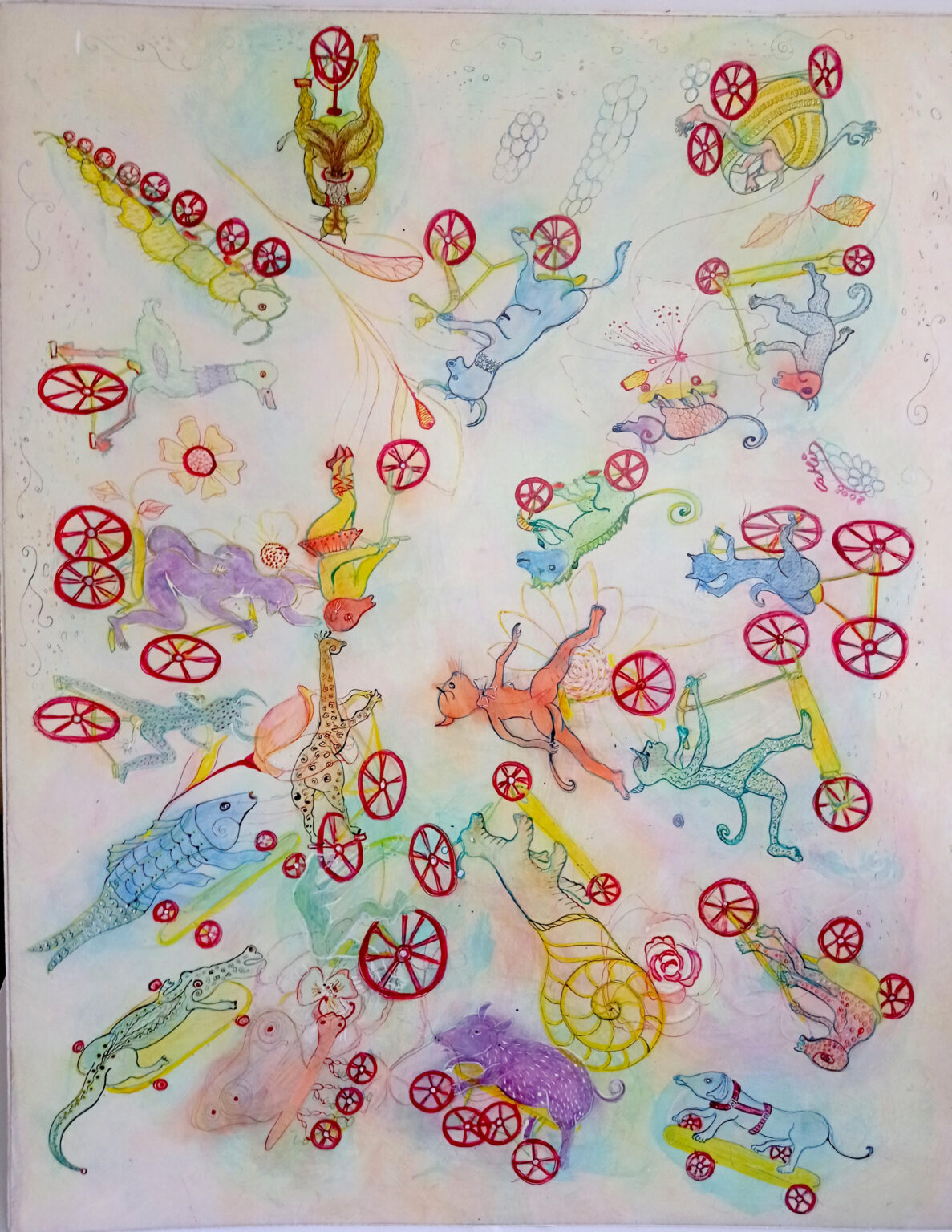
Esta imagen de suelo nació como parte de mi serie «Dimensiones infantiles». La creé principalmente para los niños, para que también ellos pudieran acercarse al arte de una manera más directa dentro de una exposición. El niño pequeño vive cerca del suelo, mira hacia abajo y descubre pequeños detalles que los adultos muchas veces pasan por alto. De ahí surgió la idea: se puede pisar la obra, rodearla y descubrirla desde cualquier dirección. Las ruedas rojas proceden de mis propios recuerdos de infancia. En los juguetes antiguos -coches, trenes, muñecas- a menudo aparecía algún pequeño detalle rojo: una rueda, un zapato, un lazo. Esos fragmentos de color quedaron profundamente grabados en mi memoria y más tarde se convirtieron en un motivo recurrente de todo un mundo visual. Estas criaturas extrañas, lúdicas y en parte híbridas avanzan todas sobre ruedas rojas. La imagen no tiene una parte superior ni inferior definida: puede contemplarse desde cualquier dirección, como si entráramos en un universo infantil abierto y expansivo, donde la rueda roja simboliza el movimiento, la energía, la curiosidad y el desarrollo.
Ez a padlókép a „Gyermeki dimenziók” sorozatom részeként született. Elsősorban a gyermekeknek készítettem, hogy egy kiállításon ők is közvetlenebb módon kerülhessenek kapcsolatba a művészettel. A kisgyermek közel él a földhöz, lefelé néz, és olyan apró részleteket is észrevesz, amelyek mellett a felnőtt gyakran elhalad. Ez adta a padlókép ötletét: rá lehet lépni, körbe lehet járni, minden irányból fel lehet fedezni. A piros kerekek saját gyermekkori emlékeimből születtek. A régi játékokon -kisautókon, vonatokon, babákongyakran egy-egy apró részlet volt piros: egy kerék, egy cipő, egy masni. Ezek a színes részletek mélyen megmaradtak bennem, és később egy egész képi világ visszatérő motívumává váltak. A különös, játékos, részben hibrid lények mind piros kerekeken haladnak. A képnek nincs kijelölt alja vagy teteje: bármelyik irányból nézhető, mintha egy szabad, kitáguló gyermeki univerzumba lépnénk, ahol a piros kerék a mozgás, az energia, a kíváncsiság és a fejlődés jelképe.
This floor artwork was created as part of my “Childhood Dimensions” series. I made it primarily for children, so that they too could encounter art more directly within an exhibition. A small child lives close to the ground, looks downward and notices tiny details that adults often pass by. This is where the idea of the floor artwork came from: it can be stepped on, walked around and discovered from every direction. The red wheels come from my own childhood memories. Old toys -little cars, trains and dolls- often had a small red detail: a wheel, a shoe, a bow. These flashes of colour remained deeply embedded in my memory and later became a recurring motif in an entire visual world. These strange, playful and partly hybrid creatures all travel on red wheels. The image has no fixed top or bottom: it can be viewed from any direction, as if we were entering a free, expanding childhood universe where the red wheel symbolizes movement, energy, curiosity and development.
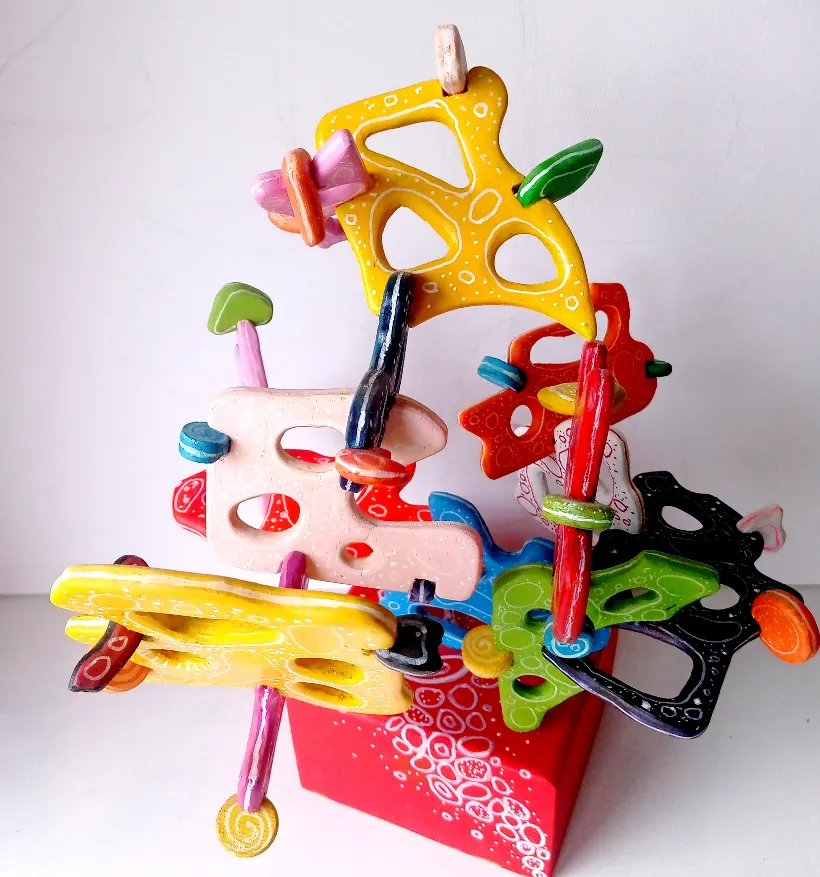
ConstrucciónKonstrukcióConstruction
Los juegos de construcción de nuestra infancia no solo nos entretenían, sino que también nos enseñaban casi sin darnos cuenta. Mientras creábamos formas nuevas una y otra vez, experimentábamos las sencillas leyes físicas del equilibrio, el peso y el apoyo: dónde colocar cada pieza para que la estructura se mantuviera en pie y cómo podía cambiar el conjunto al mover un solo elemento. La magia de estos juegos residía precisamente en que no ofrecían una forma predeterminada. No recibíamos un coche o una muñeca, sino elementos con los que cada vez podía nacer algo diferente. Era la imaginación del niño la que daba forma al juego. Esta obra lleva esa experiencia al mundo de las Vibraciones positivas: un encuentro lúdico de colores, formas y equilibrio, donde la construcción parece poder adoptar una nueva forma en cualquier momento.
Gyerekkorunk építő- és konstrukciós játékai nemcsak szórakoztattak, hanem észrevétlenül tanítottak is. Miközben újabb és újabb formákat hoztunk létre, megtapasztaltuk az egyensúly, a súly és a megtámasztás egyszerű fizikai törvényeit: mit hová kell helyezni ahhoz, hogy a szerkezet megálljon, és hogyan változik meg az egész egyetlen elem áthelyezésével. Ezeknek a játékoknak éppen az volt a varázsa, hogy nem kínáltak kész formát. Nem egy autót vagy babát kaptunk, hanem elemeket, amelyekből minden alkalommal valami más születhetett. A gyermek saját képzelete alakította a játékot. Ez a mű ennek az élménynek a továbbgondolása a Pozitív vibrációk világában: színek, formák és egyensúly játékos találkozása, ahol a konstrukció bármelyik pillanatban mintha új alakot ölthetne
The construction games of our childhood did more than entertain us; almost without noticing, they also taught us. As we created new forms again and again, we experienced the simple physical laws of balance, weight and support: where to place each element so that the structure would stand, and how the whole could change when just one piece was moved. The magic of these games lay precisely in the fact that they did not offer a predetermined form. We were not given a car or a doll, but elements from which something different could emerge every time. The child's own imagination shaped the game. This work carries that experience into the world of Positive Vibrations: a playful encounter of colours, forms and balance, where the construction seems capable of taking on a new shape at any moment.
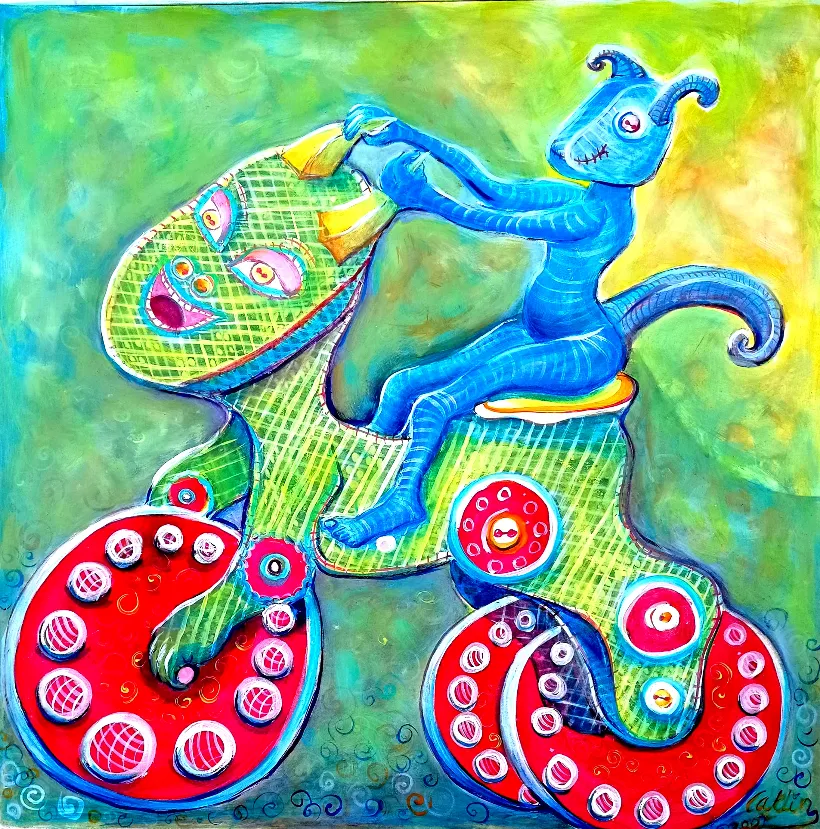
El cuento de las ruedas rojasA piros kerekek meséjeThe Tale of the Red Wheels
Las ruedas rojas son un motivo recurrente del movimiento, el juego y la imaginación infantil. De un juguete sencillo puede nacer toda una historia y un mundo propio.
A piros kerekek a mozgás, a játék és a gyermeki fantázia visszatérő motívumai. Egy egyszerű játékból egész történet és saját világ születhet.
The red wheels are a recurring motif of movement, play and childhood imagination. A simple toy can give birth to an entire story and a world of its own.
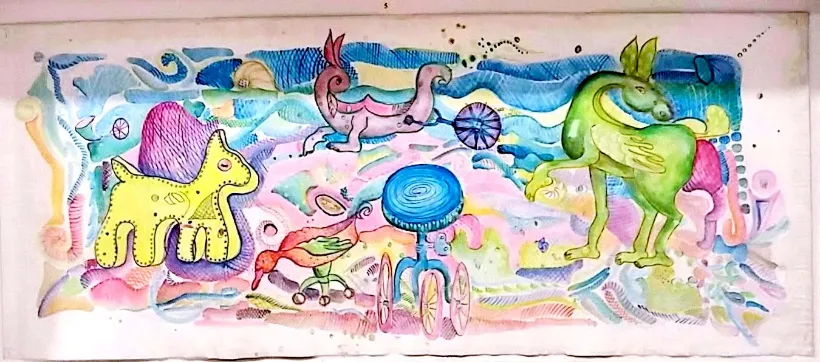
Mundo infantil inventadoKitalált gyermeki világAn Imagined Childhood World
Estos animales no existen: son criaturas de la libre fantasía. Sin embargo, en sus formas se esconden pequeñas chispas de los recuerdos de mi infancia. Entonces nosotros mismos hacíamos nuestros juguetes: inventábamos la figura, preparábamos el patrón, cortábamos las piezas y después las cosíamos. La criatura amarilla, parecida a un caballo, conserva el recuerdo de aquellos juguetes, mientras las demás figuras atraviesan libremente los límites de la realidad. En el mundo lúdico de la serie Híbridos, diferentes formas y seres pueden unirse entre sí. El motivo recurrente de la rueda aparece también aquí, siempre con un papel y un significado diferentes. Para mí, la obra habla de la libertad creadora de la infancia: de aquel tiempo en que era natural que aquello que no encontrábamos en el mundo simplemente lo inventáramos y lo creáramos. Porque, en cierto modo, eso es también el arte: la libertad de la imaginación y el deseo de dar forma a aquello que hasta entonces solo existía dentro de nosotros. Tal vez fue ya en la infancia donde germinó todo aquello que más tarde se convirtió en arte.
Ezek az állatok nem léteznek - a szabad fantázia teremtményei. Formáikban mégis ott rejtőznek gyermekkorom emlékeinek apró szikrái. Akkoriban magunk is készítettünk játékokat: kitaláltuk a figurát, szabásmintát készítettünk hozzá, kiszabtuk, majd megvarrtuk. A sárga, lószerű lény ennek az emlékét őrzi, miközben a többi figura szabadon átlépi a valóság határait. A Hibridek sorozat játékos világában különböző formák és lények kapcsolódhatnak össze. A visszatérő kerék motívuma itt is megjelenik, mindig más szerepben és jelentéssel. A kép számomra a gyermeki alkotás szabadságáról szól: arról az időről, amikor még természetes volt, hogy amit nem találtunk meg a világban, azt egyszerűen kitaláltuk és megteremtettük. Hiszen valahol ez maga a művészet is: a képzelet szabadsága és a vágy, hogy formát adjunk annak, ami addig csak bennünk létezett. Talán már gyermekkorban itt fogant meg mindaz, ami később művészetté vált.
These animals do not exist - they are creatures of free imagination. Yet their forms contain small sparks of my childhood memories. Back then, we made our own toys: we invented the figure, created the pattern, cut out the pieces and then sewed them together. The yellow, horse-like creature preserves the memory of those toys, while the other figures freely cross the boundaries of reality. In the playful world of the Hybrids series, different forms and beings can merge. The recurring motif of the wheel appears here as well, each time with a different role and meaning. For me, the work is about the creative freedom of childhood: a time when it felt natural that whatever we could not find in the world, we simply imagined and created. In a way, this is also what art is: the freedom of imagination and the desire to give form to something that until then existed only within us. Perhaps it was already in childhood that everything which later became art first took root.
Museo de mis recuerdosEmlékeim MúzeumaMuseum of My Memories
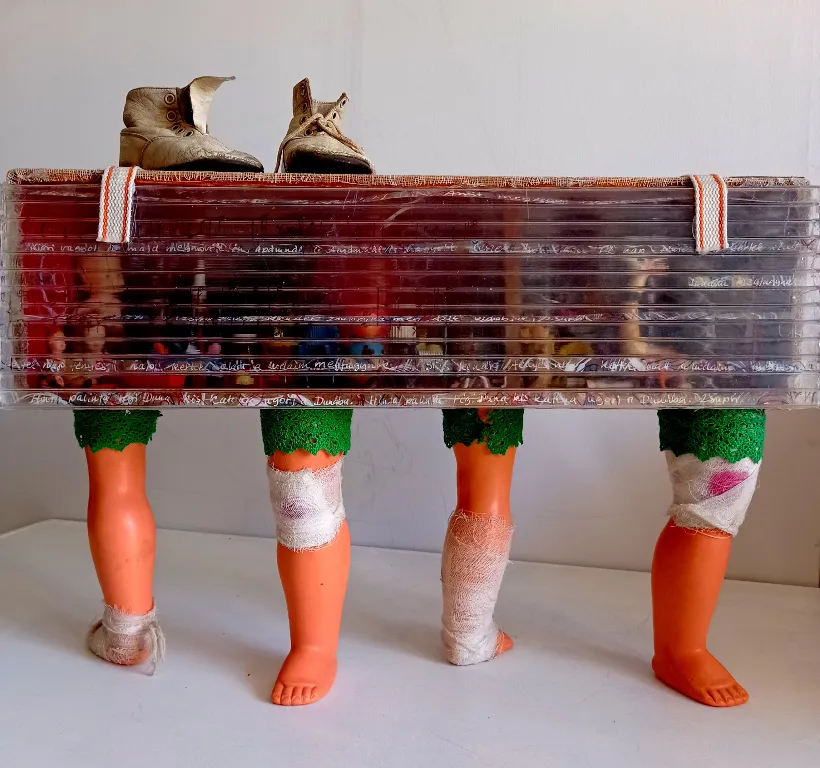
Esta instalación-caja conserva los recuerdos materiales y emocionales de mis primeros cinco o seis años de infancia. Para mí, una caja siempre fue un objeto especial, casi mágico: en mi niñez los adultos guardaban en cajas aquello que querían proteger, esconder o conservar. Por eso esta caja se convirtió también en el lugar donde guardo mis recuerdos. En su puerta transparente aparecen mis primeras rimas, pequeños versos, canciones y partituras estilizadas: ritmos y melodías repetitivas, casi como mantras, que un niño recibe y guarda incluso antes de saber hablar. Los dibujos del interior evocan mis primeros garabatos. Como no teníamos papel ni lápices, dibujábamos donde podíamos: en la arena, en la pizarra o incluso con un trozo de yeso caído sobre alguna superficie. Esos dibujos desaparecieron, igual que la mayor parte de los recuerdos materiales de mi infancia. Los pequeños juguetes, muñecas y figuras hechas con alambre, rafia y otros materiales sencillos recuerdan una infancia en la que jugábamos con lo que encontrábamos o con lo que éramos capaces de fabricar. Los zapatos infantiles gastados y heredados evocan mis primeros pasos; las piernas de muñeca vendadas, las caídas y heridas del aprendizaje de caminar. Esta obra es para mí la huella de mis recuerdos en todas sus dimensiones: todo aquello que permaneció en mí de los primeros años de mi infancia, en objetos, imágenes, sonidos y sentimientos.
Ez a dobozinstalláció gyermekkorom első öt-hat évének tárgyi és lelki emlékeit őrzi. Számomra a doboz mindig különleges, szinte mágikus tárgy volt: gyermekkoromban a felnőttek dobozokban őrizték mindazt, amit félteni, elrejteni vagy megóvni akartak. Ezért lett ez a doboz is az emlékeim őrzőhelye. Átlátszó ajtajába első mondókáim, versikéim, énekeim és stilizált kották kerültek. Azok a ritmusok és mantraszerűen ismétlődő dallamok, amelyeket a gyermek már akkor magába fogad, amikor még beszélni sem tud. A doboz belsejének rajzai az első firkákat idézik. Papír és ceruza híján oda rajzoltunk, ahová lehetett: homokba, táblára, vagy akár egy darab lehullott vakolattal valamelyik felületre. Ezek a rajzok eltűntek, ahogyan gyermekkorom tárgyi emlékeinek nagy része is. A megmaradt vagy később összegyűjtött apró játékok, babák, drótból, raffiából és más egyszerű anyagokból készített figurák egy olyan gyermekkort idéznek, amikor abból játszottunk, amit találtunk vagy magunk el tudtunk készíteni. A kopott, többször továbbörökített gyermekcipő az első lépésekre, a bekötözött babalábak pedig a járni tanulás eséseire és sérüléseire emlékeztetnek. Ez a mű számomra emlékeim lenyomata minden dimenzióban: mindaz, ami gyermekkorom első éveiből tárgyakban, képekben, hangokban és érzésekben bennem maradt.
This box installation preserves the material and emotional memories of the first five or six years of my childhood. For me, a box was always a special, almost magical object: when I was a child, adults kept in boxes whatever they wanted to protect, hide or preserve. That is why this box also became a place for keeping my memories. Its transparent door contains my first nursery rhymes, little verses, songs and stylized musical notation: rhythms and repetitive, almost mantra-like melodies that a child absorbs and carries within even before learning to speak. The drawings inside evoke my earliest scribbles. With no paper or pencils, we drew wherever we could: in the sand, on a blackboard, or even with a piece of fallen plaster on any surface where its chalky trace could be seen. Those drawings disappeared, as did most of the tangible memories of my childhood. The small toys, dolls, and figures made from wire, raffia and other simple materials recall a childhood in which we played with whatever we could find or make ourselves. The worn children's shoes, passed from one child to another, evoke my first steps; the bandaged doll legs recall the falls and injuries that came with learning to walk. For me, this work is the imprint of my memories in every dimension: everything that has remained within me from the first years of childhood, in objects, images, sounds and feelings.
Un programa de vida sin madreEgy anya nélküli élet programjaA programme for life without a mother
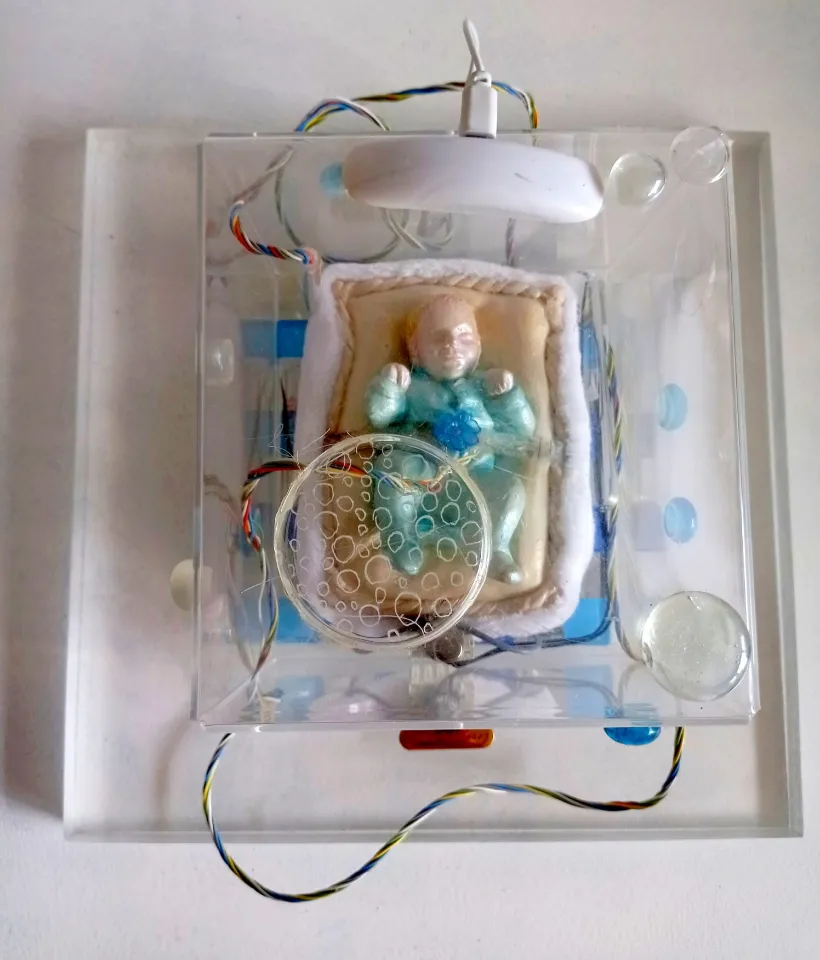
La tecnología interviene cada vez más profundamente en el comienzo de la vida humana. La obra plantea un posible futuro en el que la gestación y el nacimiento de un niño ya no estén necesariamente ligados al cuerpo de la madre. En un entorno artificial, sus conocimientos, capacidades e incluso determinadas características podrían llegar a definirse o programarse de antemano.
A technológia egyre mélyebben avatkozik be az emberi élet kezdetébe. A mű egy lehetséges jövőt vetít elénk, amelyben a gyermek kihordása és megszületése már nem feltétlenül az anya testéhez kötődik. Egy mesterséges környezetben fejlődő gyermek tudása, képességei és bizonyos tulajdonságai akár előre meghatározhatók, programozhatók is lehetnek. A mű nem választ ad, hanem kérdez: mi marad az emberi kötődésből, ha az élet már nem az anya testében és ölelésében kezdődik?
Technology is intervening ever more deeply in the beginning of human life. The work imagines a possible future in which carrying and giving birth to a child may no longer necessarily depend on the mother's body. Within an artificial environment, a child's knowledge, abilities and even certain characteristics could potentially be determined or programmed in advance.
The work does not offer an answer, but asks a question: what remains of the human bond if life no longer begins within a mother's body and embrace?
Un possible mañanaEgy lehetséges holnapA possible tomorrow
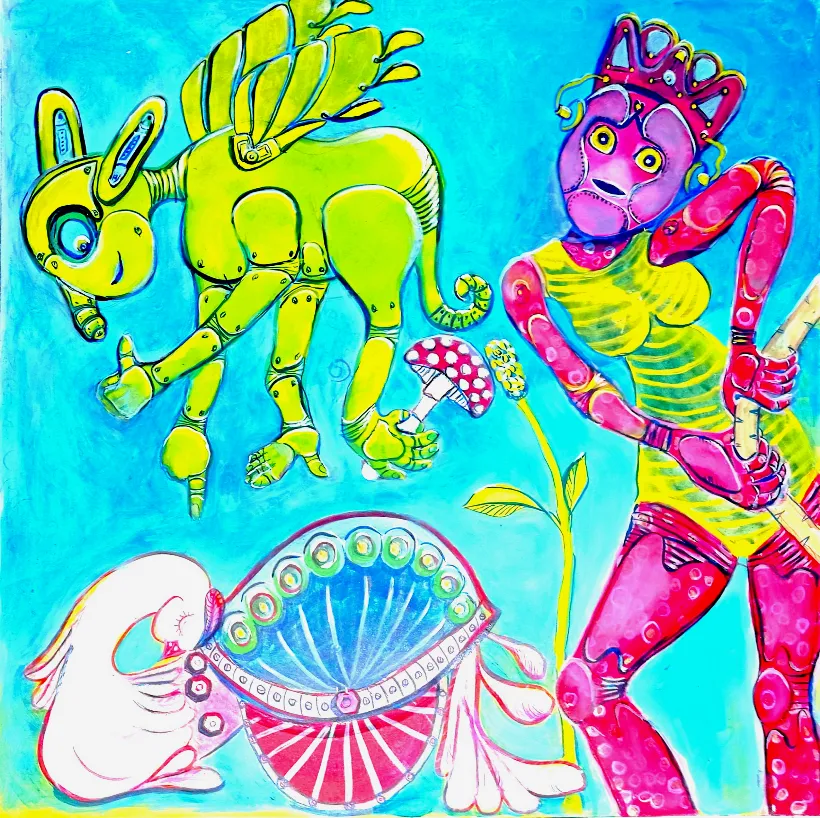
Una escena entre el cuento y un futuro imaginado: figuras híbridas, entre humano, animal y máquina, parecen viajar sobre una criatura fantástica. La rueda roja, elemento recurrente de esta serie, une el recuerdo de los antiguos juguetes infantiles con la imaginación de un posible mañana.
Mesevilág és egy elképzelt jövő találkozik a képen: ember, állat és gép között létező hibrid alakok utaznak egy fantasztikus lényen. A sorozatban visszatérő piros kerék a régi gyermekjátékok emlékét kapcsolja össze egy lehetséges holnap képzeletvilágával.
A scene between a fairy tale and an imagined future: hybrid figures, part human, animal and machine, seem to travel on a fantastic creature. The red wheel, a recurring element in this series, connects the memory of old childhood toys with the imagination of a possible tomorrow.

La «evolución» de los juguetesA gyermekjátékok „evolúciója”The “evolution” of toys
La transformación de los juguetes infantiles: desde el mundo tradicional del juego hacia un futuro cada vez más determinado por la tecnología. El juguete no es solo un objeto, sino también un reflejo de cómo cambian el niño y el mundo que lo rodea.
A gyermekjátékok változásának története: a hagyományos játékvilágból egy technológia által egyre inkább meghatározott jövő felé. A játék már nemcsak tárgy, hanem annak tükre is, hogyan változik a gyermek és az őt körülvevő világ.
The transformation of children's toys: from the traditional world of play towards a future increasingly shaped by technology. The toy is not only an object, but also a reflection of how the child and the surrounding world are changing.
En las garras de los númerosA számok karmai közöttIn the claws of numbers
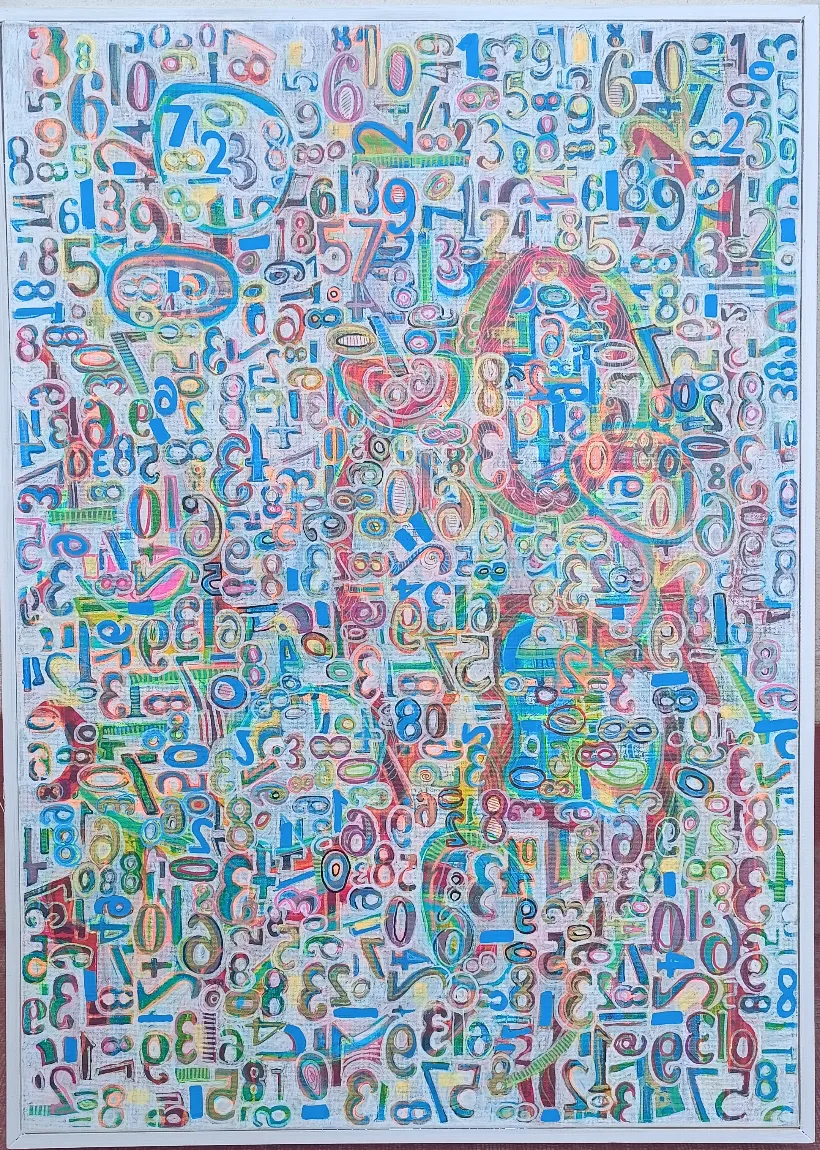
En el mundo del niño entran cada vez con más fuerza los números, los sistemas y la tecnología. Junto al juego y la libertad aparece otro mundo: el de la medición, el rendimiento y el control.
Numbers, systems and technology are entering the child's world with increasing force. Alongside play and freedom, another world appears: one of measurement, performance and control.
A gyermek világába egyre erősebben belépnek a számok, a rendszerek és a technológia. A játék és a szabadság mellett megjelenik egy másik világ is: a mérhetőség, a teljesítmény és a kontroll világa.
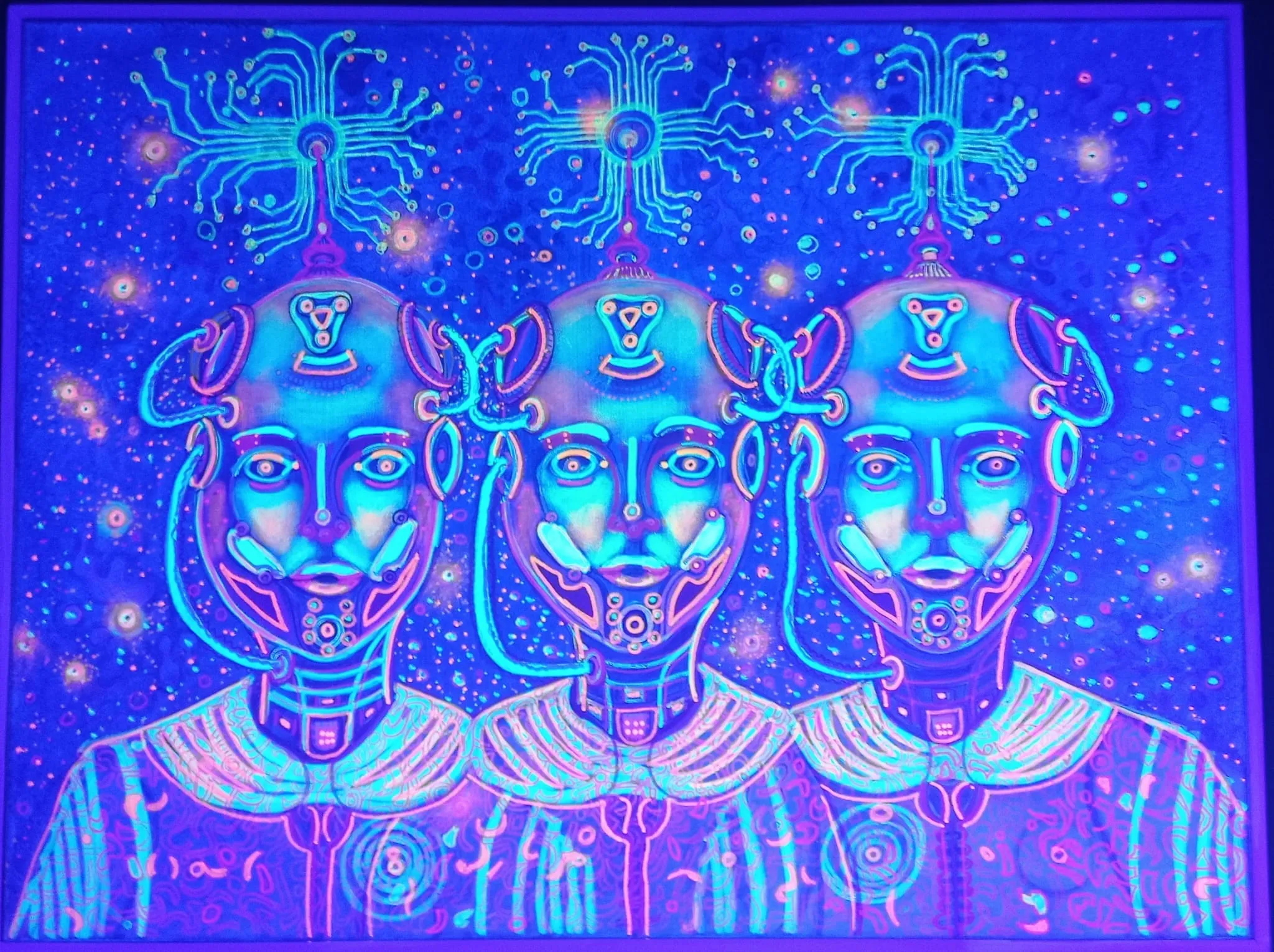
HumanoidesHumanoidokHumanoids
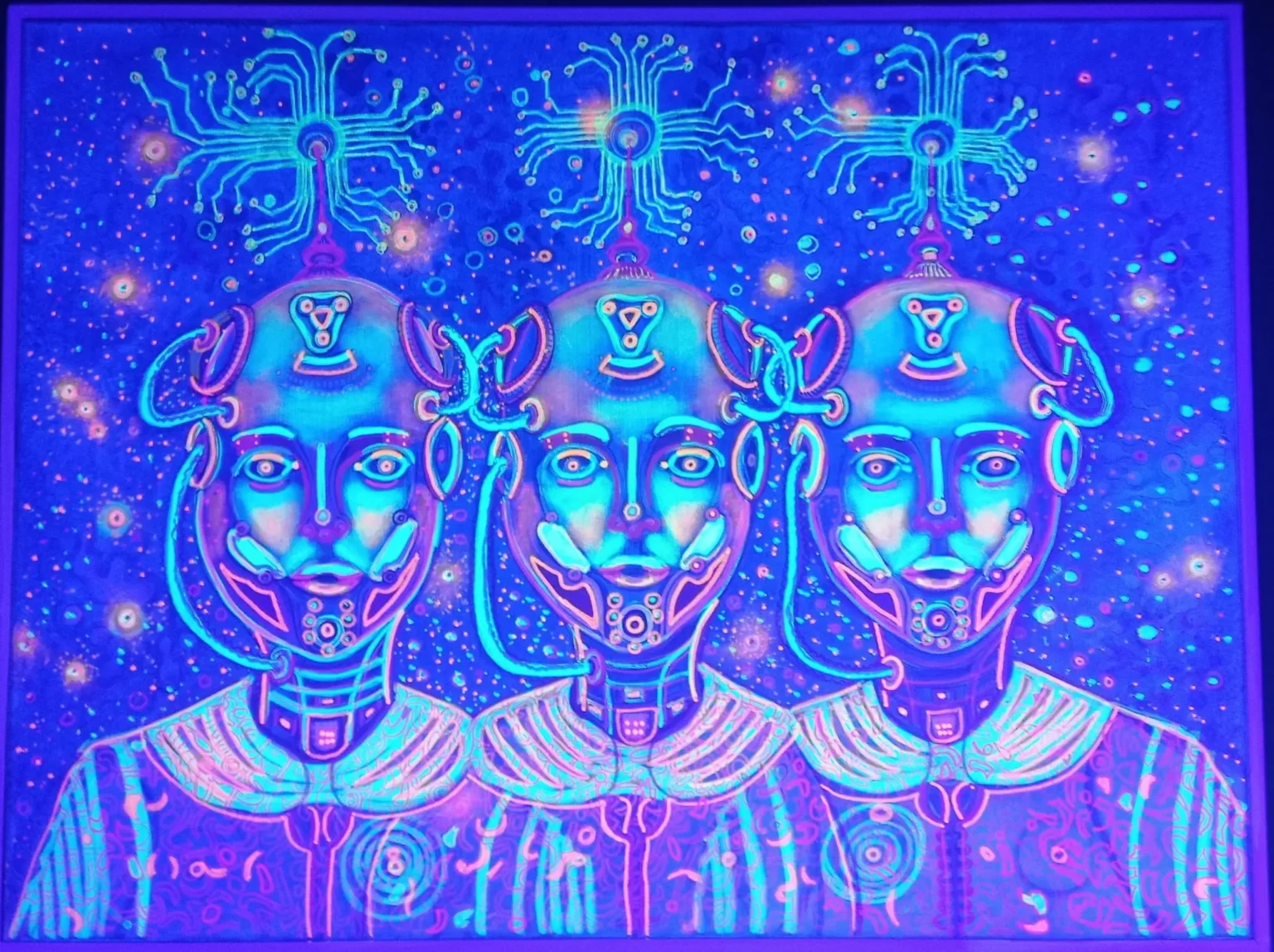
La frontera entre el ser humano y la máquina se vuelve cada vez más incierta. Las figuras humanoides resultan a la vez familiares y extrañas, evocando un futuro en el que la tecnología puede dejar de ser solo una herramienta para convertirse también en compañera.
The boundary between human and machine is becoming increasingly uncertain. The humanoid figures seem both familiar and strange, evoking a future in which technology may no longer be merely a tool, but also a companion.
Az ember és a gép közötti határ egyre bizonytalanabbá válik. A humanoid alakok egyszerre ismerősek és idegenek: egy olyan jövőt idéznek meg, amelyben a technológia már nemcsak eszköz, hanem társ is lehet.
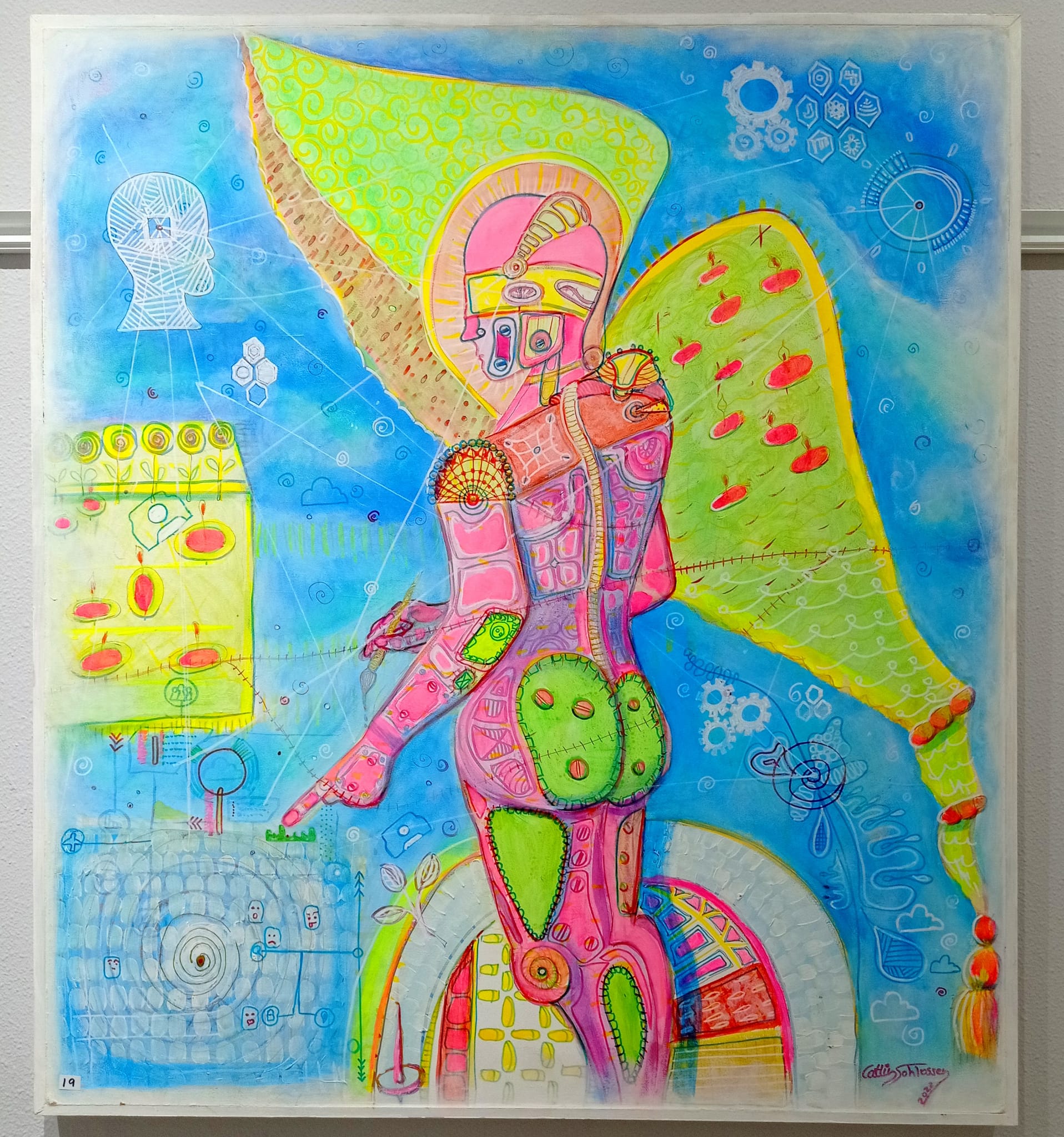
Ángel que perdió su papelAz angyal, aki elvesztette a szerepétThe angel who lost his role
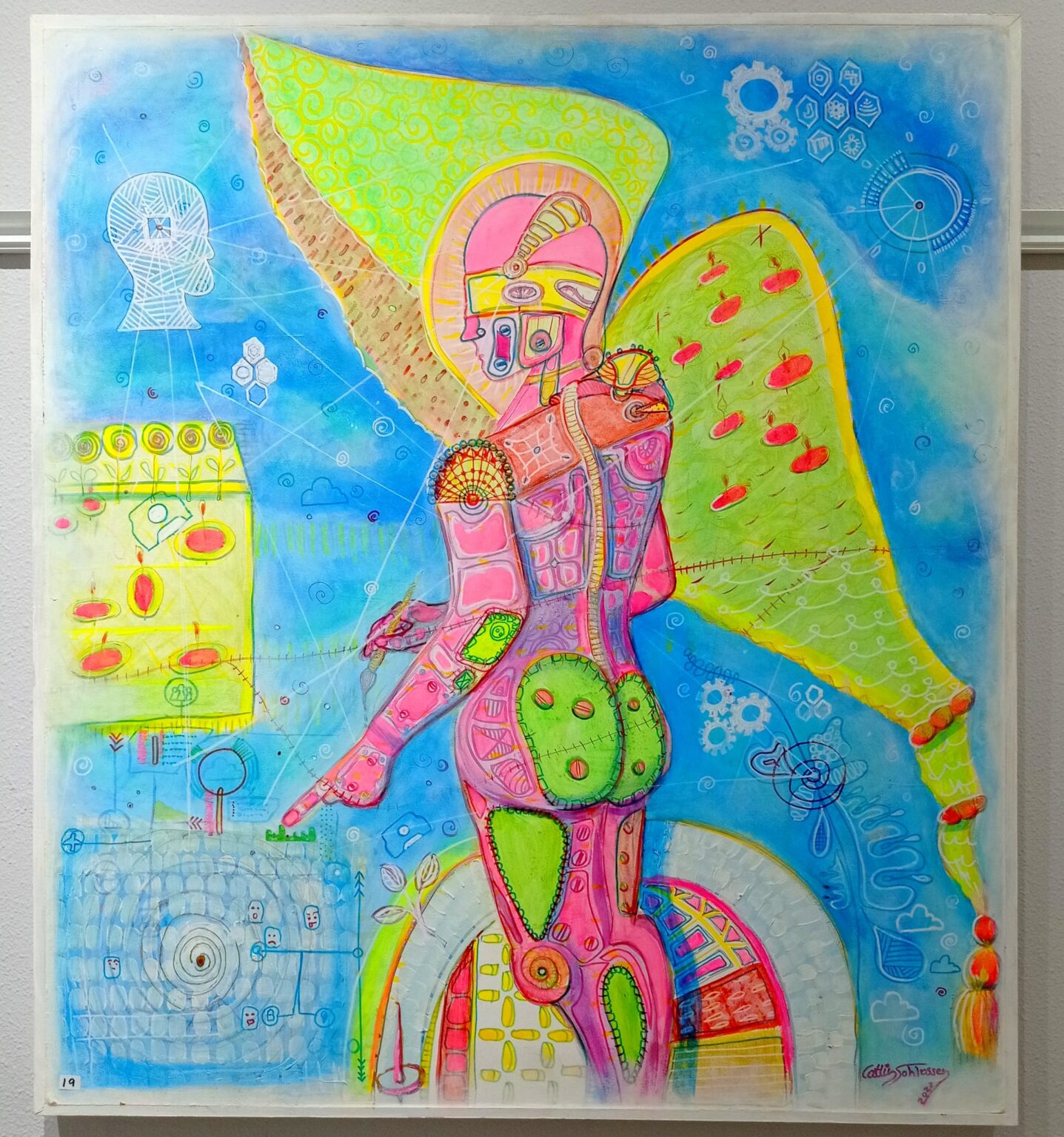
Un mundo en el que los antiguos papeles y significados se transforman. El ángel pierde su función habitual y busca su lugar dentro de un nuevo entorno tecnológico.
Egy világ, amelyben a régi szerepek és jelentések átalakulnak. Az angyal elveszíti megszokott szerepét, miközben egy új, technológiai környezetben keresi a helyét.
A world in which old roles and meanings are being transformed. The angel loses its familiar role and searches for its place within a new technological environment.
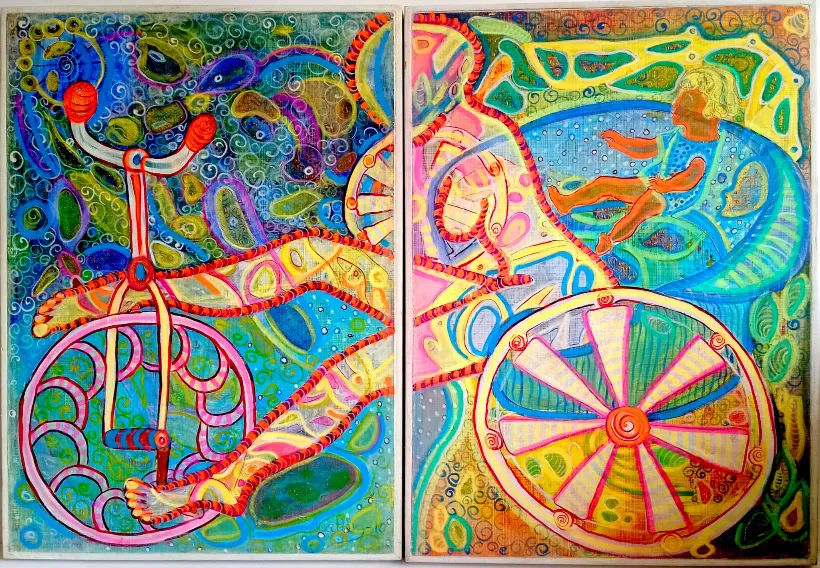
El viaje de la imaginaciónA képzelet utazásaJourney of the imagination
En la imaginación infantil no existen límites fijos. A través del juego, los objetos, los animales y los seres extraños pueden transformarse y crear nuevos mundos.
A gyermeki képzeletben nincsenek rögzített határok. A játék segítségével tárgyak, állatok és különös lények átalakulhatnak, és új világokat teremthetnek.
There are no fixed boundaries in a child's imagination. Through play, objects, animals and strange creatures can transform and create new worlds.
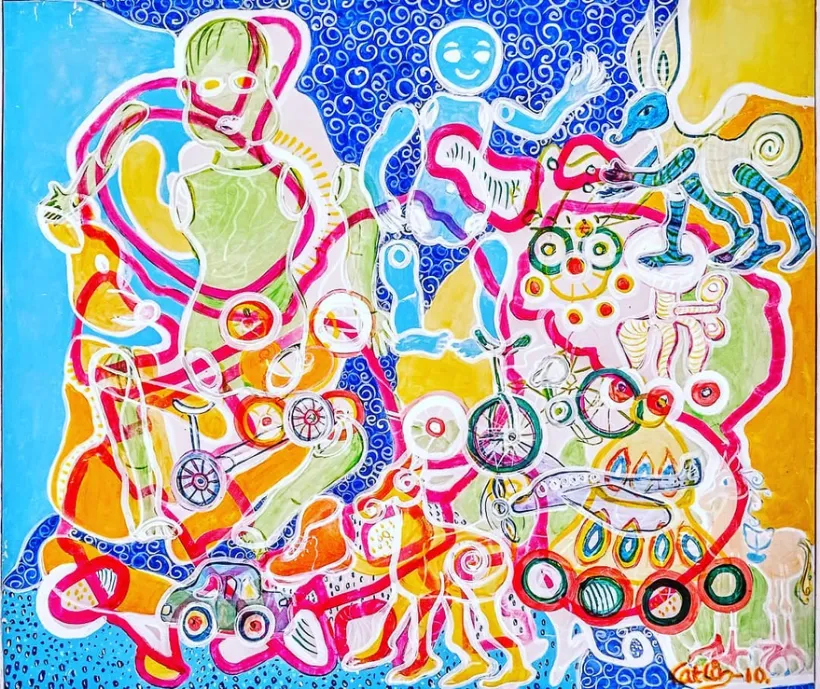
La vida en la habitación infantilFluoreszkáló akril farostlemezenFluorescent acrylic on hardboard
La habitación infantil es un universo propio: un lugar donde se encuentran juguetes, recuerdos y seres imaginarios. Desde aquí comienza un viaje de la imaginación que adopta formas siempre nuevas.
A gyerekszoba önálló univerzum: játékok, emlékek és fantázialények találkozási helye. Innen indul az a képzeletbeli út, amely később egyre újabb formákat ölt.
The child's room is a universe of its own: a meeting place for toys, memories and imaginary beings. From here begins a journey of imagination that continually takes on new forms.
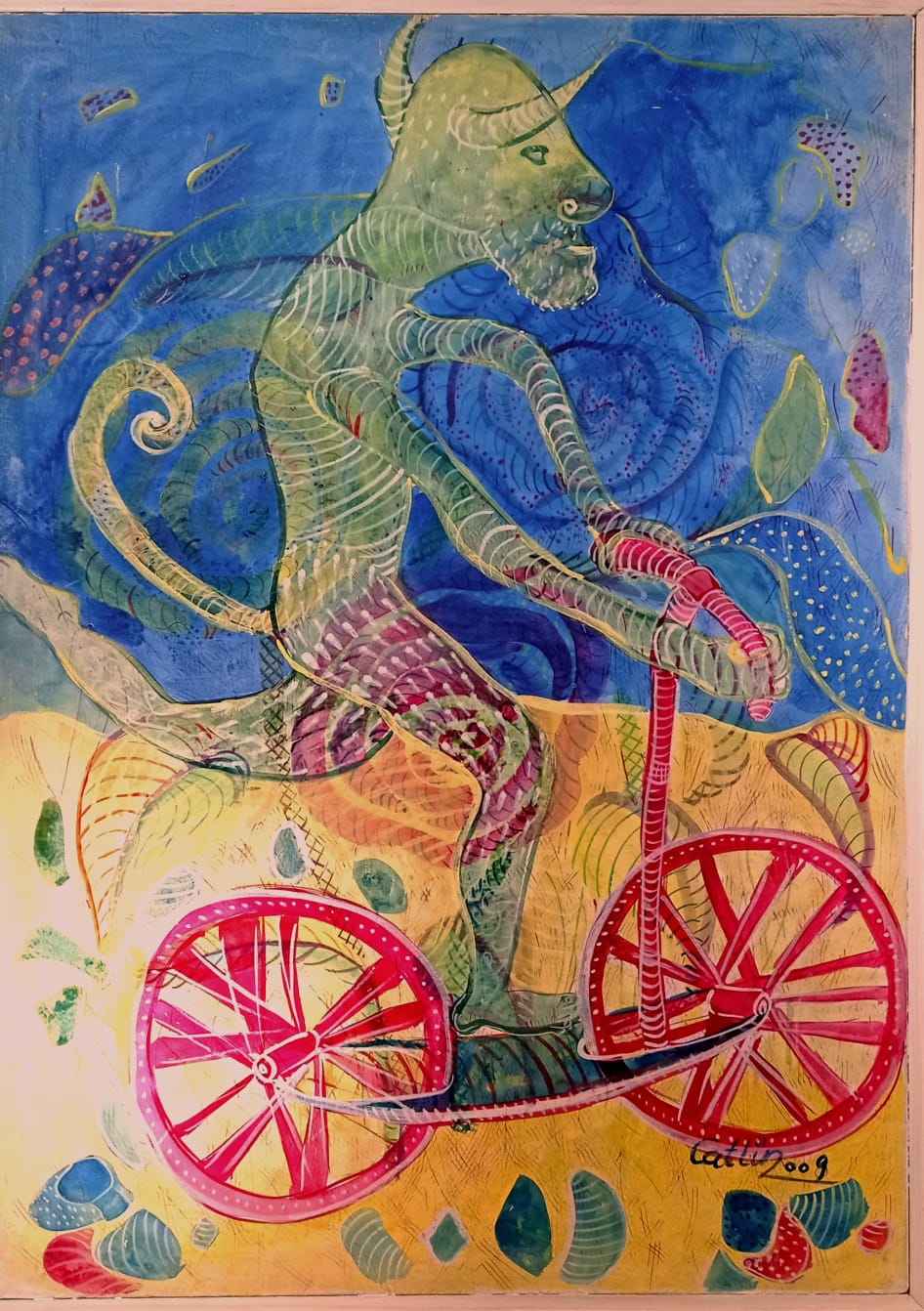
Corre en su patinete de ruedas rojas como un diablitoÚgy száguld a piros kerekű rollerén, mint egy kisördögHe races around on his red-wheeled scooter like a little devil
La energía, la libertad y el movimiento incontenible de la infancia aparecen a través del motivo recurrente de las ruedas rojas.
A gyermeki energia, szabadság és fékezhetetlen mozgás jelenik meg a piros kerekek visszatérő motívumán keresztül.
Childhood energy, freedom and unstoppable movement appear through the recurring motif of the red wheels.
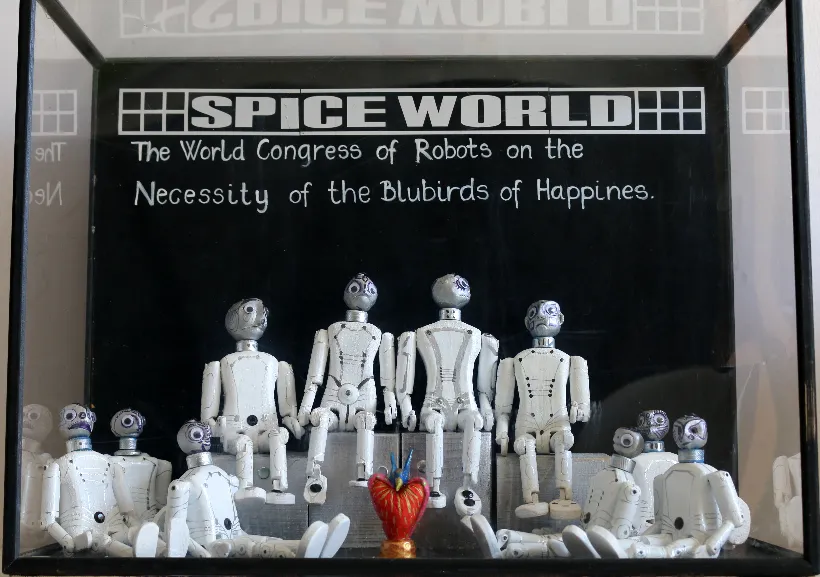
Congreso mundial de robotsVilágrobot KongresszusWorld Robot Congress
Los robots ya no son simples juguetes: aparecen como personajes diferentes que forman su propia comunidad. El mundo del juego se transforma en una sociedad imaginaria que, con humor, nos invita a pensar en un futuro posible.
A robotok itt már nem egyszerű játékok: különböző karakterekként saját közösséget alkotnak. A játékvilág egy elképzelt társadalommá alakul, amely humorosan, de egyben elgondolkodtatóan idézi meg a lehetséges jövőt.
The robots are no longer simply toys: they appear as individual characters forming their own community. The world of play becomes an imaginary society that, with humour, invites us to consider a possible future.
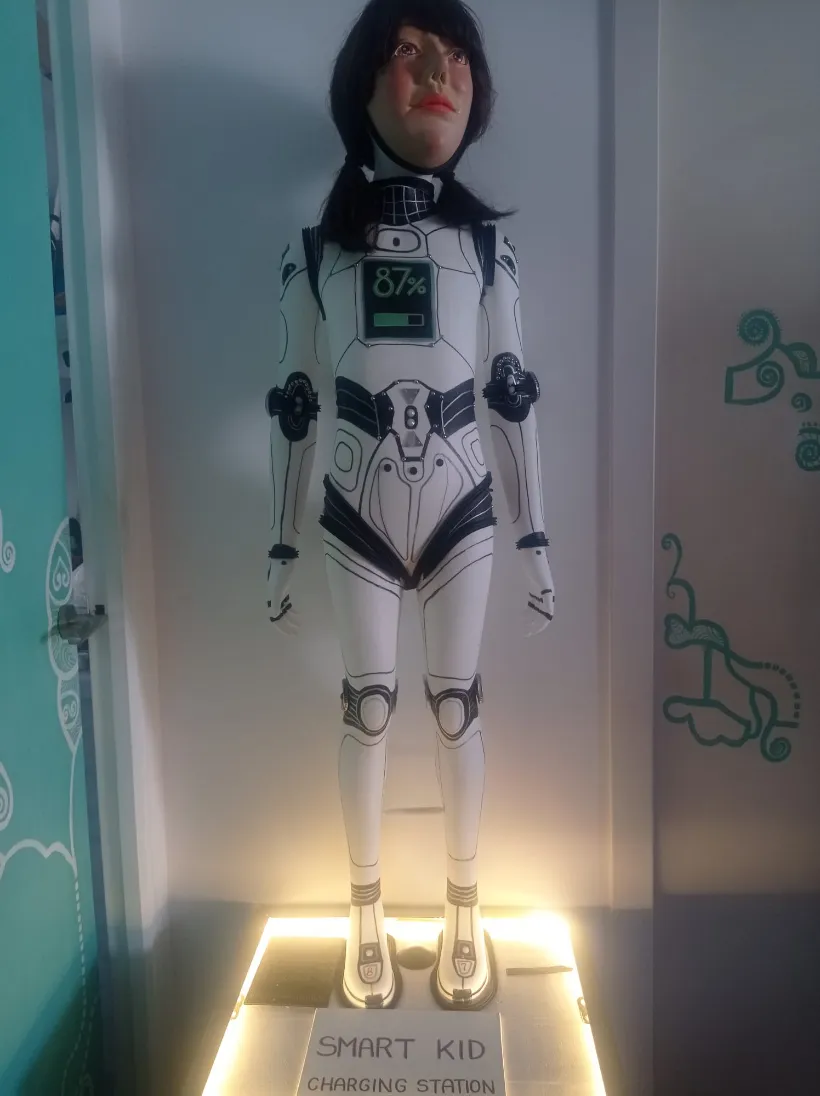
Estación de carga para niños inteligentesSmart Kid töltőállomásSmart kid charging station
La evolución del juguete llega aquí hasta el propio niño. En un futuro imaginado, quizá ya no solo carguemos y programemos nuestros dispositivos: también el ser humano podría convertirse en un ser conectado, recargable y regulable.
A játék evolúciója itt már magához a gyermekhez érkezik. Egy elképzelt jövőben talán már nemcsak az eszközeinket töltjük fel és programozzuk: maga az ember is egy rendszerhez kapcsolható, tölthető és szabályozható lénnyé válhat.
Here, the evolution of the toy reaches the child itself. In an imagined future, perhaps we will no longer charge and program only our devices: the human being, too, could become connected, rechargeable and controllable.
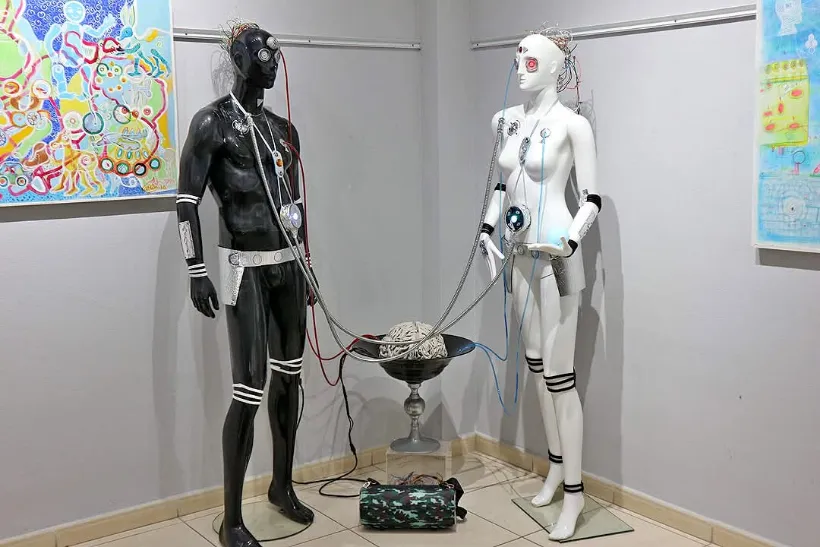
Robot hombre / Robot mujerFérfi robot / Női robotRobot man / Robot woman
El juguete se convierte en un ser artificial de dimensiones humanas. El líquido que circula entre el cerebro y los siete corazones evoca el funcionamiento de un organismo vivo. La pregunta ya no es solamente cómo será el juguete del futuro, sino dónde estará la frontera entre el ser humano y la máquina.
A játékból emberméretű mesterséges lény lesz. Az agy és a hét szív között keringő folyadék az élő szervezet működését idézi. A kérdés már nemcsak az, hogy milyen lesz a jövő játéka, hanem az is, hol húzódik majd az ember és a gép közötti határ.
The toy becomes an artificial being of human dimensions. The liquid circulating between the brain and the seven hearts evokes the functioning of a living organism. The question is no longer simply what the toy of the future will be like, but where the boundary between human and machine will lie.
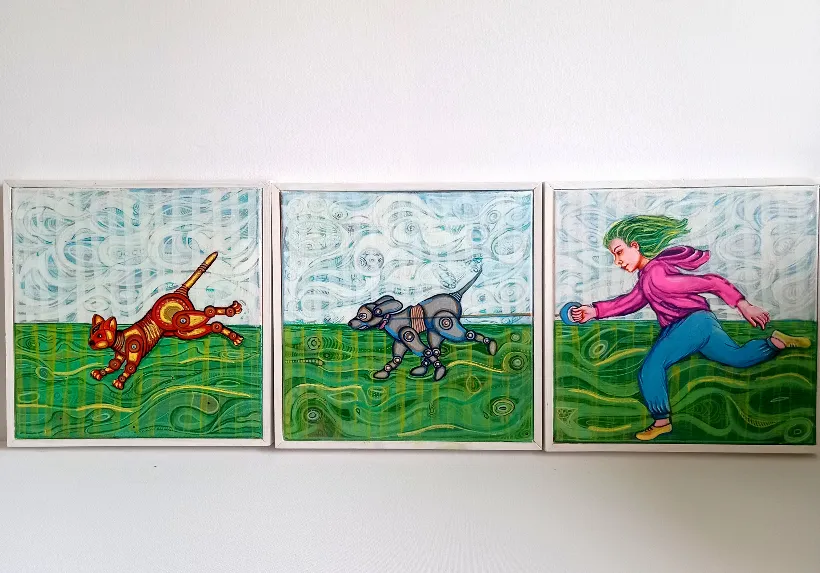
La evolución de la convivenciaA együttélés fejlődéseThe evolution of coexistence
También evolucionan las formas de convivencia. El ser humano, la máquina y los seres artificiales se acercan cada vez más, planteando una nueva pregunta: ¿cómo será su relación?
Az együttélés formái is változnak. Az ember, a gép és a mesterséges lények egyre közelebb kerülnek egymáshoz, ami egy új kérdést vet fel: milyen lesz a kapcsolatuk?
The ways in which we live together are also evolving. Humans, machines and artificial beings are growing ever closer, raising a new question: what will their relationship be like?
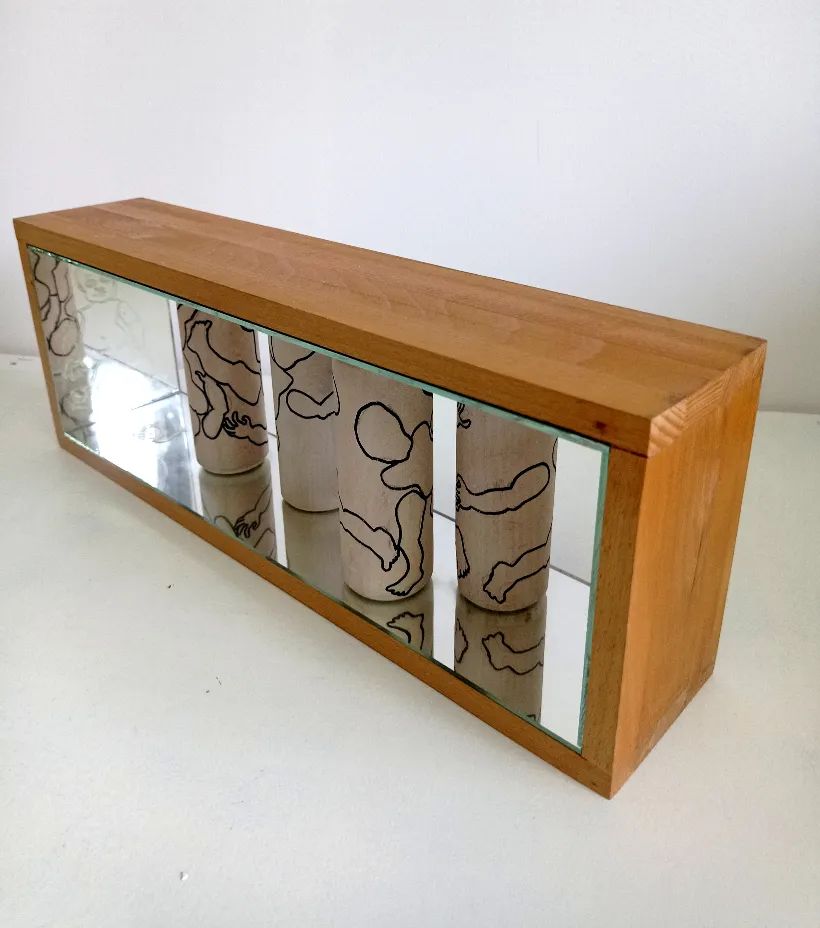
El reflejo infinito de la curiosidadA kíváncsiság végtelen tükröződéseThe Infinite Reflection of Curiosity
La obra nace del recuerdo de la curiosidad y de los descubrimientos de mi infancia. En las superficies interiores de espejo aparecen motivos que evocan dibujos infantiles hechos con tiza, mientras que sobre cuatro varillas de madera se representan muñecas desarticuladas: memoria de aquellos juguetes sencillos y frágiles que, en mi infancia, se rompían con facilidad. Los espejos multiplican las varillas, las figuras y los dibujos hasta conducirlos visualmente hacia el infinito. Según se observe la caja desde arriba, desde abajo o lateralmente, se abre ante el espectador un espacio diferente. Esta perspectiva cambiante remite a la curiosidad infantil que busca mirar las cosas desde todos los ángulos y descubrir, una y otra vez, nuevos mundos dentro de lo cotidiano. La obra nació originalmente dentro de la serie Dimensiones infantiles y constituye uno de los pilares de una exposición itinerante que ha ido transformándose y enriqueciéndose a lo largo de los años. En la exposición actual se integra como uno de los puntos de partida de la reflexión sobre la «evolución» de los juguetes y su influencia en el ser humano.
A mű saját gyermekkori kíváncsiságom és felfedezéseim emlékéből született. A doboz belső tükörfelületein gyermeki krétarajzokat idéző motívumok jelennek meg, míg a benne elhelyezett négy farúdon szétesett babák figurái láthatók azoknak az egyszerű, törékeny játékoknak az emlékeként, amelyek gyermekkoromban hamar szétestek. A tükrök a rudakat, figurákat és rajzokat megsokszorozva látszólag a végtelenbe vezetik. Attól függően, hogy felülről, alulról vagy oldalról tekintünk a dobozba, mindig más tér és más látvány tárul elénk. Ez a folyton változó perspektíva azt a gyermeki kíváncsiságot idézi fel, amely minden oldalról meg akarja vizsgálni és újra felfedezni a világot. A mű eredetileg a Gyermekes dimenziók sorozat részeként született, és egy hosszú évek óta folyamatosan alakuló vándorkiállítás egyik alappillére. A jelenlegi kiállításban a játékok „evolúcióját” és az emberre gyakorolt hatását vizsgáló gondolatmenet kiindulópontjai közé tartozik.
The work grew out of memories of my childhood curiosity and discoveries. The mirrored inner surfaces carry motifs reminiscent of children’s chalk drawings, while four wooden rods bear images of disjointed dolls - a memory of the simple, fragile toys of my childhood that often fell apart. The mirrors multiply the rods, figures and drawings, visually extending them toward infinity. Depending on whether the box is viewed from above, below or from the side, a different spatial experience emerges. This constantly changing perspective recalls the curiosity of a child who wants to examine things from every angle and repeatedly discover new worlds within the familiar. The work was originally created as part of the Childhood Dimensions series and became one of the foundational pieces of a travelling exhibition that has continued to evolve and incorporate new ideas over the years. In the current exhibition, it serves as one of the starting points for the exploration of the “evolution” of toys and their influence on human beings.
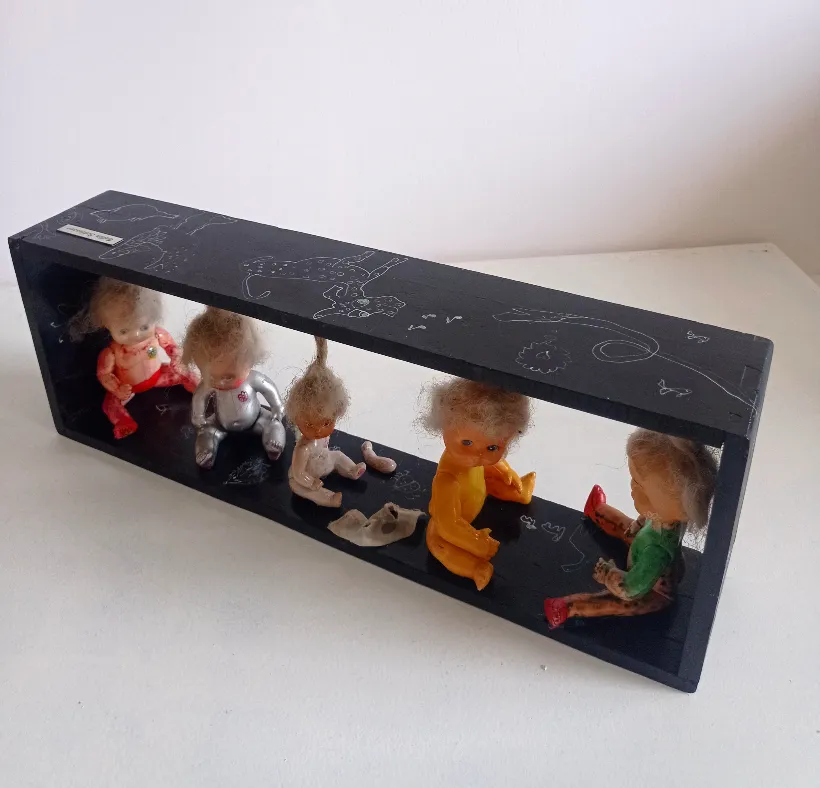
La creatividad de la carenciaA hiány kreativitásaThe Creativity of Scarcity
En mi infancia teníamos pocos juguetes y aún menos materiales para crear. Transformaba las sencillas muñecas de plástico con aquello que encontraba a mi alrededor: les hacía peinados con pelo animal, pintaba ropa sobre sus cuerpos y, más tarde, también les cosía vestidos. Al no disponer apenas de papel ni lápices, nuestros dibujos muchas veces nacían en una pizarra o en una pared y después desaparecían. La carencia despertó el ingenio: aquel impulso infantil de transformar lo que tenía a mi alcance, embellecerlo y darle un nuevo significado. Esta actitud se convirtió más tarde en una de las raíces de mi pensamiento artístico. Los dibujos infantiles de la superficie pintada de la caja, que evocan trazos de tiza blanca, conservan el recuerdo de aquel mundo de dibujos efímeros de la infancia.
Gyermekkoromban kevés játék és még kevesebb alkotásra alkalmas eszköz állt rendelkezésünkre. Az egyszerű műanyag babákat abból alakítottam át, amit magam körül találtam: állati szőrből frizurát készítettem nekik, testükre ruhát festettem, később ruhákat is varrtam számukra. Papír és ceruza híján rajzaink sokszor csak táblán vagy falon születtek meg, majd eltűntek. A hiány találékonyságot szült: azt a gyermekkori késztetést, hogy a rendelkezésre álló dolgokat átalakítsam, szebbé tegyem és új jelentéssel ruházzam fel. Ez a szemlélet későbbi művészi gondolkodásom egyik forrásává vált. A doboz festett felületén megjelenő, fehér krétarajzokat idéző gyermekrajzok ennek az eltűnő gyermekkori rajzvilágnak az emlékét őrzik.
In my childhood, we had few toys and even fewer materials with which to create. I transformed simple plastic dolls using whatever I could find around me: I made hairstyles for them from animal hair, painted clothes onto their bodies, and later sewed clothes for them as well. With hardly any paper or pencils available, our drawings were often made on a blackboard or a wall and then disappeared. Scarcity gave rise to resourcefulness: the childhood impulse to transform what was available, make it more beautiful, and give it new meaning. This way of thinking later became one of the roots of my artistic practice. The childlike drawings on the painted surface of the box, reminiscent of white chalk marks, preserve the memory of that fleeting world of childhood drawing.
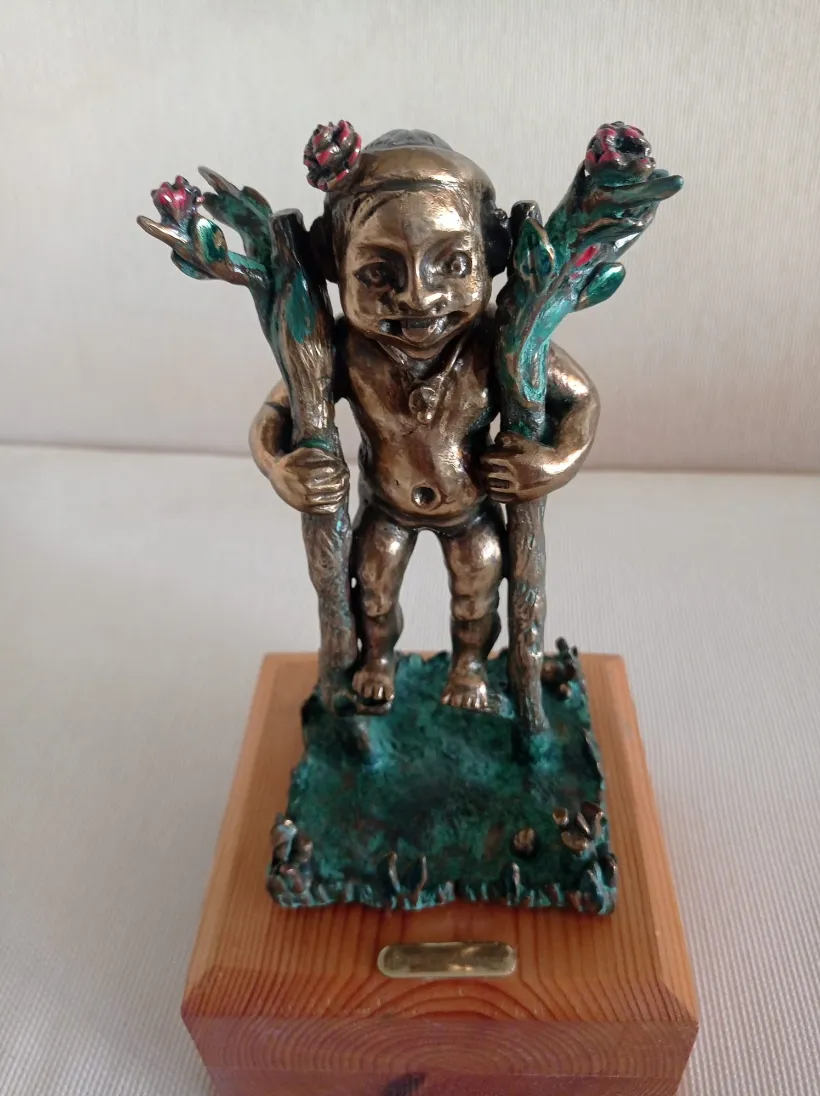
La primera conquistaAz első hódításThe First Conquest
La escultura evoca mi propia figura en la primera infancia, cuando apenas sabía caminar, pero ya quería trepar a todo. La niña que se sostiene entre dos árboles simboliza la curiosidad y la alegría del movimiento. A esa edad, el entorno todavía no es un obstáculo, sino un desafío por descubrir: algo que hay que tocar, probar y conquistar. La obra conserva, como recuerdo personal, ese impulso infantil instintivo y las primeras aventuras del desarrollo motor.
A szobor saját kisgyermekkori alakomat idézi meg abból az időből, amikor még alig tudtam járni, de már mindenre fel akartam mászni. A két fa között kapaszkodó gyermek a kíváncsiság és a mozgás örömének jelképe. Ebben az életkorban a környezet még nem akadály, hanem felfedezésre váró kihívás: valami, amit meg kell érinteni, ki kell próbálni és meg kell hódítani. A mű ezt az ösztönös gyermeki törekvést és a motorikus fejlődés első kalandjait őrzi személyes emlékként.
The sculpture evokes my own early childhood, when I could barely walk but already wanted to climb everything around me. The child holding on between two trees symbolizes curiosity and the joy of movement. At this age, the surrounding world is not yet an obstacle, but a challenge waiting to be explored: something to touch, try, and conquer. As a personal memory, the work preserves this instinctive childhood impulse and the first adventures of motor development.
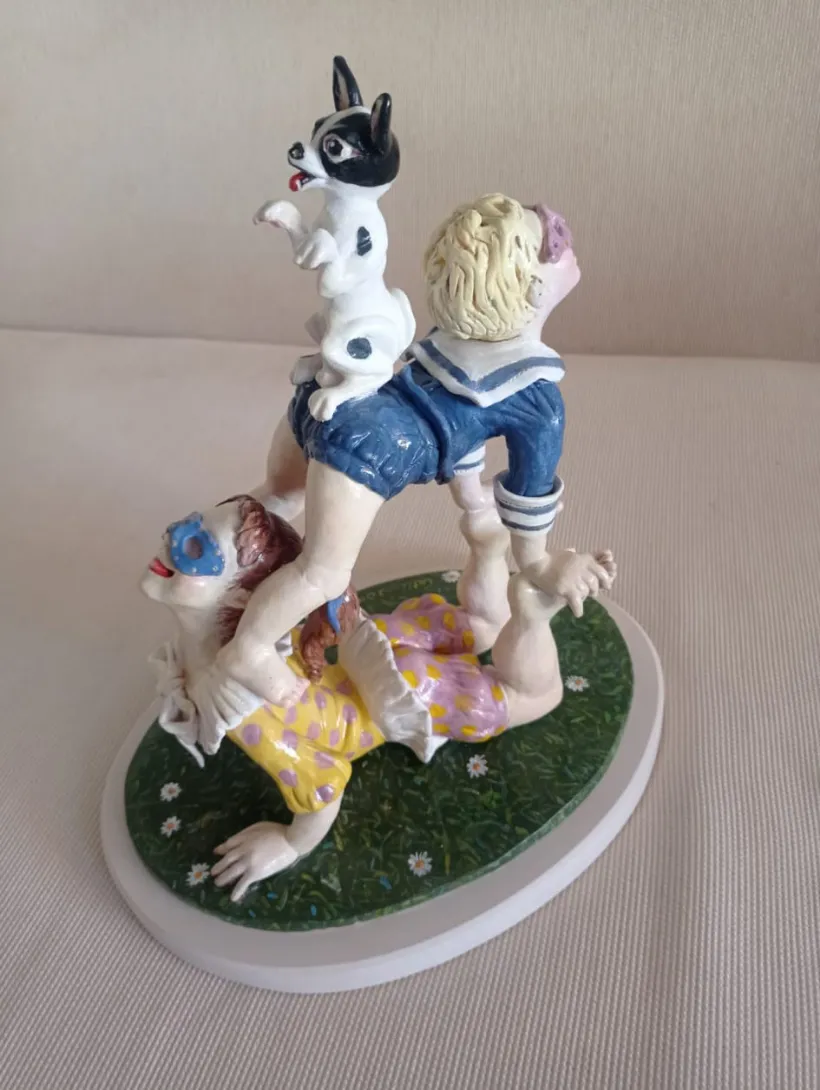
¡Juguemos al circo!Játsszunk cirkuszt!Let’s Play Circus!
El juego de roles es una parte importante de la imaginación infantil. Los niños inventan sus propias historias, personajes y reglas mientras experimentan de forma lúdica diferentes situaciones de la vida. En este circo espontáneo, los niños y el perro se convierten juntos en protagonistas de una actuación improvisada. Las máscaras, los equilibrios y las situaciones divertidas evocan la alegría del juego libre y la imaginación sin límites de la infancia.
A szerepjáték a gyermeki képzelet fontos része. A gyerekek saját történeteket, szerepeket és szabályokat találnak ki, miközben játékosan próbálják ki a világ különböző helyzeteit. Ebben a spontán cirkuszi játékban gyerekek és kutya együtt válnak egy rögtönzött előadás szereplőivé. A maszkok, az egyensúlyozás és a mókás helyzetek a szabad játék örömét és a gyermeki fantázia határtalanságát idézik.
Role-playing is an important part of a child’s imagination. Children invent their own stories, roles and rules while playfully exploring different situations in life. In this spontaneous circus game, the children and the dog become performers in an improvised show. The masks, balancing acts and playful situations evoke the joy of free play and the boundless imagination of childhood.
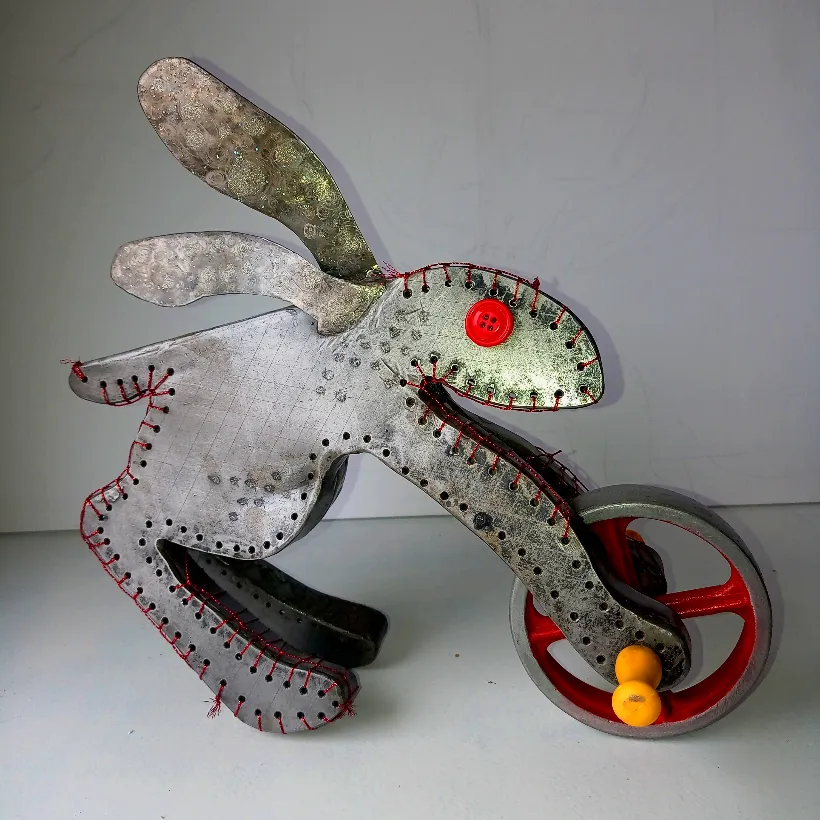
Un recurdo al hierroEgy visszaszerzett emlékműA memory of iron
Conejo realizado en chapa de hierro, cuyas piezas están unidas con hilo de seda mediante una costura que recuerda al punto de festón. La rueda es de aluminio y está pintada de rojo. La obra evoca el recuerdo de juguetes similares que hacía con mis propias manos durante mi infancia; destaca especialmente el contraste entre la dureza del hierro y la delicadeza de la costura, casi textil.
Vaslemezből készült nyuszi, amelynek elemei selyemszállal, pelenkaöltést idéző varrással vannak összeillesztve. A kereke alumíniumból készült és pirosra van festve. A mű a gyermekkoromban saját kezűleg készített, hasonló játékok emlékét őrzi; különösen fontos benne a kemény vas és a finom, szinte textilszerű varrás ellentéte.
A rabbit made of sheet iron, its pieces joined with silk thread using stitching reminiscent of blanket stitch. The wheel is made of aluminium and painted red. The work evokes memories of similar toys I made with my own hands during my childhood, highlighting the contrast between the hardness of the iron and the delicacy of the almost textile-like stitching.
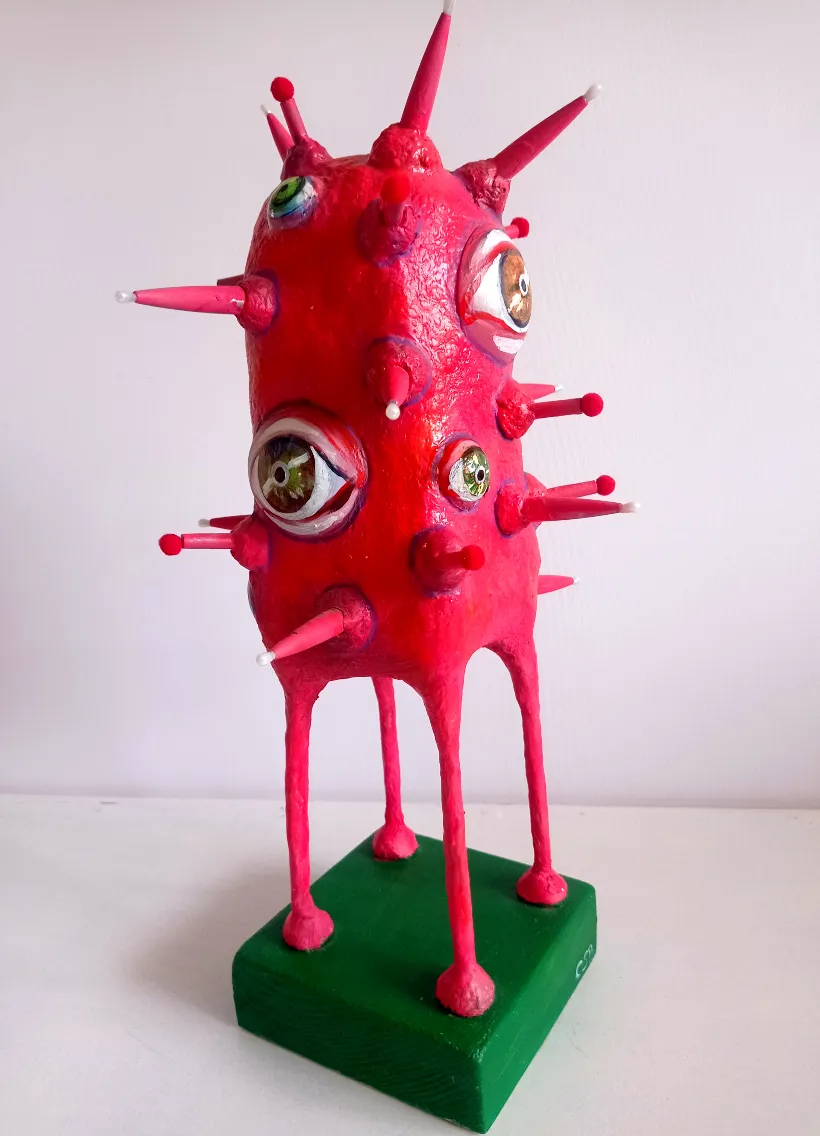
Cámara de vigilancia viralTérmegfigyelő kamera virússurveillance camera viral
La obra presenta el mundo de las cámaras de vigilancia como un ser vivo, una extraña criatura semejante a un virus. Sus cámaras miran en todas direcciones, como si se adaptaran continuamente a su entorno, adoptando nuevas formas para que nada pueda escapar a su mirada.
La denominación «virus» se utiliza en sentido metafórico: alude a la forma en que la vigilancia se extiende casi imperceptiblemente y ocupa cada vez más ámbitos de nuestra vida. Aunque la presencia de las cámaras suele justificarse por nuestra seguridad, llega un momento en que surge la pregunta: ¿dónde termina la protección y dónde comienza el control de nuestra vida privada?
La obra hace visible esta frontera incierta: la sensación de que, mientras se nos promete una mayor seguridad, resulta cada vez más difícil encontrar un espacio en el que podamos permanecer realmente sin ser observados.
A mű egy élő organizmusra, egy különös vírusra emlékeztető lényként jeleníti meg a megfigyelő kamerák világát. Kamerái minden irányba tekintenek, mintha folyamatosan alkalmazkodnának környezetükhöz, újabb és újabb formát öltve, hogy semmi ne kerülhesse el a figyelmüket.
A „vírus” elnevezés átvitt értelmű: arra a jelenségre utal, ahogyan a megfigyelés szinte észrevétlenül terjed, és mind több területét hálózza be az életünknek. Bár a kamerák jelenlétét gyakran a biztonságunkkal indokolják, egy ponton felmerül a kérdés: hol ér véget a védelem, és hol kezdődik a magánéletünk ellenőrzése?
A mű ezt a bizonytalan határvonalat teszi láthatóvá - azt az érzést, hogy miközben nagyobb biztonságot ígérnek nekünk, egyre nehezebb olyan helyet találni, ahol valóban megfigyelés nélkül maradhatunk.
The work presents the world of surveillance cameras as a living organism, a strange virus-like creature. Its cameras look in every direction, as if constantly adapting to their surroundings and taking on new forms so that nothing can escape their gaze.
The word “virus” is used metaphorically: it refers to the way surveillance spreads almost unnoticed, reaching into more and more areas of our lives. Although the presence of cameras is often justified in the name of our safety, at some point a question arises: where does protection end, and where does the monitoring of our private lives begin?
The work makes this uncertain boundary visible - the feeling that while we are promised greater security, it is becoming increasingly difficult to find a place where we can truly remain unobserved.
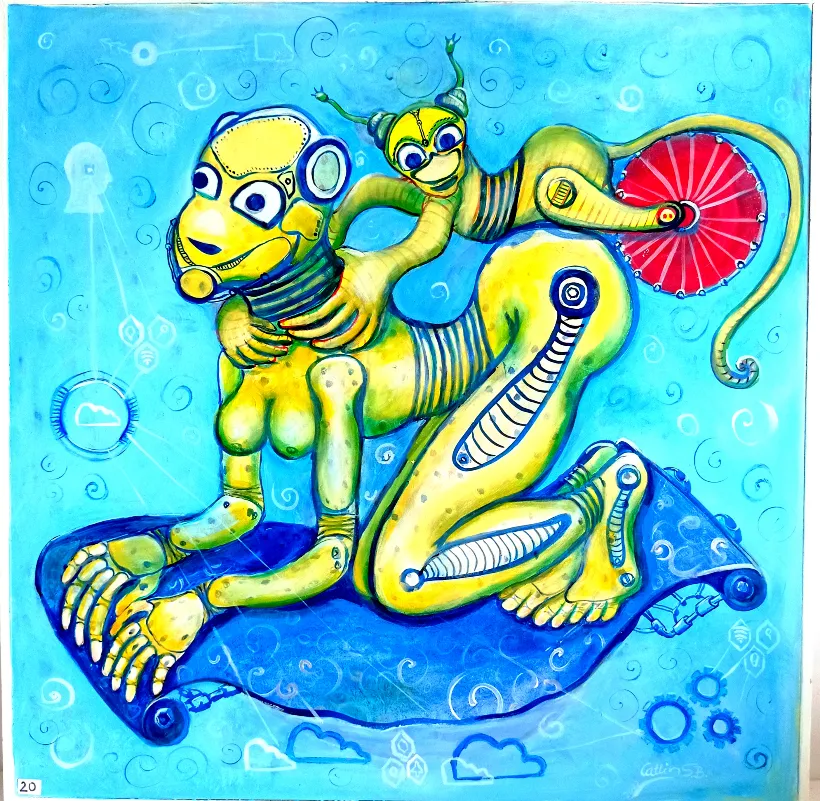
El cuenta de la mañanaA reggeli beszámolóThe morning account
Una visión imaginaria del futuro en la que el mundo de los cuentos se encuentra con una nueva realidad. Una figura humanoide femenina avanza a cuatro patas sobre una alfombra voladora, evocando las antiguas historias, pero ya perteneciendo a otro tiempo. Sobre su espalda lleva una pequeña criatura que recuerda a la vez a un niño y a un animal; sus patas traseras han sido sustituidas por ruedas. La obra imagina un futuro en el que los límites entre el ser humano, el animal y la máquina comienzan a desaparecer y surgen nuevas formas híbridas. A pesar de esta transformación, la escena conserva algo cercano, lúdico y afectuoso: un cuento del futuro en el que la fantasía de la infancia se mezcla con las posibilidades de un mundo todavía desconocido.
A jövő elképzelt képe, amelyben a mesék világa találkozik egy új valósággal. Egy női humanoid négykézláb halad egy repülő szőnyegen, amely a régi meséket idézi, mégis már egy másik korhoz tartozik. A hátán egy kis lényt visz, amely egyszerre emlékeztet gyermekre és állatra; hátsó lábait kerekek helyettesítik. A mű egy olyan jövőt képzel el, amelyben az ember, az állat és a gép közötti határok lassan elmosódnak, és új, hibrid lények jelennek meg. A jelenet mindeközben megőrzi játékos, kedves és szeretetteljes hangulatát: egy mese a jövőről, amelyben a gyermeki fantázia összekapcsolódik egy még ismeretlen világ lehetőségeivel.
An imagined vision of the future in which the world of fairy tales meets a new reality. A female humanoid figure moves on all fours on a flying carpet, recalling the old stories while already belonging to another age. On her back she carries a small creature that resembles both a child and an animal; its hind legs have been replaced by wheels. The work imagines a future in which the boundaries between humans, animals and machines begin to disappear, giving rise to new hybrid forms. Despite this transformation, the scene retains something warm, playful and affectionate: a tale of the future where childhood fantasy merges with the possibilities of a world still unknown.
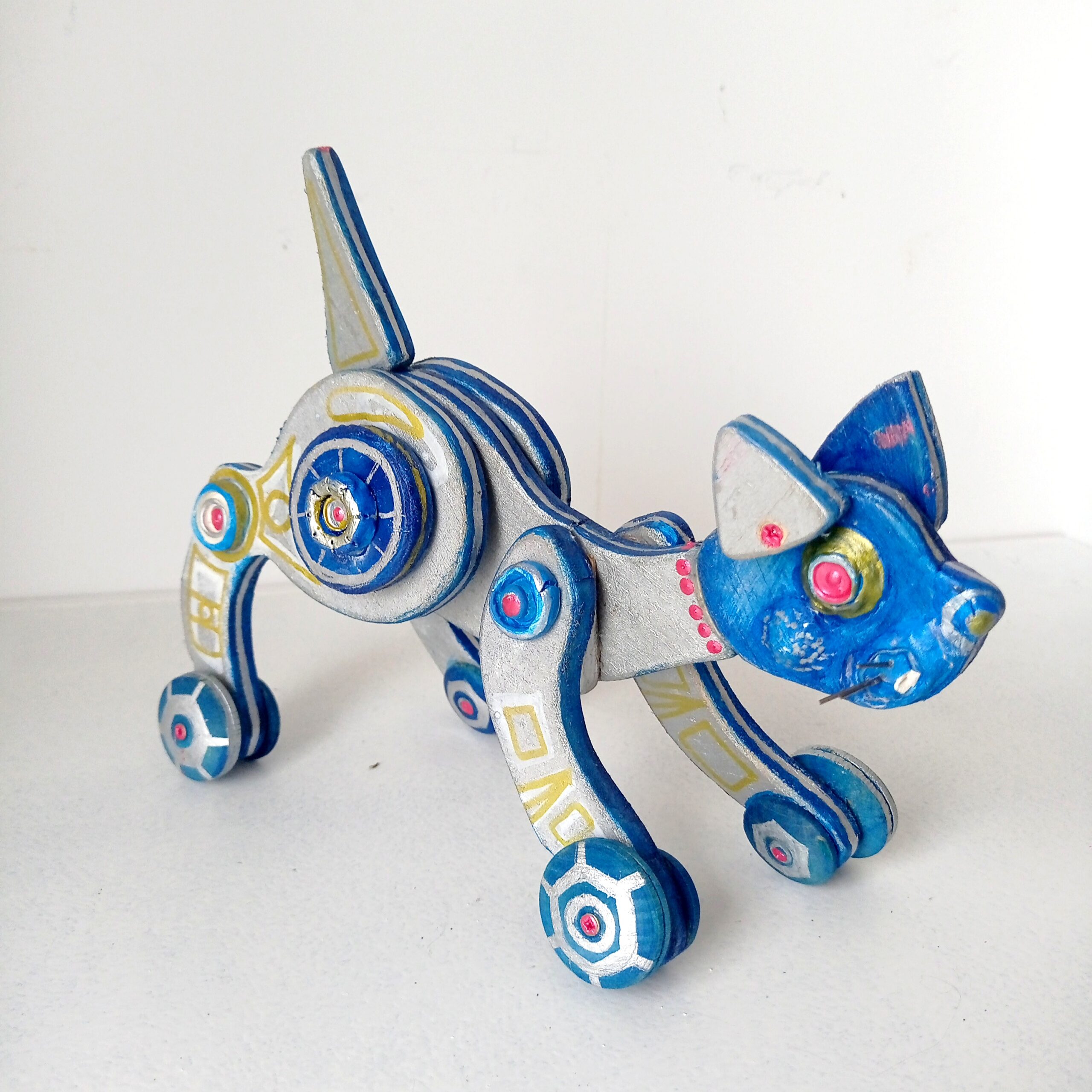
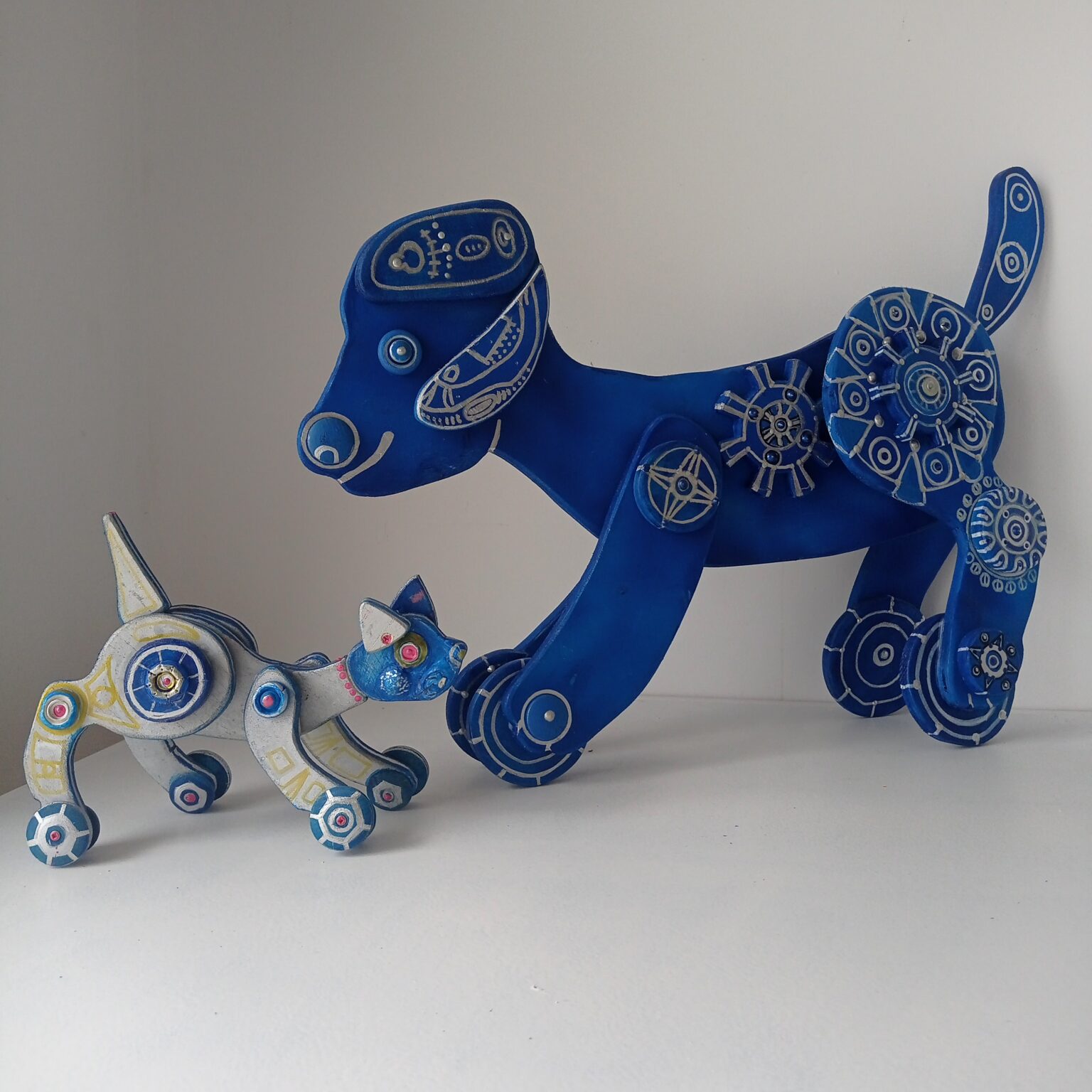
El mecanismo de la imaginación – gatoA képzelet mechanizmusa – macskaPainted wood
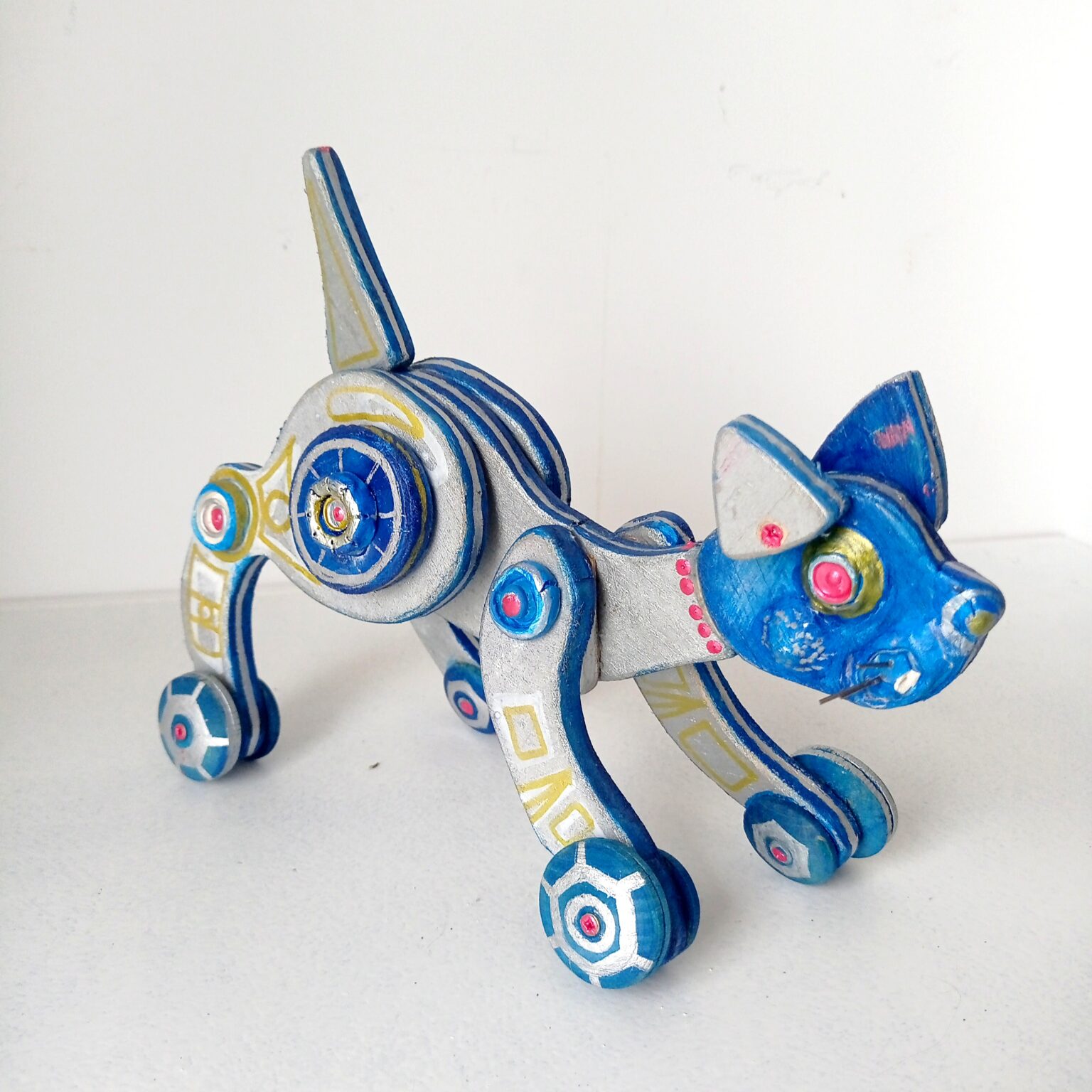
El mecanismo de la imaginación Esta obra evoca una época en la que la escasez de juguetes fabricados impulsaba al niño a recurrir a su propia imaginación. Las limitaciones económicas y la falta de juguetes disponibles se convertían así en un estímulo para la creatividad, el ingenio y la capacidad de crear: a partir de materiales sencillos y accesibles nacían nuevos juguetes y nuevas formas. La escultura rinde homenaje a esa creatividad infantil nacida de la carencia y a las posibilidades casi ilimitadas de la imaginación.
Ez a mű egy olyan korszakot idéz fel, amikor a gyártott játékok hiánya arra késztette a gyermeket, hogy saját képzeletére támaszkodjon. Az anyagi lehetőségek és a rendelkezésre álló játékok korlátozottsága így a kreativitás, a találékonyság és az alkotás ösztönzőjévé vált: egyszerű, kéznél lévő anyagokból új játékok és új formák születtek. A szobor ennek a hiányból születő gyermeki kreativitásnak és a fantázia szinte korlátlan lehetőségeinek állít emléket.
The Mechanism of Imagination This work evokes a time when the scarcity of manufactured toys encouraged children to rely on their own imagination. Limited financial means and the lack of available toys thus became a stimulus for creativity, ingenuity and the ability to create: simple, readily available materials were transformed into new toys and new forms. The sculpture pays tribute to this childhood creativity born out of scarcity and to the almost limitless possibilities of the imagination.
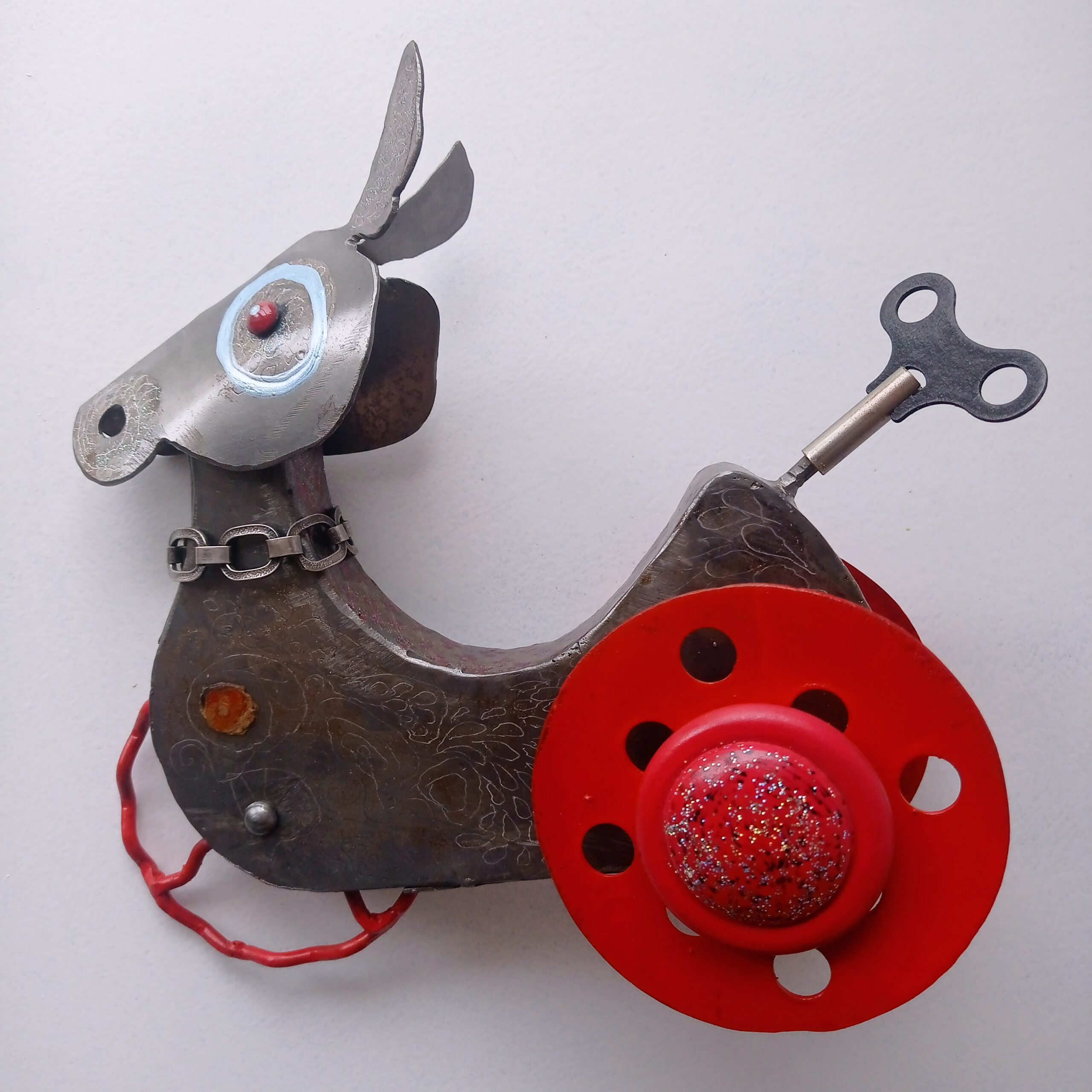
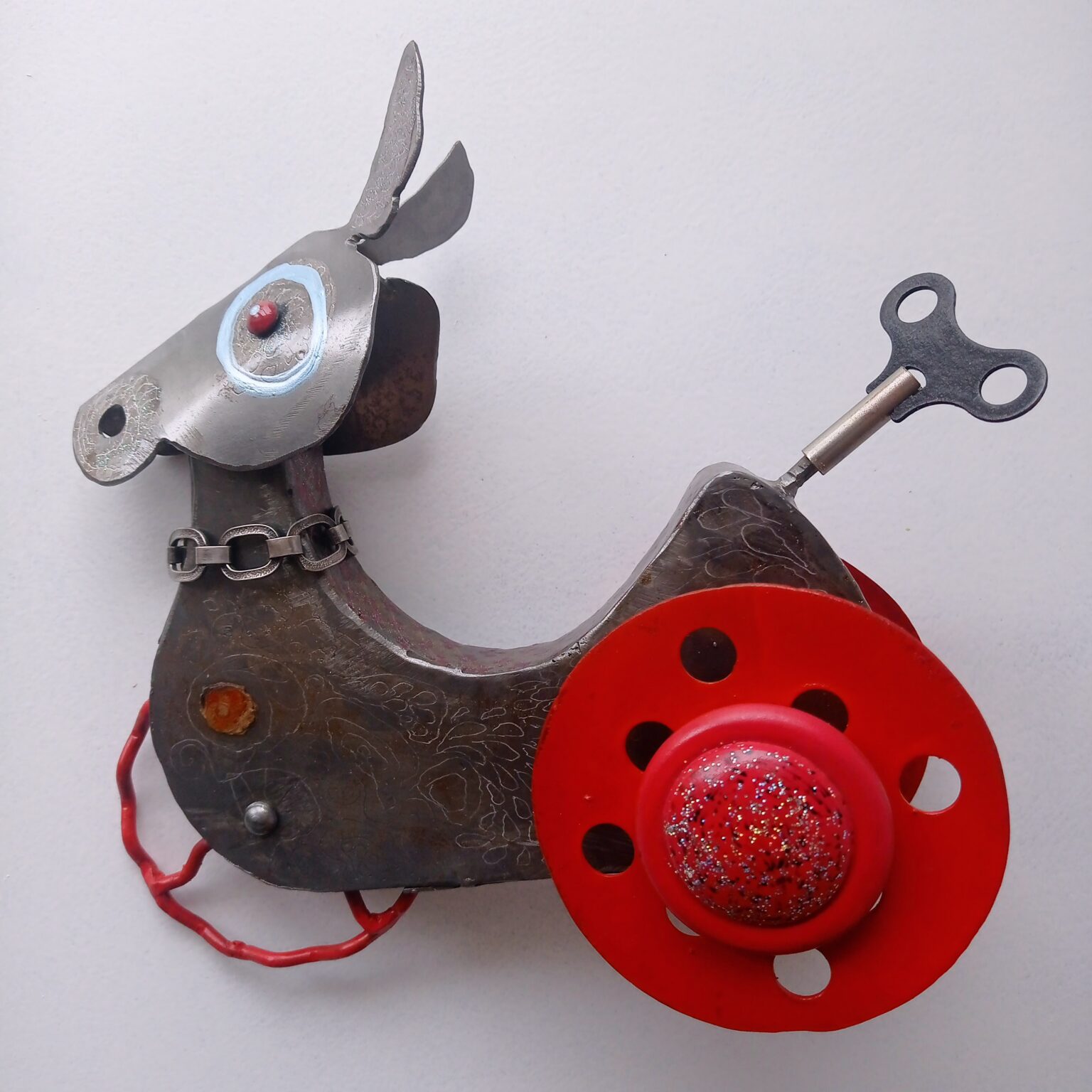
La llave del recuerdoA memória kulcsaThe Key of Memory
La obra nace del recuerdo de los juguetes fabricados a mano durante la infancia, cuando unas pocas piezas sencillas y la imaginación bastaban para crear una figura.
En lugar de cola, el animal de hierro lleva soldada la llave real de un antiguo juguete de cuerda. Esta solución lúdica remite tanto al funcionamiento de aquellos juguetes como a la imaginación infantil, capaz de convertir una pieza cotidiana en la cola de un animal.
La rueda roja es también un recuerdo recurrente de la infancia: en los juguetes antiguos, un pequeño detalle rojo intenso —una rueda, un lazo, un zapato u otro elemento— atraía a menudo la mirada del niño. La llave y la rueda roja se convierten así en motivos personales del juego y de la memoria infantil.
A mű a gyerekkor saját készítésű, összefabrikált játékainak emlékéből született, amikor néhány egyszerű darabból és a képzelet segítségével készült el egy-egy figura.
A vasból készült állat farkának helyére egy régi felhúzható játék valódi kulcsa van ráhegesztve. Ez a játékos megoldás egyszerre utal a felhúzható játékok működésére és arra a gyermeki képzeletre, amely egy hétköznapi alkatrészből akár egy állat farkát is képes megteremteni.
A piros kerék szintén visszatérő gyermekkori emlék: a régi játékokon gyakran egy-egy élénkpiros részlet – kerék, masni, cipő vagy más apró elem – ragadta meg a gyermek figyelmét. A kulcs és a piros kerék így a gyermekkori játék és az emlékezés személyes motívumaivá válnak.
The work grew out of memories of handmade childhood toys, when a few simple pieces and imagination were enough to create a figure.
In place of a tail, the iron animal has the actual key from an old wind-up toy welded onto it. This playful solution refers both to the mechanism of those toys and to a child's imagination, capable of turning an everyday component into an animal's tail.
The red wheel is another recurring childhood memory: old toys often featured a small, vivid red detail — a wheel, bow, shoe or other element — that caught a child's attention. The key and the red wheel thus become personal motifs of childhood play and memory.
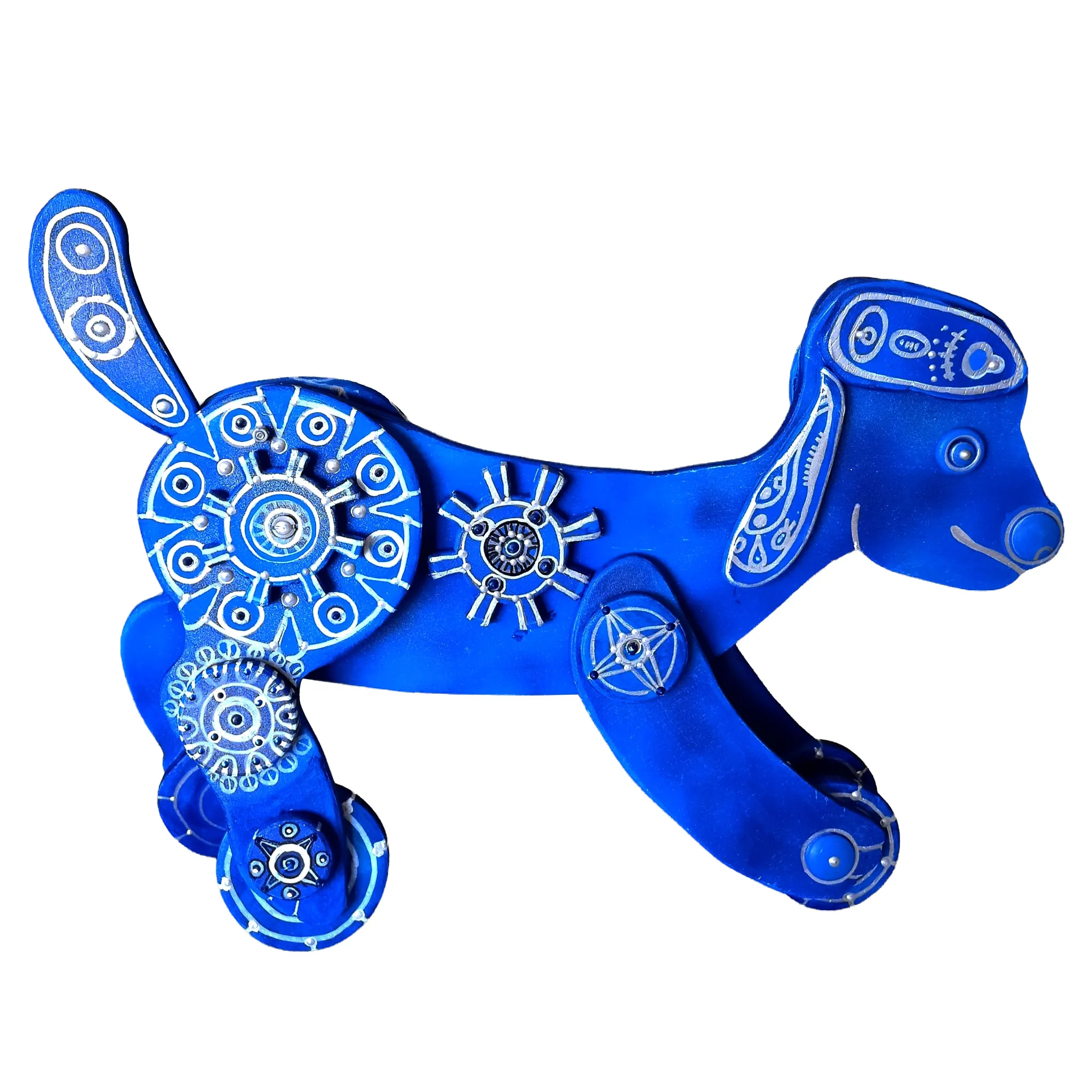
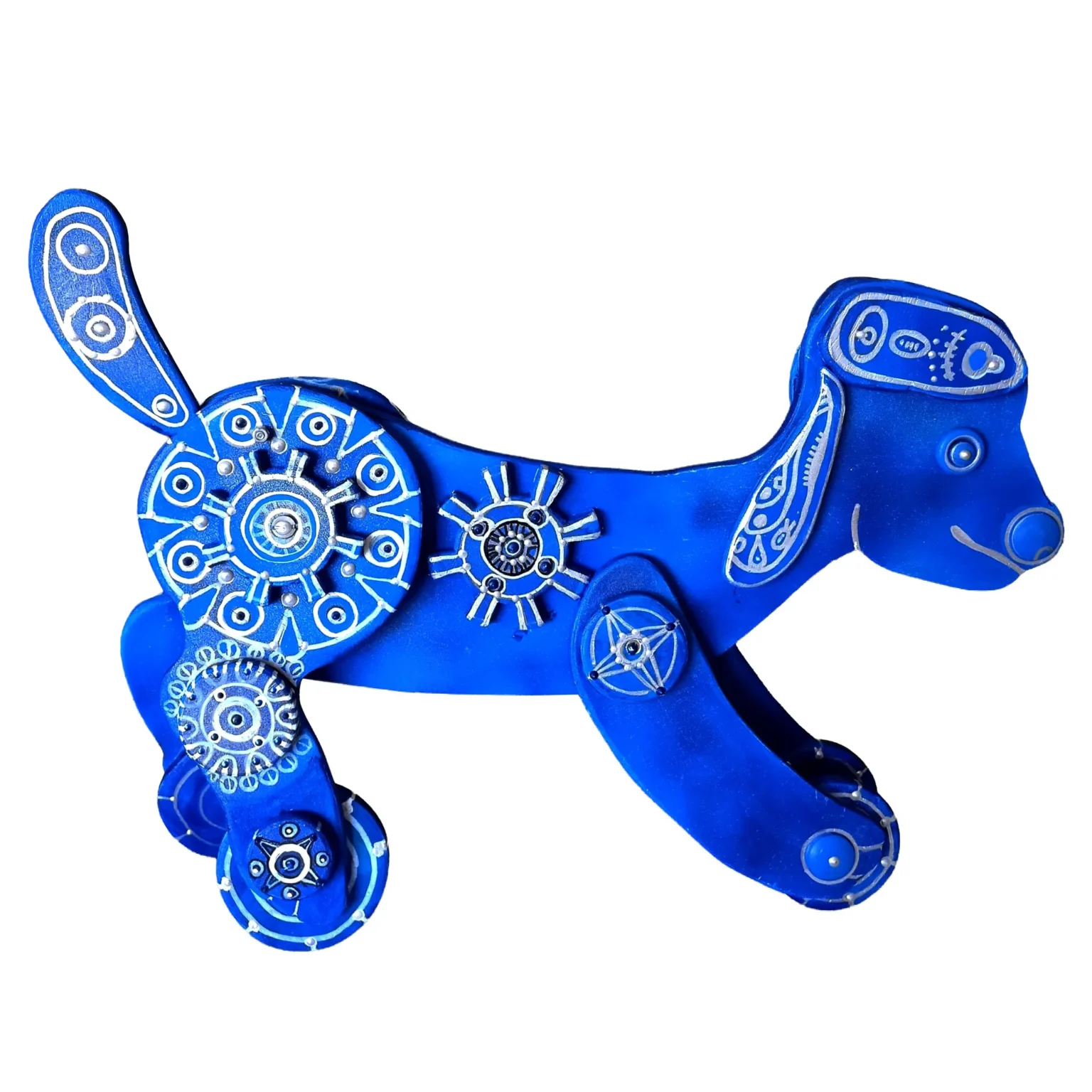
El mecanismo de la imaginación – perroA képzelet mechanizmusa – kutyaThe Mechanism of Imagination – Dog
El mecanismo de la imaginación Esta obra evoca una época en la que la escasez de juguetes fabricados impulsaba al niño a recurrir a su propia imaginación. Las limitaciones económicas y la falta de juguetes disponibles se convertían así en un estímulo para la creatividad, el ingenio y la capacidad de crear: a partir de materiales sencillos y accesibles nacían nuevos juguetes y nuevas formas. La escultura rinde homenaje a esa creatividad infantil nacida de la carencia y a las posibilidades casi ilimitadas de la imaginación.
Ez a mű egy olyan korszakot idéz fel, amikor a gyártott játékok hiánya arra késztette a gyermeket, hogy saját képzeletére támaszkodjon. Az anyagi lehetőségek és a rendelkezésre álló játékok korlátozottsága így a kreativitás, a találékonyság és az alkotás ösztönzőjévé vált: egyszerű, kéznél lévő anyagokból új játékok és új formák születtek. A szobor ennek a hiányból születő gyermeki kreativitásnak és a fantázia szinte korlátlan lehetőségeinek állít emléket.
The Mechanism of Imagination This work evokes a time when the scarcity of manufactured toys encouraged children to rely on their own imagination. Limited financial means and the lack of available toys thus became a stimulus for creativity, ingenuity and the ability to create: simple, readily available materials were transformed into new toys and new forms. The sculpture pays tribute to this childhood creativity born out of scarcity and to the almost limitless possibilities of the imagination.
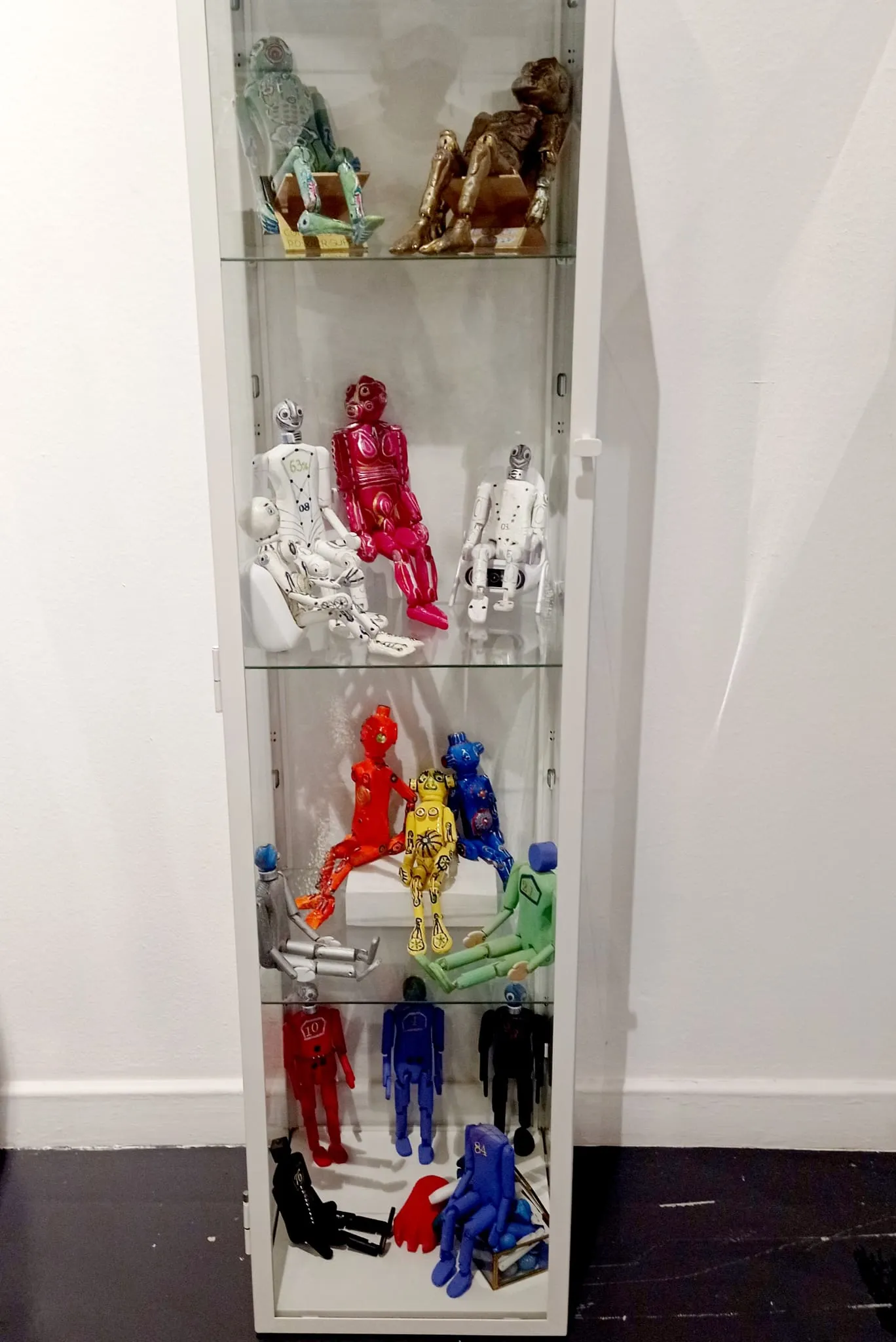
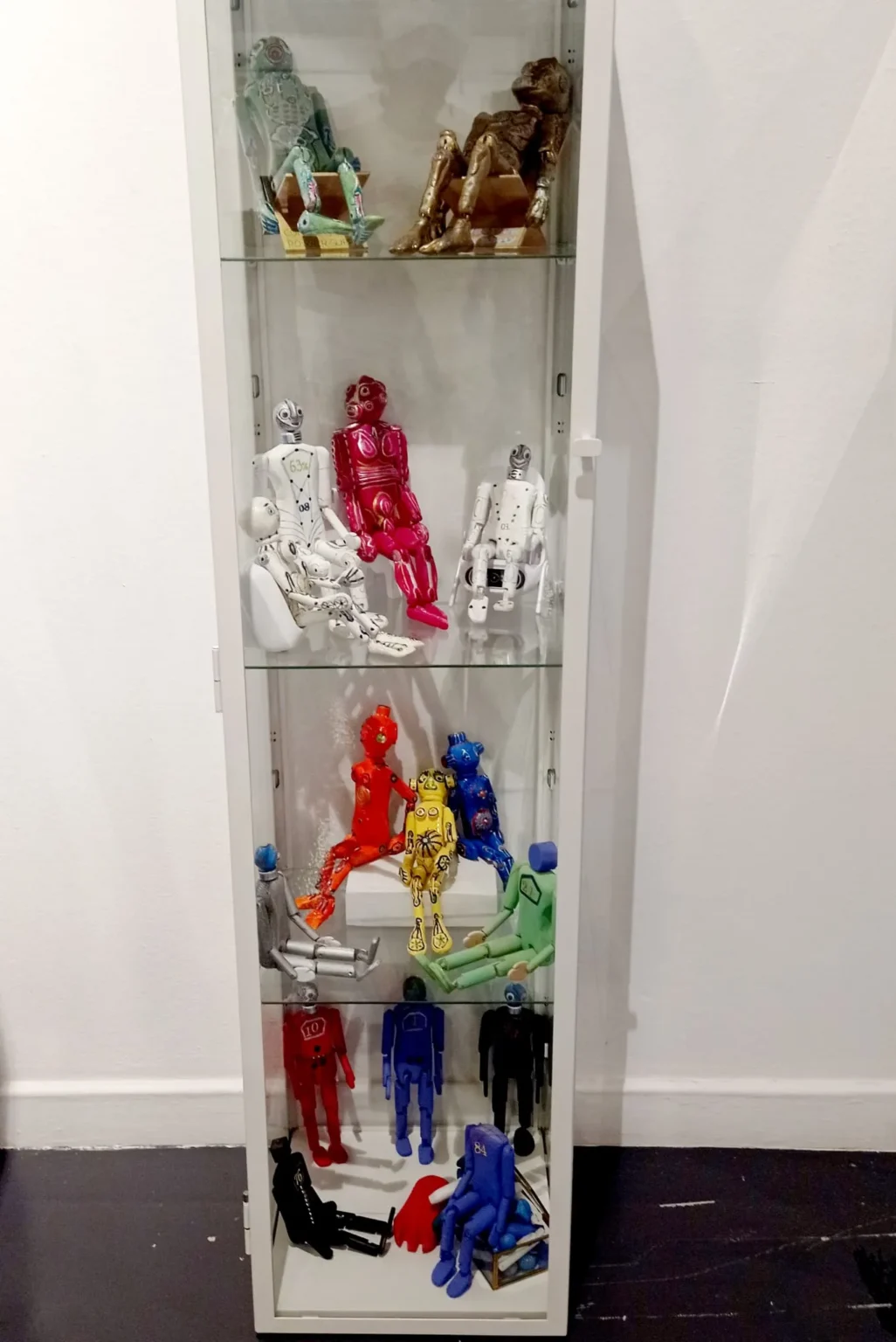
Vida en la casa de los robotsÉlet a robotházbanLife in the Robot House
Una casa de robots de varios pisos de un futuro imaginado, donde los robots ya viven sus propias pequeñas vidas. Descansan, se recargan y se encuentran, mientras que en el nivel inferior hay espacio para los habitantes que esperan ser reparados o recibir nuevas piezas. La instalación, semejante a una caja, crea un pequeño mundo independiente a través del cual podemos asomarnos a la vida cotidiana de un posible futuro.
Egy elképzelt jövő emeletes robotháza, ahol a robotok már saját kis életüket élik. Pihennek, feltöltődnek, találkoznak, míg az alsó szinten a javításra és új alkatrészekre váró lakók kapnak helyet. A dobozszerű installáció egy önálló kis világ, amelyen keresztül bepillanthatunk egy lehetséges jövő hétköznapjaiba.
A multi-storey robot house from an imagined future, where robots already live their own little lives. They rest, recharge and meet one another, while the lower level provides a place for inhabitants waiting to be repaired or fitted with new parts. The box-like installation creates a small world of its own, offering us a glimpse into the everyday life of a possible future.
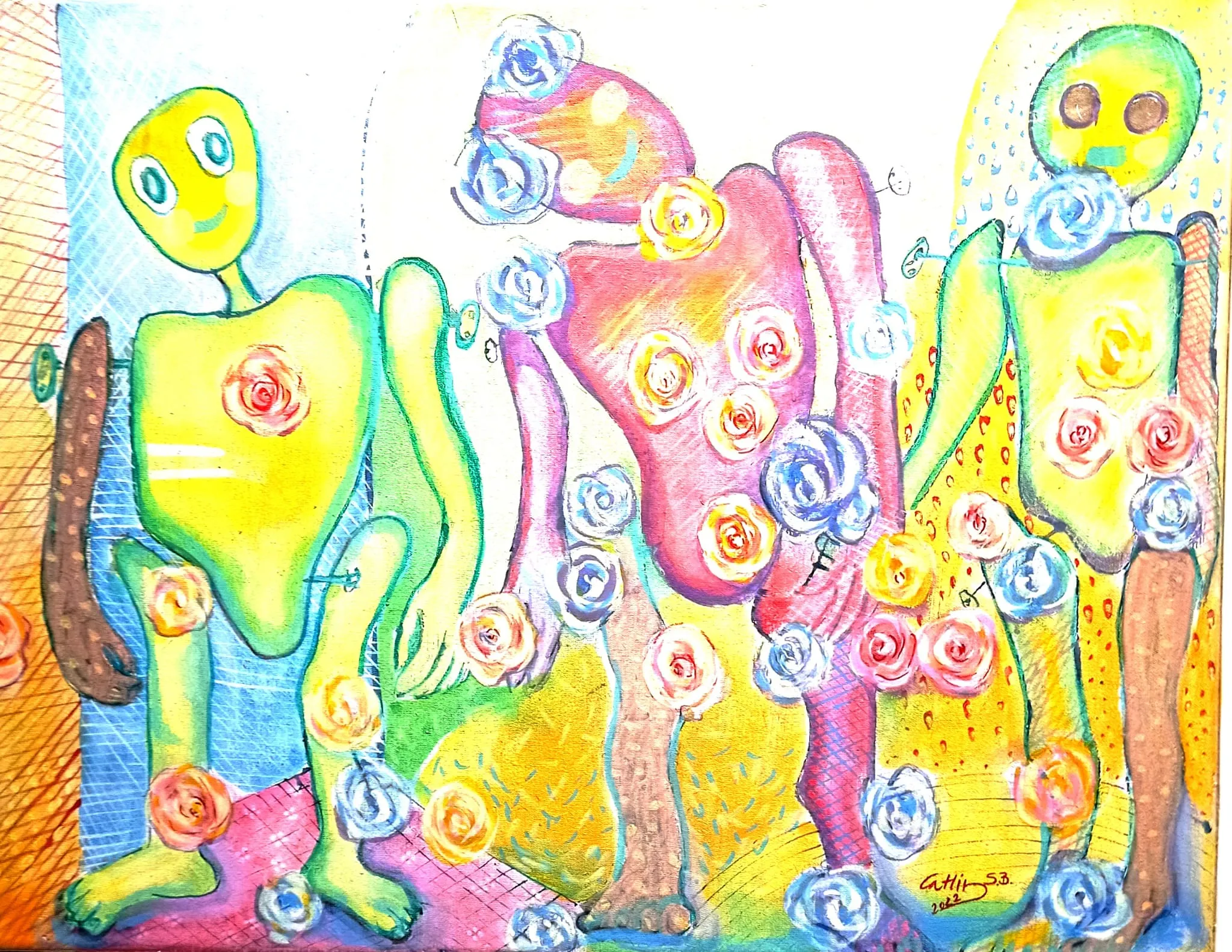
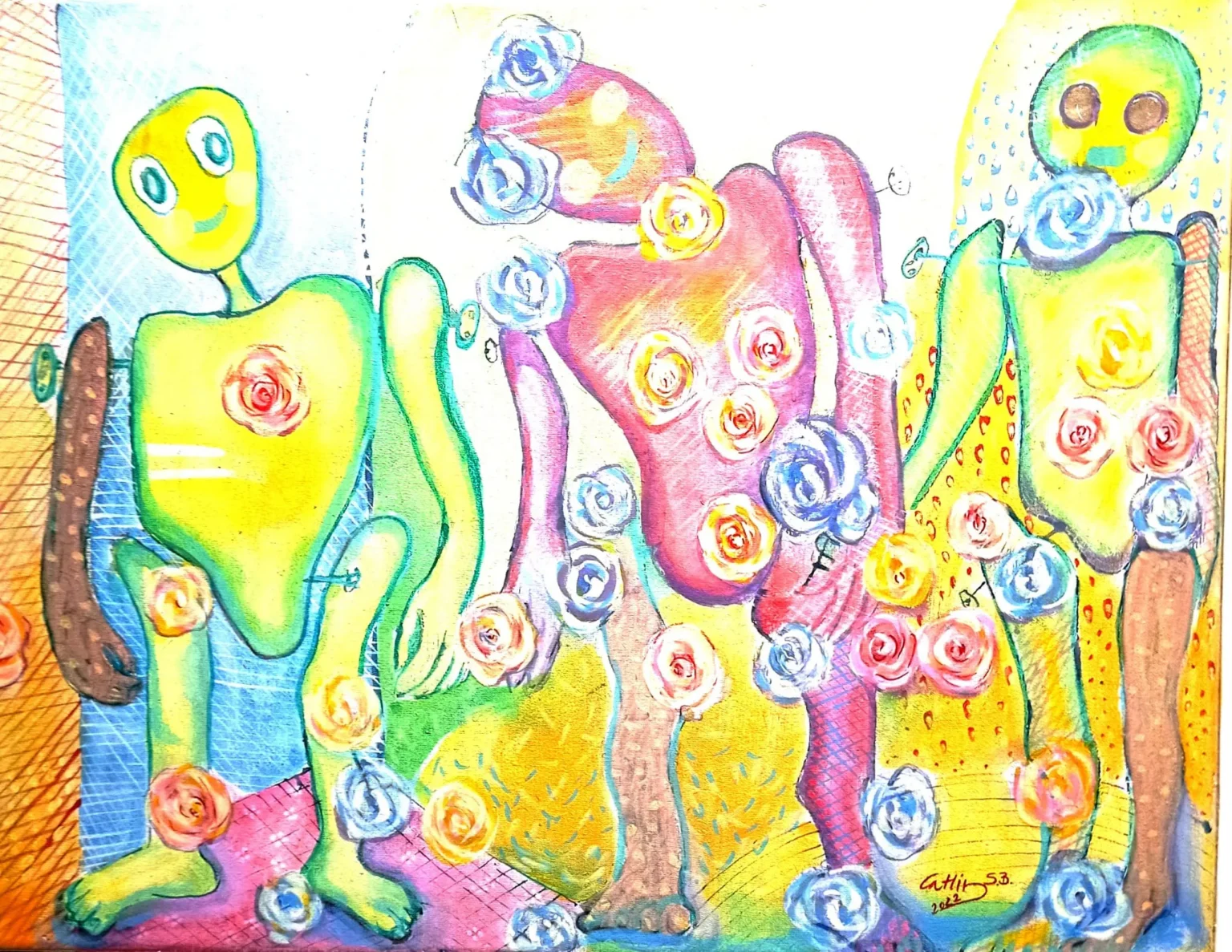
Infancia de color de rosaRózsás gyermekkorA rosy childhood
La expresión «infancia de color de rosa» evoca el recuerdo embellecido y luminoso de los años de la niñez. Las sencillas figuras infantiles, inspiradas en muñecas de trapo, y las rosas dan vida a esta imagen verbal: el pasado tal como lo conserva la memoria, fresco, lúdico y entrelazado con rosas.
A „rózsás gyermekkor” régi kifejezés a gyermekévek megszépült, derűs emlékét idézi. A festmény egyszerű, rongybabákat idéző gyermekfigurái és a rózsák ezt a nyelvi képet keltik életre: a múltat, ahogyan az emlékezet őrzi üdén, játékosan, rózsákkal átszőve.
The expression “a rosy childhood” evokes an idealized, bright memory of childhood years. The simple childlike figures, reminiscent of handmade rag dolls, and the roses bring this verbal image to life: the past as memory preserves it - fresh, playful, and intertwined with roses.
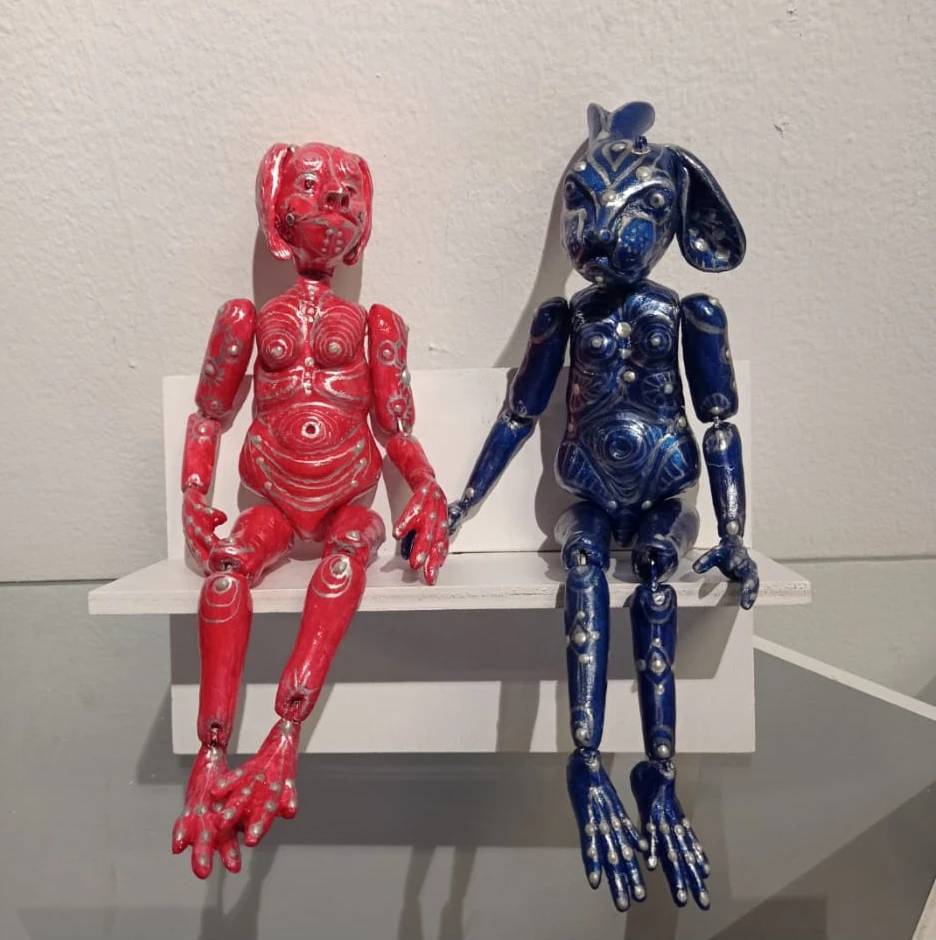
Los compañeros de juego del futuroA jövő játszótársaiThe Playmates of the Future
Los rasgos del ser humano, del animal y del robot se unen en unas singulares figuras híbridas articuladas. Son compañeros de juego de un futuro imaginado, en el que las figuras tradicionales pueden dar paso a nuevos y extraños seres. ¿Con qué jugarán los niños del futuro?
Az ember, az állat és a robot jegyei különös, mozgatható hibrid figurákban egyesülnek. Egy elképzelt jövő játszótársai, ahol a megszokott játékfigurák helyét új, különös lények vehetik át. Vajon mivel játszanak majd a jövő gyermekei?
Human, animal and robotic features merge in these unusual articulated hybrid figures. They are playmates from an imagined future, where familiar toy figures may give way to new and strange beings. What will the children of the future play with?
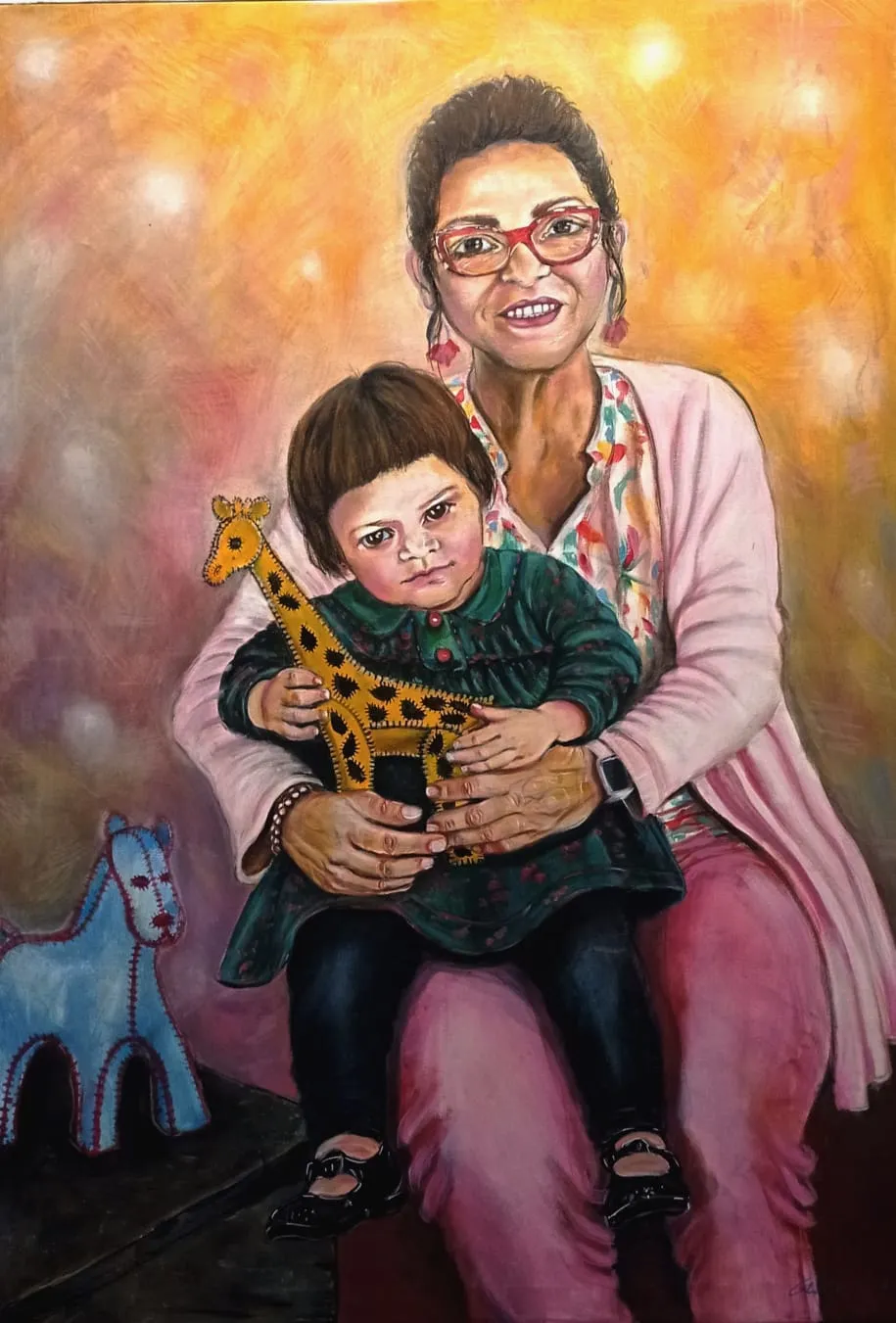
En el abrazo de mí mismaÖnmagam ölelésébenIn My Own Embrace
El cuadro titulado «En el abrazo de mi yo» constituye el punto de partida conceptual de la exposición: una mirada personal hacia la infancia, desde donde parte el hilo de la memoria para, tras recorrer un largo camino, regresar al presente. En la imagen, mi yo actual abraza a ese niño de un año y medio que una vez fui yo. En ese niño curioso, de ojos muy abiertos, ya se adivina el germen de la creatividad y el deseo de conocer el mundo. Sostiene en la mano un jirafa de peluche y, junto a él, se ve un perro de peluche sobre una caja de madera. Los juguetes y la caja son símbolos importantes de mi infancia y del mundo de la posguerra. Nací en una época devastada y azotada por la pobreza, en la que casi nada funcionaba y rara vez se podían comprar juguetes ya fabricados. Las familias solían fabricarlos ellas mismas con ropa vieja, trapos y otros materiales que les sobraban. La jirafa y el perro evocan ese mundo. Mi creatividad nació de la carencia: de la necesidad de sustituir con algo lo que no estaba disponible. La imaginación y el deseo de crear se convirtieron ya en mi infancia en una respuesta natural a la escasez. Por eso, estos objetos no son solo recuerdos, sino también símbolos de esa fuerza creativa que me ha acompañado toda mi vida. El cofre es un motivo recurrente en mi arte. Aparece como un lugar de recuerdos, objetos conservados y secretos, especialmente en mis esculturas de cajas y en mis instalaciones. El pasado y el presente están unidos por un hilo rojo, como símbolo del hilo de Ariadna. Este hilo guía el arco conceptual de la exposición: desde el recuerdo personal, pasando por el juego, el ser humano y las cuestiones del mundo cambiante, hasta volver al punto de partida. El niño que una vez fui y la persona que soy hoy son dos puntos de la misma historia. El círculo se cierra: en el abrazo de mí misma.
Az Önmagam ölelésében című festmény a kiállítás gondolati kiindulópontja: személyes visszatekintés a gyermekkorba, ahonnan az emlékezés fonala elindul, majd hosszú utat bejárva visszatér a jelenbe. A képen a jelenlegi önmagam öleli azt a másfél éves gyermeket, aki egykor én voltam. A kíváncsi, tágra nyílt szemű gyermekben már felismerhető a kreativitás kezdete és a világ megismerésének vágya. Kezében varrott zsiráfot tart, mellette egy varrott kutya látható egy faládán. A játékok és a láda gyermekkorom, valamint a háború utáni világ fontos jelképei. Egy lerombolt, szegénységgel sújtott korszakban születtem, amikor alig működött valami, és kész gyermekjátékokat csak ritkán lehetett vásárolni. A családok gyakran maguk készítették el őket régi ruhákból, rongyokból és más megmaradt anyagokból. A zsiráf és a kutya ezt a világot idézi fel. Kreativitásom a hiányból született: abból a szükségből, hogy ami nem állt rendelkezésre, azt valamivel helyettesíteni kellett. A képzelet és a teremtés vágya már gyermekkoromban természetes válasszá vált a szűkösségre. Ezért ezek a tárgyak nem csupán emlékek, hanem annak a kreatív erőnek a szimbólumai is, amely egész életemben elkísért. A láda visszatérő motívum művészetemben. Az emlékek, a megőrzött tárgyak és a titkok helyeként jelenik meg, különösen dobozszobraimban és installációimban. A múltat és a jelent vörös fonal kapcsolja össze, Ariadné fonalának jelképeként. Ez a fonal vezeti végig a kiállítás gondolati ívét: a személyes emlékezéstől a játék, az ember és a változó világ kérdésein át vissza a kiindulóponthoz. A gyermek, aki egykor én voltam, és az ember, aki ma vagyok, ugyanannak a történetnek két pontja. A kör bezárul: önmagam ölelésében.
The painting In My Own Embrace is the conceptual starting point of the exhibition: a personal look back at childhood, from which the thread of memory begins and, after travelling a long path, returns to the present. In the painting, my present self embraces the child of about eighteen months that I once was. In this curious, wide-eyed child, the beginnings of creativity and the desire to discover the world can already be recognised. She holds a hand-sewn giraffe, while beside her a hand-sewn dog rests on a wooden chest. The toys and the chest are important symbols of my childhood and of the post-war world. I was born into a devastated period marked by poverty, when very little functioned normally and ready-made children's toys were rarely available to buy. Families often made them themselves from old clothes, scraps of fabric and other remaining materials. The giraffe and the dog evoke that world. My creativity was born out of scarcity: from the need to replace, through imagination, what was not available. The desire to imagine and create became a natural response to limitation from my earliest childhood. These objects are therefore not merely memories, but also symbols of the creative force that has accompanied me throughout my life. The chest is a recurring motif in my art. It appears as a place for memories, preserved objects and secrets, especially in my box sculptures and installations. A red thread connects past and present, as a symbol of Ariadne's thread. It guides the conceptual arc of the exhibition: from personal memory, through questions of play, humanity and a changing world, and finally back to the point of departure. The child I once was and the person I am today are two points in the same story. The circle closes: in my own embrace.
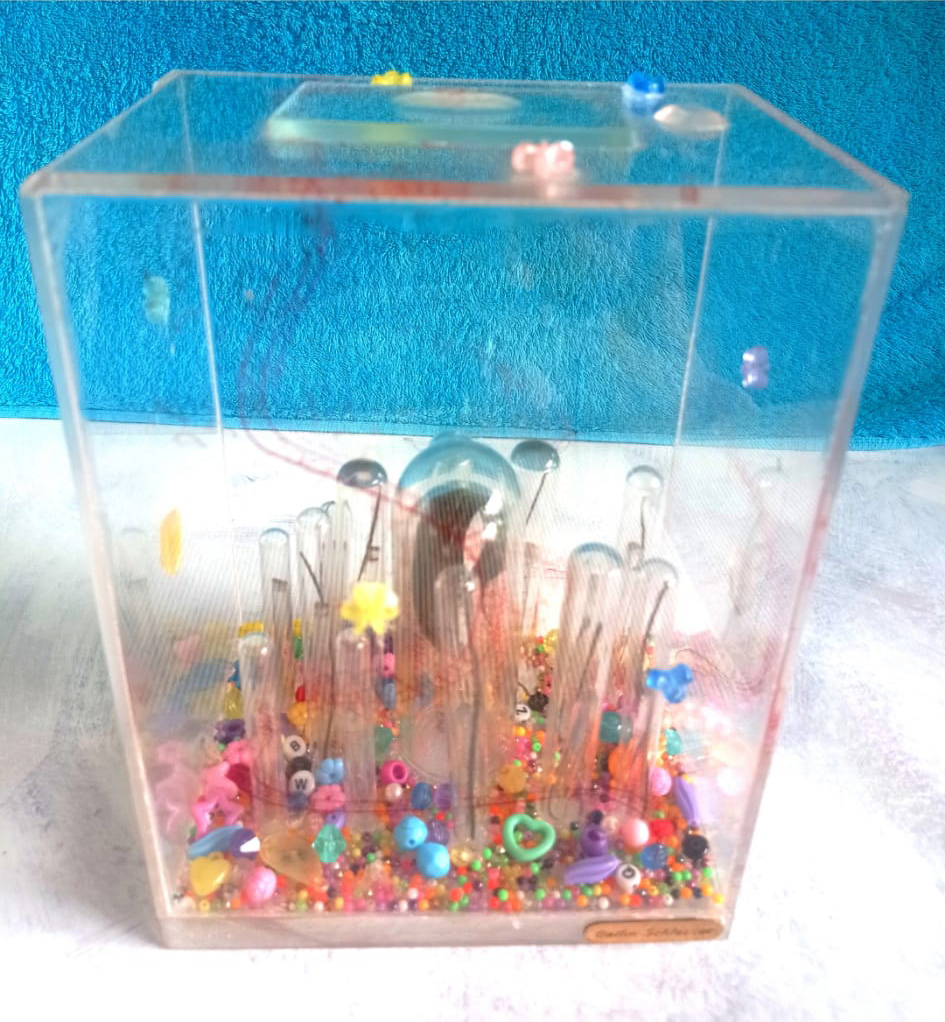
Cápsula del tiempo cósmica - Mensaje a los niños del futuroKozmikus időkapszula - Üzenet a jövő gyermekeinekCosmic Time Capsule - A Message to the Children of the Future
La obra fue creada en el marco de una iniciativa internacional financiada por Japón, en la que fueron invitadas 360 mujeres artistas a realizar una obra bajo el tema “Mensaje a los niños del futuro en el universo”. La idea de la artista parte de los antiguos mensajes introducidos en una botella y lanzados al mar, a la espera de que alguien, quizá mucho tiempo después, los encontrara. En este caso, la caja se convierte simbólicamente en una cápsula destinada al universo: un mensaje enviado hacia un futuro desconocido, dirigido a los niños que algún día podrían descubrirlo. Dentro de la caja transparente, pequeños tubos de vidrio protegen los mensajes. En ellos se conservan delicados filamentos de plumas de pavo real y diminutas varillas en las que la artista escribió palabras que considera esenciales para las futuras generaciones: amor, confianza, perdón, respeto y otros valores fundamentales para el ser humano. En el centro se encuentra el “ojo” de una pluma de pavo real. Para la artista, el pavo real es una de las aves más bellas de la Tierra, fascinante cuando despliega su extraordinario plumaje. Su presencia simboliza la belleza de la naturaleza y aquello que nuestra generación debería preservar y transmitir a quienes vendrán después. La base de la caja contiene pequeñas cuentas de colores, flores, letras y diminutos objetos que evocan el mundo de la infancia y del juego. La obra, sin embargo, guarda otra sorpresa. En la parte superior hay un elemento óptico a través del cual todo el interior se transforma. Las pequeñas formas y los colores aparecen convertidos en esferas luminosas, semejantes a las burbujas de jabón que hacen los niños. Este cambio de perspectiva forma parte esencial de la obra: un mismo mundo puede mostrarse de manera completamente distinta según desde dónde y cómo lo observemos. La caja es al mismo tiempo cápsula del tiempo, objeto de memoria y mensaje. Protege, en varias capas, aquello que la artista desea enviar hacia el futuro: un fragmento de la belleza de la naturaleza, la imaginación de la infancia y palabras sencillas que quizá, incluso dentro de siglos, sigan siendo indispensables para la humanidad. Un mensaje hacia un futuro desconocido sobre aquello que, como seres humanos, nunca deberíamos perder.
A mű egy japán finanszírozású nemzetközi kezdeményezés keretében született, amelyben 360 női alkotót hívtak meg arra, hogy az „Üzenet a jövő gyermekeinek az univerzumba” témájára készítsenek egy művet. Az alkotó gondolata a régi, tengerbe dobott palackpostából indult ki: az ember egy üvegbe zárta az üzenetét, majd útjára bocsátotta abban a reményben, hogy talán egyszer, akár sok év múlva, valaki megtalálja. Ebben a műben az átlátszó doboz jelképesen az univerzumba küldött kapszulává válik: egy ismeretlen jövőbe elindított üzenetté, amelyet a jövő gyermekei számára őriz. A doboz belsejében apró üvegcsövek védik az üzeneteket. Pávatoll finom szálai és kis rudacskák találhatók bennük, amelyekre az alkotó olyan szavakat írt, amelyeket a következő nemzedékek számára is nélkülözhetetlennek tart: szeretet, bizalom, megbocsátás, tisztelet, valamint más alapvető emberi értékek. A kompozíció középpontjában a pávatoll „szeme” található. Az alkotó számára a páva a Föld egyik legszebb madara, különösen akkor, amikor széttárja lenyűgöző tollazatát. A műben a természet szépségét és mindazt jelképezi, amit a jelen nemzedéknek érdemes megőriznie és továbbadnia azoknak, akik utánunk következnek. A doboz alját színes gyöngyök, apró virágok, betűk és miniatűr, játékokat idéző tárgyak töltik meg, felidézve a gyermekkor színes és játékos világát. A mű egy további optikai meglepetést is rejt. A doboz tetején elhelyezett optikai elemen keresztül nézve a belső világ átalakul: az apró tárgyak és színek fénylő gömbökként jelennek meg, akár a gyermekek által fújt szappanbuborékok. Ez a nézőpontváltás a mű egyik lényeges gondolata: ugyanaz a világ egészen másképp mutatkozhat meg attól függően, honnan és hogyan tekintünk rá. A doboz egyszerre időkapszula, emléktár és üzenet. Többszörös védelemben őrzi mindazt, amit az alkotó tovább szeretne küldeni a jövőbe: a természet szépségének egy darabját, a gyermekkor képzeletét és azokat az egyszerű emberi szavakat, amelyek talán évszázadok múlva is nélkülözhetetlenek lesznek. Üzenet egy ismeretlen jövőbe arról, amit emberként soha nem lenne szabad elveszítenünk.
The work was created as part of an international initiative funded by Japan, in which 360 women artists were invited to make a work around the theme “A Message to the Children of the Future in the Universe.” The artist’s idea grew from the old tradition of placing a message inside a bottle and casting it into the sea, hoping that someone, perhaps many years later, would eventually find it. Here, the transparent box becomes a symbolic capsule intended for the universe: a message sent into an unknown future and addressed to the children who may one day discover it. Inside the transparent box, small glass tubes protect the messages. They contain delicate strands of peacock feathers and tiny rods on which the artist inscribed words she considers essential for future generations: love, trust, forgiveness, respect, and other fundamental human values. At the centre is the “eye” of a peacock feather. For the artist, the peacock is one of the most beautiful birds on Earth, especially when it fans out its extraordinary plumage. Here it represents the beauty of nature and that which our generation should preserve and pass on to those who come after us. The bottom of the box is filled with colourful beads, tiny flowers, letters and miniature objects that evoke childhood and play. The work also contains an optical surprise. Through an element placed on the top of the box, the interior is transformed. The tiny objects and colours become luminous spheres, reminiscent of the soap bubbles blown by children. This change of perspective is an essential part of the work: the same world can appear completely different depending on where and how we look at it. The box is simultaneously a time capsule, a vessel of memory and a message. Within its multiple layers of protection, it preserves what the artist wishes to send into the future: a fragment of nature’s beauty, the imagination of childhood, and simple human words that may remain essential even centuries from now. A message sent into an unknown future about what we, as human beings, should never allow ourselves to lose.

La "evolución" de los juegos infantilesA gyermekjátékok „evolúciója”The ‘evolution’ of children’s games
Viaje a toda velocidad sobre ruedas rojasSzáguldás piros kerekekenRacing on red wheels
ConstrucciónKonstrukcióConstruction
El cuento de las ruedas rojasA piros kerekek meséjeThe Tale of the Red Wheels
Mundo infantil inventadoKitalált gyermeki világAn Imagined Childhood World
Museo de mis recuerdosEmlékeim MúzeumaMuseum of My Memories
Un programa de vida sin madreEgy anya nélküli élet programjaA programme for life without a mother
Un possible mañanaEgy lehetséges holnapA possible tomorrow
La «evolución» de los juguetesA gyermekjátékok „evolúciója”The “evolution” of toys
En las garras de los númerosA számok karmai közöttIn the claws of numbers
HumanoidesHumanoidokHumanoids
Ángel que perdió su papelAz angyal, aki elvesztette a szerepétThe angel who lost his role
El viaje de la imaginaciónA képzelet utazásaJourney of the imagination
La vida en la habitación infantilFluoreszkáló akril farostlemezenFluorescent acrylic on hardboard
Corre en su patinete de ruedas rojas como un diablitoÚgy száguld a piros kerekű rollerén, mint egy kisördögHe races around on his red-wheeled scooter like a little devil
Congreso mundial de robotsVilágrobot KongresszusWorld Robot Congress
Estación de carga para niños inteligentesSmart Kid töltőállomásSmart kid charging station
Robot hombre / Robot mujerFérfi robot / Női robotRobot man / Robot woman
La evolución de la convivenciaA együttélés fejlődéseThe evolution of coexistence
El reflejo infinito de la curiosidadA kíváncsiság végtelen tükröződéseThe Infinite Reflection of Curiosity
Escultura-cajaDobozszoborBox sculpture
La creatividad de la carenciaA hiány kreativitásaThe Creativity of Scarcity
La primera conquistaAz első hódításThe First Conquest
¡Juguemos al circo!Játsszunk cirkuszt!Let’s Play Circus!
Un recurdo al hierroEgy visszaszerzett emlékműA memory of iron
Cámara de vigilancia viralTérmegfigyelő kamera virússurveillance camera viral
El cuenta de la mañanaA reggeli beszámolóThe morning account
El mecanismo de la imaginación – gatoA képzelet mechanizmusa – macskaPainted wood
La llave del recuerdoA memória kulcsaThe Key of Memory
El mecanismo de la imaginación – perroA képzelet mechanizmusa – kutyaThe Mechanism of Imagination – Dog
Vida en la casa de los robotsÉlet a robotházbanLife in the Robot House
Infancia de color de rosaRózsás gyermekkorA rosy childhood
Los compañeros de juego del futuroA jövő játszótársaiThe Playmates of the Future
En el abrazo de mí mismaÖnmagam ölelésébenIn My Own Embrace
Cápsula del tiempo cósmica - Mensaje a los niños del futuroKozmikus időkapszula - Üzenet a jövő gyermekeinekCosmic Time Capsule - A Message to the Children of the Future
La «evolución» de los juegos infantilesA gyermekjátékok „evolúciója”The “Evolution” of Children’s Games
Del mundo de la infancia al futuro programado
El primer capítulo de la exposición parte del niño: de ese mundo infantil en el que la curiosidad, el juego, la imaginación y la experiencia todavía son inseparables. Desde aquí comienza un recorrido conceptual que, a través de recuerdos personales y de la transformación de los juegos, conduce hasta la posibilidad de un futuro programado.
El punto de partida está marcado por dos obras. En una pintura, mi yo actual sostiene en sus brazos a mi propia niña. No es una mirada nostálgica, sino el reconocimiento de que la personalidad se construye a partir de todo lo vivido, observado, imaginado y creado durante la infancia. El niño juega, pregunta, descubre y crea y, sin saberlo, se va construyendo a sí mismo.
La otra obra fundamental es El Museo de mis Recuerdos: un archivo interior y personal que conserva recuerdos materiales y espirituales de la infancia. Dibujos, canciones y rimas infantiles, juguetes, el primer zapato y pequeños objetos guardados evocan un mundo en el que el verdadero valor de las cosas no dependía de su materia ni de su precio, sino de la experiencia ligada a ellas. La carencia tampoco aparece necesariamente como pérdida: a veces la imaginación comienza a trabajar con mayor fuerza allí donde terminan las posibilidades materiales. Desde este espacio de la memoria, el recorrido continúa hacia el mundo de los juegos. Las muñecas, los juegos de construcción y montaje, la rayuela y otras formas sencillas de juego de generaciones anteriores no eran sólo entretenimiento. Estimulaban el movimiento, el pensamiento, la cooperación, el cuidado y la resolución de problemas. Así, el juego se convertía de manera natural e imperceptible en aprendizaje, formación de la personalidad y preparación para la vida.
A lo largo del capítulo, sin embargo, este mundo se transforma gradualmente. Con la evolución de los juegos aparecen la tecnología, la robótica y la inteligencia artificial, hasta llegar a la posibilidad de un futuro utópico -o quizá distópico-. En este punto, la exposición no critica la tecnología. Formula una pregunta:
¿Qué ocurre si, junto al niño que se desarrolla de manera natural, aparece algún día la posibilidad de un ser programable y diseñado para ser perfecto? ¿Un niño cuyo conocimiento, comportamiento, capacidades e incluso parte de su personalidad puedan determinarse de antemano? Esta idea resulta al mismo tiempo fascinante e inquietante. Entre los dos extremos del capítulo se abre así una distancia singular: por un lado, el niño que se construye a partir de sus propias experiencias, errores, alegrías, juegos y descubrimientos; por otro, la imagen de un futuro posible en el que la promesa de perfección podría relegar precisamente aquello que hace del desarrollo humano algo natural, único e irrepetible. La exposición no responde hacia dónde conduce este camino. Invita a que, mientras construimos el futuro, volvamos a plantearnos una de las preguntas más sencillas y quizá más importantes: ¿qué significa realmente ser niño y qué significa llegar a ser humano?
A gyermeki világtól a programozott jövőig A kiállítás első fejezete a gyermekből indul ki - abból a gyermeki világból, ahol a kíváncsiság, a játék, a képzelet és a tapasztalás még elválaszthatatlan egymástól. Innen kezdődik az a gondolati ív, amely személyes emlékeken és a játékok változásán keresztül egészen egy lehetséges, programozott jövőig vezet.
A fejezet kiindulópontját két alkotás jelöli. Az egyik egy festmény, amelyen jelenlegi önmagam a saját gyermekkori énemet tartja az ölében. Ez a találkozás nem nosztalgikus visszatekintés, hanem annak felismerése, hogy az ember személyisége mindabból épül fel, amit gyermekként megtapasztalt, megfigyelt, elképzelt és létrehozott. A gyermek játszik, kérdez, felfedez és alkot - és közben, anélkül hogy tudná, önmagát is formálja.
A másik meghatározó alkotás az Emlékeim Múzeuma: egy személyes belső archívum, amely a gyermekkor tárgyi és szellemi emlékeit őrzi. Rajzok, mondókák, játékok, az első cipő és apró megőrzött tárgyak idézik fel azt a világot, amelyben egy tárgy értékét nem az anyaga vagy az ára, hanem a hozzá kapcsolódó élmény adta. A hiány sem feltétlenül veszteségként jelenik meg: olykor éppen ott kezd dolgozni legerősebben a képzelet, ahol a tárgyi lehetőségek véget érnek.
Ebből az emlékezeti térből vezet tovább az út a játékok világába. A korábbi generációk babái, építő- és szerelhető játékai, az ugróiskola és más egyszerű játékformák nem csupán szórakoztattak. Mozgásra, gondolkodásra, együttműködésre, gondoskodásra és problémamegoldásra ösztönöztek. A játék így észrevétlenül vált a tanulás, a személyiségfejlődés és az életre való felkészülés természetes részévé. A fejezet során azonban ez a világ fokozatosan átalakul. A játékok változásával megjelenik a technológia, majd a robotika és a mesterséges intelligencia, végül pedig egy utópisztikus - vagy talán disztópikus - jövő lehetősége. A kiállítás ezen a ponton nem a technológiát bírálja. Kérdést tesz fel.
Mi történik akkor, ha a természetes módon fejlődő gyermek mellett egyszer megjelenik egy előre programozható, tökéletesre tervezett lény lehetősége? Egy olyan gyermeké, akinek tudása, viselkedése, képességei, talán még személyiségének egy része is előre meghatározható? E gondolat egyszerre lenyűgöző és nyugtalanító. A fejezet két végpontja között így egy különös távolság feszül. Az egyik oldalon ott áll a gyermek, aki saját tapasztalataiból, hibáiból, örömeiből, játékaiból és felfedezéseiből építi fel önmagát. A másikon egy lehetséges jövő képe, amelyben a tökéletesség ígérete talán éppen azt szoríthatja háttérbe, ami az emberi fejlődést természetessé, egyedivé és megismételhetetlenné teszi. A kiállítás nem ad választ arra, merre vezet ez az út. Arra hív, hogy miközben a jövőt építjük, újra feltegyük az egyik legegyszerűbb és talán legfontosabb kérdést: mit jelent gyermeknek lenni - és mit jelent emberré válni?
From the World of Childhood to a Programmed Future The first chapter of the exhibition begins with the child - with a world in which curiosity, play, imagination and experience are still inseparable. From this point unfolds a conceptual journey that moves through personal memories and the transformation of play toward the possibility of a programmed future. Two works mark the starting point. In one painting, my present self holds my childhood self in her arms. This encounter is not a nostalgic return to the past, but a recognition that personality is built from everything we experience, observe, imagine and create as children. A child plays, questions, discovers and creates - and, without knowing it, is already shaping the person they will become.
The other defining work is The Museum of My Memories: a personal inner archive preserving the material and spiritual traces of childhood. Drawings, nursery rhymes, toys, a first shoe and small preserved objects evoke a world in which the true value of things lay not in their material or price, but in the experiences attached to them. Lack is not necessarily presented as loss: imagination often begins to work most powerfully where material possibilities end. From this space of memory, the journey continues into the world of play. Dolls, construction and assembly toys, hopscotch and other simple games of earlier generations did more than entertain. They encouraged movement, thought, cooperation, care and problem-solving. Play thus became, almost imperceptibly, a natural part of learning, personality development and preparation for life.
As the chapter progresses, however, this world gradually changes. With the transformation of play come technology, robotics and artificial intelligence, leading finally to the possibility of a utopian - or perhaps dystopian - future. At this point, the exhibition does not criticize technology. It asks a question:
What happens if, alongside the naturally developing child, there one day appears the possibility of a programmable being designed for perfection? A child whose knowledge, behaviour, abilities and perhaps even part of their personality can be determined in advance? The idea is both fascinating and unsettling. Between the two endpoints of the chapter lies a striking distance: on one side, the child who builds the self through personal experiences, mistakes, joys, games and discoveries; on the other, a possible future in which the promise of perfection may push into the background precisely what makes human development natural, unique and unrepeatable. The exhibition does not answer where this path will lead. Instead, as we build the future, it invites us to ask again one of the simplest and perhaps most important questions: what does it truly mean to be a child - and what does it mean to become human?
Viaje a toda velocidad sobre ruedas rojasSzáguldás piros kerekekenRacing on red wheels
Esta imagen de suelo nació como parte de mi serie «Dimensiones infantiles». La creé principalmente para los niños, para que también ellos pudieran acercarse al arte de una manera más directa dentro de una exposición. El niño pequeño vive cerca del suelo, mira hacia abajo y descubre pequeños detalles que los adultos muchas veces pasan por alto. De ahí surgió la idea: se puede pisar la obra, rodearla y descubrirla desde cualquier dirección. Las ruedas rojas proceden de mis propios recuerdos de infancia. En los juguetes antiguos -coches, trenes, muñecas- a menudo aparecía algún pequeño detalle rojo: una rueda, un zapato, un lazo. Esos fragmentos de color quedaron profundamente grabados en mi memoria y más tarde se convirtieron en un motivo recurrente de todo un mundo visual. Estas criaturas extrañas, lúdicas y en parte híbridas avanzan todas sobre ruedas rojas. La imagen no tiene una parte superior ni inferior definida: puede contemplarse desde cualquier dirección, como si entráramos en un universo infantil abierto y expansivo, donde la rueda roja simboliza el movimiento, la energía, la curiosidad y el desarrollo.
Ez a padlókép a „Gyermeki dimenziók” sorozatom részeként született. Elsősorban a gyermekeknek készítettem, hogy egy kiállításon ők is közvetlenebb módon kerülhessenek kapcsolatba a művészettel. A kisgyermek közel él a földhöz, lefelé néz, és olyan apró részleteket is észrevesz, amelyek mellett a felnőtt gyakran elhalad. Ez adta a padlókép ötletét: rá lehet lépni, körbe lehet járni, minden irányból fel lehet fedezni. A piros kerekek saját gyermekkori emlékeimből születtek. A régi játékokon -kisautókon, vonatokon, babákongyakran egy-egy apró részlet volt piros: egy kerék, egy cipő, egy masni. Ezek a színes részletek mélyen megmaradtak bennem, és később egy egész képi világ visszatérő motívumává váltak. A különös, játékos, részben hibrid lények mind piros kerekeken haladnak. A képnek nincs kijelölt alja vagy teteje: bármelyik irányból nézhető, mintha egy szabad, kitáguló gyermeki univerzumba lépnénk, ahol a piros kerék a mozgás, az energia, a kíváncsiság és a fejlődés jelképe.
This floor artwork was created as part of my “Childhood Dimensions” series. I made it primarily for children, so that they too could encounter art more directly within an exhibition. A small child lives close to the ground, looks downward and notices tiny details that adults often pass by. This is where the idea of the floor artwork came from: it can be stepped on, walked around and discovered from every direction. The red wheels come from my own childhood memories. Old toys -little cars, trains and dolls- often had a small red detail: a wheel, a shoe, a bow. These flashes of colour remained deeply embedded in my memory and later became a recurring motif in an entire visual world. These strange, playful and partly hybrid creatures all travel on red wheels. The image has no fixed top or bottom: it can be viewed from any direction, as if we were entering a free, expanding childhood universe where the red wheel symbolizes movement, energy, curiosity and development.
ConstrucciónKonstrukcióConstruction
Los juegos de construcción de nuestra infancia no solo nos entretenían, sino que también nos enseñaban casi sin darnos cuenta. Mientras creábamos formas nuevas una y otra vez, experimentábamos las sencillas leyes físicas del equilibrio, el peso y el apoyo: dónde colocar cada pieza para que la estructura se mantuviera en pie y cómo podía cambiar el conjunto al mover un solo elemento. La magia de estos juegos residía precisamente en que no ofrecían una forma predeterminada. No recibíamos un coche o una muñeca, sino elementos con los que cada vez podía nacer algo diferente. Era la imaginación del niño la que daba forma al juego. Esta obra lleva esa experiencia al mundo de las Vibraciones positivas: un encuentro lúdico de colores, formas y equilibrio, donde la construcción parece poder adoptar una nueva forma en cualquier momento.
Gyerekkorunk építő- és konstrukciós játékai nemcsak szórakoztattak, hanem észrevétlenül tanítottak is. Miközben újabb és újabb formákat hoztunk létre, megtapasztaltuk az egyensúly, a súly és a megtámasztás egyszerű fizikai törvényeit: mit hová kell helyezni ahhoz, hogy a szerkezet megálljon, és hogyan változik meg az egész egyetlen elem áthelyezésével. Ezeknek a játékoknak éppen az volt a varázsa, hogy nem kínáltak kész formát. Nem egy autót vagy babát kaptunk, hanem elemeket, amelyekből minden alkalommal valami más születhetett. A gyermek saját képzelete alakította a játékot. Ez a mű ennek az élménynek a továbbgondolása a Pozitív vibrációk világában: színek, formák és egyensúly játékos találkozása, ahol a konstrukció bármelyik pillanatban mintha új alakot ölthetne
The construction games of our childhood did more than entertain us; almost without noticing, they also taught us. As we created new forms again and again, we experienced the simple physical laws of balance, weight and support: where to place each element so that the structure would stand, and how the whole could change when just one piece was moved. The magic of these games lay precisely in the fact that they did not offer a predetermined form. We were not given a car or a doll, but elements from which something different could emerge every time. The child's own imagination shaped the game. This work carries that experience into the world of Positive Vibrations: a playful encounter of colours, forms and balance, where the construction seems capable of taking on a new shape at any moment.
El cuento de las ruedas rojasA piros kerekek meséjeThe Tale of the Red Wheels
Las ruedas rojas son un motivo recurrente del movimiento, el juego y la imaginación infantil. De un juguete sencillo puede nacer toda una historia y un mundo propio.
A piros kerekek a mozgás, a játék és a gyermeki fantázia visszatérő motívumai. Egy egyszerű játékból egész történet és saját világ születhet.
The red wheels are a recurring motif of movement, play and childhood imagination. A simple toy can give birth to an entire story and a world of its own.
Mundo infantil inventadoKitalált gyermeki világAn Imagined Childhood World
Estos animales no existen: son criaturas de la libre fantasía. Sin embargo, en sus formas se esconden pequeñas chispas de los recuerdos de mi infancia. Entonces nosotros mismos hacíamos nuestros juguetes: inventábamos la figura, preparábamos el patrón, cortábamos las piezas y después las cosíamos. La criatura amarilla, parecida a un caballo, conserva el recuerdo de aquellos juguetes, mientras las demás figuras atraviesan libremente los límites de la realidad. En el mundo lúdico de la serie Híbridos, diferentes formas y seres pueden unirse entre sí. El motivo recurrente de la rueda aparece también aquí, siempre con un papel y un significado diferentes. Para mí, la obra habla de la libertad creadora de la infancia: de aquel tiempo en que era natural que aquello que no encontrábamos en el mundo simplemente lo inventáramos y lo creáramos. Porque, en cierto modo, eso es también el arte: la libertad de la imaginación y el deseo de dar forma a aquello que hasta entonces solo existía dentro de nosotros. Tal vez fue ya en la infancia donde germinó todo aquello que más tarde se convirtió en arte.
Ezek az állatok nem léteznek - a szabad fantázia teremtményei. Formáikban mégis ott rejtőznek gyermekkorom emlékeinek apró szikrái. Akkoriban magunk is készítettünk játékokat: kitaláltuk a figurát, szabásmintát készítettünk hozzá, kiszabtuk, majd megvarrtuk. A sárga, lószerű lény ennek az emlékét őrzi, miközben a többi figura szabadon átlépi a valóság határait. A Hibridek sorozat játékos világában különböző formák és lények kapcsolódhatnak össze. A visszatérő kerék motívuma itt is megjelenik, mindig más szerepben és jelentéssel. A kép számomra a gyermeki alkotás szabadságáról szól: arról az időről, amikor még természetes volt, hogy amit nem találtunk meg a világban, azt egyszerűen kitaláltuk és megteremtettük. Hiszen valahol ez maga a művészet is: a képzelet szabadsága és a vágy, hogy formát adjunk annak, ami addig csak bennünk létezett. Talán már gyermekkorban itt fogant meg mindaz, ami később művészetté vált.
These animals do not exist - they are creatures of free imagination. Yet their forms contain small sparks of my childhood memories. Back then, we made our own toys: we invented the figure, created the pattern, cut out the pieces and then sewed them together. The yellow, horse-like creature preserves the memory of those toys, while the other figures freely cross the boundaries of reality. In the playful world of the Hybrids series, different forms and beings can merge. The recurring motif of the wheel appears here as well, each time with a different role and meaning. For me, the work is about the creative freedom of childhood: a time when it felt natural that whatever we could not find in the world, we simply imagined and created. In a way, this is also what art is: the freedom of imagination and the desire to give form to something that until then existed only within us. Perhaps it was already in childhood that everything which later became art first took root.
Museo de mis recuerdosEmlékeim MúzeumaMuseum of My Memories
Esta instalación-caja conserva los recuerdos materiales y emocionales de mis primeros cinco o seis años de infancia. Para mí, una caja siempre fue un objeto especial, casi mágico: en mi niñez los adultos guardaban en cajas aquello que querían proteger, esconder o conservar. Por eso esta caja se convirtió también en el lugar donde guardo mis recuerdos. En su puerta transparente aparecen mis primeras rimas, pequeños versos, canciones y partituras estilizadas: ritmos y melodías repetitivas, casi como mantras, que un niño recibe y guarda incluso antes de saber hablar. Los dibujos del interior evocan mis primeros garabatos. Como no teníamos papel ni lápices, dibujábamos donde podíamos: en la arena, en la pizarra o incluso con un trozo de yeso caído sobre alguna superficie. Esos dibujos desaparecieron, igual que la mayor parte de los recuerdos materiales de mi infancia. Los pequeños juguetes, muñecas y figuras hechas con alambre, rafia y otros materiales sencillos recuerdan una infancia en la que jugábamos con lo que encontrábamos o con lo que éramos capaces de fabricar. Los zapatos infantiles gastados y heredados evocan mis primeros pasos; las piernas de muñeca vendadas, las caídas y heridas del aprendizaje de caminar. Esta obra es para mí la huella de mis recuerdos en todas sus dimensiones: todo aquello que permaneció en mí de los primeros años de mi infancia, en objetos, imágenes, sonidos y sentimientos.
Ez a dobozinstalláció gyermekkorom első öt-hat évének tárgyi és lelki emlékeit őrzi. Számomra a doboz mindig különleges, szinte mágikus tárgy volt: gyermekkoromban a felnőttek dobozokban őrizték mindazt, amit félteni, elrejteni vagy megóvni akartak. Ezért lett ez a doboz is az emlékeim őrzőhelye. Átlátszó ajtajába első mondókáim, versikéim, énekeim és stilizált kották kerültek. Azok a ritmusok és mantraszerűen ismétlődő dallamok, amelyeket a gyermek már akkor magába fogad, amikor még beszélni sem tud. A doboz belsejének rajzai az első firkákat idézik. Papír és ceruza híján oda rajzoltunk, ahová lehetett: homokba, táblára, vagy akár egy darab lehullott vakolattal valamelyik felületre. Ezek a rajzok eltűntek, ahogyan gyermekkorom tárgyi emlékeinek nagy része is. A megmaradt vagy később összegyűjtött apró játékok, babák, drótból, raffiából és más egyszerű anyagokból készített figurák egy olyan gyermekkort idéznek, amikor abból játszottunk, amit találtunk vagy magunk el tudtunk készíteni. A kopott, többször továbbörökített gyermekcipő az első lépésekre, a bekötözött babalábak pedig a járni tanulás eséseire és sérüléseire emlékeztetnek. Ez a mű számomra emlékeim lenyomata minden dimenzióban: mindaz, ami gyermekkorom első éveiből tárgyakban, képekben, hangokban és érzésekben bennem maradt.
This box installation preserves the material and emotional memories of the first five or six years of my childhood. For me, a box was always a special, almost magical object: when I was a child, adults kept in boxes whatever they wanted to protect, hide or preserve. That is why this box also became a place for keeping my memories. Its transparent door contains my first nursery rhymes, little verses, songs and stylized musical notation: rhythms and repetitive, almost mantra-like melodies that a child absorbs and carries within even before learning to speak. The drawings inside evoke my earliest scribbles. With no paper or pencils, we drew wherever we could: in the sand, on a blackboard, or even with a piece of fallen plaster on any surface where its chalky trace could be seen. Those drawings disappeared, as did most of the tangible memories of my childhood. The small toys, dolls, and figures made from wire, raffia and other simple materials recall a childhood in which we played with whatever we could find or make ourselves. The worn children's shoes, passed from one child to another, evoke my first steps; the bandaged doll legs recall the falls and injuries that came with learning to walk. For me, this work is the imprint of my memories in every dimension: everything that has remained within me from the first years of childhood, in objects, images, sounds and feelings.
Un programa de vida sin madreEgy anya nélküli élet programjaA programme for life without a mother
La tecnología interviene cada vez más profundamente en el comienzo de la vida humana. La obra plantea un posible futuro en el que la gestación y el nacimiento de un niño ya no estén necesariamente ligados al cuerpo de la madre. En un entorno artificial, sus conocimientos, capacidades e incluso determinadas características podrían llegar a definirse o programarse de antemano.
A technológia egyre mélyebben avatkozik be az emberi élet kezdetébe. A mű egy lehetséges jövőt vetít elénk, amelyben a gyermek kihordása és megszületése már nem feltétlenül az anya testéhez kötődik. Egy mesterséges környezetben fejlődő gyermek tudása, képességei és bizonyos tulajdonságai akár előre meghatározhatók, programozhatók is lehetnek. A mű nem választ ad, hanem kérdez: mi marad az emberi kötődésből, ha az élet már nem az anya testében és ölelésében kezdődik?
Technology is intervening ever more deeply in the beginning of human life. The work imagines a possible future in which carrying and giving birth to a child may no longer necessarily depend on the mother's body. Within an artificial environment, a child's knowledge, abilities and even certain characteristics could potentially be determined or programmed in advance.
The work does not offer an answer, but asks a question: what remains of the human bond if life no longer begins within a mother's body and embrace?
Un possible mañanaEgy lehetséges holnapA possible tomorrow
Una escena entre el cuento y un futuro imaginado: figuras híbridas, entre humano, animal y máquina, parecen viajar sobre una criatura fantástica. La rueda roja, elemento recurrente de esta serie, une el recuerdo de los antiguos juguetes infantiles con la imaginación de un posible mañana.
Mesevilág és egy elképzelt jövő találkozik a képen: ember, állat és gép között létező hibrid alakok utaznak egy fantasztikus lényen. A sorozatban visszatérő piros kerék a régi gyermekjátékok emlékét kapcsolja össze egy lehetséges holnap képzeletvilágával.
A scene between a fairy tale and an imagined future: hybrid figures, part human, animal and machine, seem to travel on a fantastic creature. The red wheel, a recurring element in this series, connects the memory of old childhood toys with the imagination of a possible tomorrow.
La «evolución» de los juguetesA gyermekjátékok „evolúciója”The “evolution” of toys
La transformación de los juguetes infantiles: desde el mundo tradicional del juego hacia un futuro cada vez más determinado por la tecnología. El juguete no es solo un objeto, sino también un reflejo de cómo cambian el niño y el mundo que lo rodea.
A gyermekjátékok változásának története: a hagyományos játékvilágból egy technológia által egyre inkább meghatározott jövő felé. A játék már nemcsak tárgy, hanem annak tükre is, hogyan változik a gyermek és az őt körülvevő világ.
The transformation of children's toys: from the traditional world of play towards a future increasingly shaped by technology. The toy is not only an object, but also a reflection of how the child and the surrounding world are changing.
En las garras de los númerosA számok karmai közöttIn the claws of numbers
En el mundo del niño entran cada vez con más fuerza los números, los sistemas y la tecnología. Junto al juego y la libertad aparece otro mundo: el de la medición, el rendimiento y el control.
Numbers, systems and technology are entering the child's world with increasing force. Alongside play and freedom, another world appears: one of measurement, performance and control.
A gyermek világába egyre erősebben belépnek a számok, a rendszerek és a technológia. A játék és a szabadság mellett megjelenik egy másik világ is: a mérhetőség, a teljesítmény és a kontroll világa.
HumanoidesHumanoidokHumanoids
La frontera entre el ser humano y la máquina se vuelve cada vez más incierta. Las figuras humanoides resultan a la vez familiares y extrañas, evocando un futuro en el que la tecnología puede dejar de ser solo una herramienta para convertirse también en compañera.
The boundary between human and machine is becoming increasingly uncertain. The humanoid figures seem both familiar and strange, evoking a future in which technology may no longer be merely a tool, but also a companion.
Az ember és a gép közötti határ egyre bizonytalanabbá válik. A humanoid alakok egyszerre ismerősek és idegenek: egy olyan jövőt idéznek meg, amelyben a technológia már nemcsak eszköz, hanem társ is lehet.
Ángel que perdió su papelAz angyal, aki elvesztette a szerepétThe angel who lost his role
Un mundo en el que los antiguos papeles y significados se transforman. El ángel pierde su función habitual y busca su lugar dentro de un nuevo entorno tecnológico.
Egy világ, amelyben a régi szerepek és jelentések átalakulnak. Az angyal elveszíti megszokott szerepét, miközben egy új, technológiai környezetben keresi a helyét.
A world in which old roles and meanings are being transformed. The angel loses its familiar role and searches for its place within a new technological environment.
El viaje de la imaginaciónA képzelet utazásaJourney of the imagination
En la imaginación infantil no existen límites fijos. A través del juego, los objetos, los animales y los seres extraños pueden transformarse y crear nuevos mundos.
A gyermeki képzeletben nincsenek rögzített határok. A játék segítségével tárgyak, állatok és különös lények átalakulhatnak, és új világokat teremthetnek.
There are no fixed boundaries in a child's imagination. Through play, objects, animals and strange creatures can transform and create new worlds.
La vida en la habitación infantilFluoreszkáló akril farostlemezenFluorescent acrylic on hardboard
La habitación infantil es un universo propio: un lugar donde se encuentran juguetes, recuerdos y seres imaginarios. Desde aquí comienza un viaje de la imaginación que adopta formas siempre nuevas.
A gyerekszoba önálló univerzum: játékok, emlékek és fantázialények találkozási helye. Innen indul az a képzeletbeli út, amely később egyre újabb formákat ölt.
The child's room is a universe of its own: a meeting place for toys, memories and imaginary beings. From here begins a journey of imagination that continually takes on new forms.
Corre en su patinete de ruedas rojas como un diablitoÚgy száguld a piros kerekű rollerén, mint egy kisördögHe races around on his red-wheeled scooter like a little devil
La energía, la libertad y el movimiento incontenible de la infancia aparecen a través del motivo recurrente de las ruedas rojas.
A gyermeki energia, szabadság és fékezhetetlen mozgás jelenik meg a piros kerekek visszatérő motívumán keresztül.
Childhood energy, freedom and unstoppable movement appear through the recurring motif of the red wheels.
Congreso mundial de robotsVilágrobot KongresszusWorld Robot Congress
Los robots ya no son simples juguetes: aparecen como personajes diferentes que forman su propia comunidad. El mundo del juego se transforma en una sociedad imaginaria que, con humor, nos invita a pensar en un futuro posible.
A robotok itt már nem egyszerű játékok: különböző karakterekként saját közösséget alkotnak. A játékvilág egy elképzelt társadalommá alakul, amely humorosan, de egyben elgondolkodtatóan idézi meg a lehetséges jövőt.
The robots are no longer simply toys: they appear as individual characters forming their own community. The world of play becomes an imaginary society that, with humour, invites us to consider a possible future.
Estación de carga para niños inteligentesSmart Kid töltőállomásSmart kid charging station
La evolución del juguete llega aquí hasta el propio niño. En un futuro imaginado, quizá ya no solo carguemos y programemos nuestros dispositivos: también el ser humano podría convertirse en un ser conectado, recargable y regulable.
A játék evolúciója itt már magához a gyermekhez érkezik. Egy elképzelt jövőben talán már nemcsak az eszközeinket töltjük fel és programozzuk: maga az ember is egy rendszerhez kapcsolható, tölthető és szabályozható lénnyé válhat.
Here, the evolution of the toy reaches the child itself. In an imagined future, perhaps we will no longer charge and program only our devices: the human being, too, could become connected, rechargeable and controllable.
Robot hombre / Robot mujerFérfi robot / Női robotRobot man / Robot woman
El juguete se convierte en un ser artificial de dimensiones humanas. El líquido que circula entre el cerebro y los siete corazones evoca el funcionamiento de un organismo vivo. La pregunta ya no es solamente cómo será el juguete del futuro, sino dónde estará la frontera entre el ser humano y la máquina.
A játékból emberméretű mesterséges lény lesz. Az agy és a hét szív között keringő folyadék az élő szervezet működését idézi. A kérdés már nemcsak az, hogy milyen lesz a jövő játéka, hanem az is, hol húzódik majd az ember és a gép közötti határ.
The toy becomes an artificial being of human dimensions. The liquid circulating between the brain and the seven hearts evokes the functioning of a living organism. The question is no longer simply what the toy of the future will be like, but where the boundary between human and machine will lie.
La evolución de la convivenciaA együttélés fejlődéseThe evolution of coexistence
También evolucionan las formas de convivencia. El ser humano, la máquina y los seres artificiales se acercan cada vez más, planteando una nueva pregunta: ¿cómo será su relación?
Az együttélés formái is változnak. Az ember, a gép és a mesterséges lények egyre közelebb kerülnek egymáshoz, ami egy új kérdést vet fel: milyen lesz a kapcsolatuk?
The ways in which we live together are also evolving. Humans, machines and artificial beings are growing ever closer, raising a new question: what will their relationship be like?
El reflejo infinito de la curiosidadA kíváncsiság végtelen tükröződéseThe Infinite Reflection of Curiosity
La obra nace del recuerdo de la curiosidad y de los descubrimientos de mi infancia. En las superficies interiores de espejo aparecen motivos que evocan dibujos infantiles hechos con tiza, mientras que sobre cuatro varillas de madera se representan muñecas desarticuladas: memoria de aquellos juguetes sencillos y frágiles que, en mi infancia, se rompían con facilidad. Los espejos multiplican las varillas, las figuras y los dibujos hasta conducirlos visualmente hacia el infinito. Según se observe la caja desde arriba, desde abajo o lateralmente, se abre ante el espectador un espacio diferente. Esta perspectiva cambiante remite a la curiosidad infantil que busca mirar las cosas desde todos los ángulos y descubrir, una y otra vez, nuevos mundos dentro de lo cotidiano. La obra nació originalmente dentro de la serie Dimensiones infantiles y constituye uno de los pilares de una exposición itinerante que ha ido transformándose y enriqueciéndose a lo largo de los años. En la exposición actual se integra como uno de los puntos de partida de la reflexión sobre la «evolución» de los juguetes y su influencia en el ser humano.
A mű saját gyermekkori kíváncsiságom és felfedezéseim emlékéből született. A doboz belső tükörfelületein gyermeki krétarajzokat idéző motívumok jelennek meg, míg a benne elhelyezett négy farúdon szétesett babák figurái láthatók azoknak az egyszerű, törékeny játékoknak az emlékeként, amelyek gyermekkoromban hamar szétestek. A tükrök a rudakat, figurákat és rajzokat megsokszorozva látszólag a végtelenbe vezetik. Attól függően, hogy felülről, alulról vagy oldalról tekintünk a dobozba, mindig más tér és más látvány tárul elénk. Ez a folyton változó perspektíva azt a gyermeki kíváncsiságot idézi fel, amely minden oldalról meg akarja vizsgálni és újra felfedezni a világot. A mű eredetileg a Gyermekes dimenziók sorozat részeként született, és egy hosszú évek óta folyamatosan alakuló vándorkiállítás egyik alappillére. A jelenlegi kiállításban a játékok „evolúcióját” és az emberre gyakorolt hatását vizsgáló gondolatmenet kiindulópontjai közé tartozik.
The work grew out of memories of my childhood curiosity and discoveries. The mirrored inner surfaces carry motifs reminiscent of children’s chalk drawings, while four wooden rods bear images of disjointed dolls - a memory of the simple, fragile toys of my childhood that often fell apart. The mirrors multiply the rods, figures and drawings, visually extending them toward infinity. Depending on whether the box is viewed from above, below or from the side, a different spatial experience emerges. This constantly changing perspective recalls the curiosity of a child who wants to examine things from every angle and repeatedly discover new worlds within the familiar. The work was originally created as part of the Childhood Dimensions series and became one of the foundational pieces of a travelling exhibition that has continued to evolve and incorporate new ideas over the years. In the current exhibition, it serves as one of the starting points for the exploration of the “evolution” of toys and their influence on human beings.
La creatividad de la carenciaA hiány kreativitásaThe Creativity of Scarcity
En mi infancia teníamos pocos juguetes y aún menos materiales para crear. Transformaba las sencillas muñecas de plástico con aquello que encontraba a mi alrededor: les hacía peinados con pelo animal, pintaba ropa sobre sus cuerpos y, más tarde, también les cosía vestidos. Al no disponer apenas de papel ni lápices, nuestros dibujos muchas veces nacían en una pizarra o en una pared y después desaparecían. La carencia despertó el ingenio: aquel impulso infantil de transformar lo que tenía a mi alcance, embellecerlo y darle un nuevo significado. Esta actitud se convirtió más tarde en una de las raíces de mi pensamiento artístico. Los dibujos infantiles de la superficie pintada de la caja, que evocan trazos de tiza blanca, conservan el recuerdo de aquel mundo de dibujos efímeros de la infancia.
Gyermekkoromban kevés játék és még kevesebb alkotásra alkalmas eszköz állt rendelkezésünkre. Az egyszerű műanyag babákat abból alakítottam át, amit magam körül találtam: állati szőrből frizurát készítettem nekik, testükre ruhát festettem, később ruhákat is varrtam számukra. Papír és ceruza híján rajzaink sokszor csak táblán vagy falon születtek meg, majd eltűntek. A hiány találékonyságot szült: azt a gyermekkori késztetést, hogy a rendelkezésre álló dolgokat átalakítsam, szebbé tegyem és új jelentéssel ruházzam fel. Ez a szemlélet későbbi művészi gondolkodásom egyik forrásává vált. A doboz festett felületén megjelenő, fehér krétarajzokat idéző gyermekrajzok ennek az eltűnő gyermekkori rajzvilágnak az emlékét őrzik.
In my childhood, we had few toys and even fewer materials with which to create. I transformed simple plastic dolls using whatever I could find around me: I made hairstyles for them from animal hair, painted clothes onto their bodies, and later sewed clothes for them as well. With hardly any paper or pencils available, our drawings were often made on a blackboard or a wall and then disappeared. Scarcity gave rise to resourcefulness: the childhood impulse to transform what was available, make it more beautiful, and give it new meaning. This way of thinking later became one of the roots of my artistic practice. The childlike drawings on the painted surface of the box, reminiscent of white chalk marks, preserve the memory of that fleeting world of childhood drawing.
La primera conquistaAz első hódításThe First Conquest
La escultura evoca mi propia figura en la primera infancia, cuando apenas sabía caminar, pero ya quería trepar a todo. La niña que se sostiene entre dos árboles simboliza la curiosidad y la alegría del movimiento. A esa edad, el entorno todavía no es un obstáculo, sino un desafío por descubrir: algo que hay que tocar, probar y conquistar. La obra conserva, como recuerdo personal, ese impulso infantil instintivo y las primeras aventuras del desarrollo motor.
A szobor saját kisgyermekkori alakomat idézi meg abból az időből, amikor még alig tudtam járni, de már mindenre fel akartam mászni. A két fa között kapaszkodó gyermek a kíváncsiság és a mozgás örömének jelképe. Ebben az életkorban a környezet még nem akadály, hanem felfedezésre váró kihívás: valami, amit meg kell érinteni, ki kell próbálni és meg kell hódítani. A mű ezt az ösztönös gyermeki törekvést és a motorikus fejlődés első kalandjait őrzi személyes emlékként.
The sculpture evokes my own early childhood, when I could barely walk but already wanted to climb everything around me. The child holding on between two trees symbolizes curiosity and the joy of movement. At this age, the surrounding world is not yet an obstacle, but a challenge waiting to be explored: something to touch, try, and conquer. As a personal memory, the work preserves this instinctive childhood impulse and the first adventures of motor development.
¡Juguemos al circo!Játsszunk cirkuszt!Let’s Play Circus!
El juego de roles es una parte importante de la imaginación infantil. Los niños inventan sus propias historias, personajes y reglas mientras experimentan de forma lúdica diferentes situaciones de la vida. En este circo espontáneo, los niños y el perro se convierten juntos en protagonistas de una actuación improvisada. Las máscaras, los equilibrios y las situaciones divertidas evocan la alegría del juego libre y la imaginación sin límites de la infancia.
A szerepjáték a gyermeki képzelet fontos része. A gyerekek saját történeteket, szerepeket és szabályokat találnak ki, miközben játékosan próbálják ki a világ különböző helyzeteit. Ebben a spontán cirkuszi játékban gyerekek és kutya együtt válnak egy rögtönzött előadás szereplőivé. A maszkok, az egyensúlyozás és a mókás helyzetek a szabad játék örömét és a gyermeki fantázia határtalanságát idézik.
Role-playing is an important part of a child’s imagination. Children invent their own stories, roles and rules while playfully exploring different situations in life. In this spontaneous circus game, the children and the dog become performers in an improvised show. The masks, balancing acts and playful situations evoke the joy of free play and the boundless imagination of childhood.
Un recurdo al hierroEgy visszaszerzett emlékműA memory of iron
Conejo realizado en chapa de hierro, cuyas piezas están unidas con hilo de seda mediante una costura que recuerda al punto de festón. La rueda es de aluminio y está pintada de rojo. La obra evoca el recuerdo de juguetes similares que hacía con mis propias manos durante mi infancia; destaca especialmente el contraste entre la dureza del hierro y la delicadeza de la costura, casi textil.
Vaslemezből készült nyuszi, amelynek elemei selyemszállal, pelenkaöltést idéző varrással vannak összeillesztve. A kereke alumíniumból készült és pirosra van festve. A mű a gyermekkoromban saját kezűleg készített, hasonló játékok emlékét őrzi; különösen fontos benne a kemény vas és a finom, szinte textilszerű varrás ellentéte.
A rabbit made of sheet iron, its pieces joined with silk thread using stitching reminiscent of blanket stitch. The wheel is made of aluminium and painted red. The work evokes memories of similar toys I made with my own hands during my childhood, highlighting the contrast between the hardness of the iron and the delicacy of the almost textile-like stitching.
Cámara de vigilancia viralTérmegfigyelő kamera virússurveillance camera viral
La obra presenta el mundo de las cámaras de vigilancia como un ser vivo, una extraña criatura semejante a un virus. Sus cámaras miran en todas direcciones, como si se adaptaran continuamente a su entorno, adoptando nuevas formas para que nada pueda escapar a su mirada.
La denominación «virus» se utiliza en sentido metafórico: alude a la forma en que la vigilancia se extiende casi imperceptiblemente y ocupa cada vez más ámbitos de nuestra vida. Aunque la presencia de las cámaras suele justificarse por nuestra seguridad, llega un momento en que surge la pregunta: ¿dónde termina la protección y dónde comienza el control de nuestra vida privada?
La obra hace visible esta frontera incierta: la sensación de que, mientras se nos promete una mayor seguridad, resulta cada vez más difícil encontrar un espacio en el que podamos permanecer realmente sin ser observados.
A mű egy élő organizmusra, egy különös vírusra emlékeztető lényként jeleníti meg a megfigyelő kamerák világát. Kamerái minden irányba tekintenek, mintha folyamatosan alkalmazkodnának környezetükhöz, újabb és újabb formát öltve, hogy semmi ne kerülhesse el a figyelmüket.
A „vírus” elnevezés átvitt értelmű: arra a jelenségre utal, ahogyan a megfigyelés szinte észrevétlenül terjed, és mind több területét hálózza be az életünknek. Bár a kamerák jelenlétét gyakran a biztonságunkkal indokolják, egy ponton felmerül a kérdés: hol ér véget a védelem, és hol kezdődik a magánéletünk ellenőrzése?
A mű ezt a bizonytalan határvonalat teszi láthatóvá - azt az érzést, hogy miközben nagyobb biztonságot ígérnek nekünk, egyre nehezebb olyan helyet találni, ahol valóban megfigyelés nélkül maradhatunk.
The work presents the world of surveillance cameras as a living organism, a strange virus-like creature. Its cameras look in every direction, as if constantly adapting to their surroundings and taking on new forms so that nothing can escape their gaze.
The word “virus” is used metaphorically: it refers to the way surveillance spreads almost unnoticed, reaching into more and more areas of our lives. Although the presence of cameras is often justified in the name of our safety, at some point a question arises: where does protection end, and where does the monitoring of our private lives begin?
The work makes this uncertain boundary visible - the feeling that while we are promised greater security, it is becoming increasingly difficult to find a place where we can truly remain unobserved.
El cuenta de la mañanaA reggeli beszámolóThe morning account
Una visión imaginaria del futuro en la que el mundo de los cuentos se encuentra con una nueva realidad. Una figura humanoide femenina avanza a cuatro patas sobre una alfombra voladora, evocando las antiguas historias, pero ya perteneciendo a otro tiempo. Sobre su espalda lleva una pequeña criatura que recuerda a la vez a un niño y a un animal; sus patas traseras han sido sustituidas por ruedas. La obra imagina un futuro en el que los límites entre el ser humano, el animal y la máquina comienzan a desaparecer y surgen nuevas formas híbridas. A pesar de esta transformación, la escena conserva algo cercano, lúdico y afectuoso: un cuento del futuro en el que la fantasía de la infancia se mezcla con las posibilidades de un mundo todavía desconocido.
A jövő elképzelt képe, amelyben a mesék világa találkozik egy új valósággal. Egy női humanoid négykézláb halad egy repülő szőnyegen, amely a régi meséket idézi, mégis már egy másik korhoz tartozik. A hátán egy kis lényt visz, amely egyszerre emlékeztet gyermekre és állatra; hátsó lábait kerekek helyettesítik. A mű egy olyan jövőt képzel el, amelyben az ember, az állat és a gép közötti határok lassan elmosódnak, és új, hibrid lények jelennek meg. A jelenet mindeközben megőrzi játékos, kedves és szeretetteljes hangulatát: egy mese a jövőről, amelyben a gyermeki fantázia összekapcsolódik egy még ismeretlen világ lehetőségeivel.
An imagined vision of the future in which the world of fairy tales meets a new reality. A female humanoid figure moves on all fours on a flying carpet, recalling the old stories while already belonging to another age. On her back she carries a small creature that resembles both a child and an animal; its hind legs have been replaced by wheels. The work imagines a future in which the boundaries between humans, animals and machines begin to disappear, giving rise to new hybrid forms. Despite this transformation, the scene retains something warm, playful and affectionate: a tale of the future where childhood fantasy merges with the possibilities of a world still unknown.
El mecanismo de la imaginación – gatoA képzelet mechanizmusa – macskaPainted wood
El mecanismo de la imaginación Esta obra evoca una época en la que la escasez de juguetes fabricados impulsaba al niño a recurrir a su propia imaginación. Las limitaciones económicas y la falta de juguetes disponibles se convertían así en un estímulo para la creatividad, el ingenio y la capacidad de crear: a partir de materiales sencillos y accesibles nacían nuevos juguetes y nuevas formas. La escultura rinde homenaje a esa creatividad infantil nacida de la carencia y a las posibilidades casi ilimitadas de la imaginación.
Ez a mű egy olyan korszakot idéz fel, amikor a gyártott játékok hiánya arra késztette a gyermeket, hogy saját képzeletére támaszkodjon. Az anyagi lehetőségek és a rendelkezésre álló játékok korlátozottsága így a kreativitás, a találékonyság és az alkotás ösztönzőjévé vált: egyszerű, kéznél lévő anyagokból új játékok és új formák születtek. A szobor ennek a hiányból születő gyermeki kreativitásnak és a fantázia szinte korlátlan lehetőségeinek állít emléket.
The Mechanism of Imagination This work evokes a time when the scarcity of manufactured toys encouraged children to rely on their own imagination. Limited financial means and the lack of available toys thus became a stimulus for creativity, ingenuity and the ability to create: simple, readily available materials were transformed into new toys and new forms. The sculpture pays tribute to this childhood creativity born out of scarcity and to the almost limitless possibilities of the imagination.
La llave del recuerdoA memória kulcsaThe Key of Memory
La obra nace del recuerdo de los juguetes fabricados a mano durante la infancia, cuando unas pocas piezas sencillas y la imaginación bastaban para crear una figura.
En lugar de cola, el animal de hierro lleva soldada la llave real de un antiguo juguete de cuerda. Esta solución lúdica remite tanto al funcionamiento de aquellos juguetes como a la imaginación infantil, capaz de convertir una pieza cotidiana en la cola de un animal.
La rueda roja es también un recuerdo recurrente de la infancia: en los juguetes antiguos, un pequeño detalle rojo intenso —una rueda, un lazo, un zapato u otro elemento— atraía a menudo la mirada del niño. La llave y la rueda roja se convierten así en motivos personales del juego y de la memoria infantil.
A mű a gyerekkor saját készítésű, összefabrikált játékainak emlékéből született, amikor néhány egyszerű darabból és a képzelet segítségével készült el egy-egy figura.
A vasból készült állat farkának helyére egy régi felhúzható játék valódi kulcsa van ráhegesztve. Ez a játékos megoldás egyszerre utal a felhúzható játékok működésére és arra a gyermeki képzeletre, amely egy hétköznapi alkatrészből akár egy állat farkát is képes megteremteni.
A piros kerék szintén visszatérő gyermekkori emlék: a régi játékokon gyakran egy-egy élénkpiros részlet – kerék, masni, cipő vagy más apró elem – ragadta meg a gyermek figyelmét. A kulcs és a piros kerék így a gyermekkori játék és az emlékezés személyes motívumaivá válnak.
The work grew out of memories of handmade childhood toys, when a few simple pieces and imagination were enough to create a figure.
In place of a tail, the iron animal has the actual key from an old wind-up toy welded onto it. This playful solution refers both to the mechanism of those toys and to a child's imagination, capable of turning an everyday component into an animal's tail.
The red wheel is another recurring childhood memory: old toys often featured a small, vivid red detail — a wheel, bow, shoe or other element — that caught a child's attention. The key and the red wheel thus become personal motifs of childhood play and memory.
El mecanismo de la imaginación – perroA képzelet mechanizmusa – kutyaThe Mechanism of Imagination – Dog
El mecanismo de la imaginación Esta obra evoca una época en la que la escasez de juguetes fabricados impulsaba al niño a recurrir a su propia imaginación. Las limitaciones económicas y la falta de juguetes disponibles se convertían así en un estímulo para la creatividad, el ingenio y la capacidad de crear: a partir de materiales sencillos y accesibles nacían nuevos juguetes y nuevas formas. La escultura rinde homenaje a esa creatividad infantil nacida de la carencia y a las posibilidades casi ilimitadas de la imaginación.
Ez a mű egy olyan korszakot idéz fel, amikor a gyártott játékok hiánya arra késztette a gyermeket, hogy saját képzeletére támaszkodjon. Az anyagi lehetőségek és a rendelkezésre álló játékok korlátozottsága így a kreativitás, a találékonyság és az alkotás ösztönzőjévé vált: egyszerű, kéznél lévő anyagokból új játékok és új formák születtek. A szobor ennek a hiányból születő gyermeki kreativitásnak és a fantázia szinte korlátlan lehetőségeinek állít emléket.
The Mechanism of Imagination This work evokes a time when the scarcity of manufactured toys encouraged children to rely on their own imagination. Limited financial means and the lack of available toys thus became a stimulus for creativity, ingenuity and the ability to create: simple, readily available materials were transformed into new toys and new forms. The sculpture pays tribute to this childhood creativity born out of scarcity and to the almost limitless possibilities of the imagination.
Vida en la casa de los robotsÉlet a robotházbanLife in the Robot House
Una casa de robots de varios pisos de un futuro imaginado, donde los robots ya viven sus propias pequeñas vidas. Descansan, se recargan y se encuentran, mientras que en el nivel inferior hay espacio para los habitantes que esperan ser reparados o recibir nuevas piezas. La instalación, semejante a una caja, crea un pequeño mundo independiente a través del cual podemos asomarnos a la vida cotidiana de un posible futuro.
Egy elképzelt jövő emeletes robotháza, ahol a robotok már saját kis életüket élik. Pihennek, feltöltődnek, találkoznak, míg az alsó szinten a javításra és új alkatrészekre váró lakók kapnak helyet. A dobozszerű installáció egy önálló kis világ, amelyen keresztül bepillanthatunk egy lehetséges jövő hétköznapjaiba.
A multi-storey robot house from an imagined future, where robots already live their own little lives. They rest, recharge and meet one another, while the lower level provides a place for inhabitants waiting to be repaired or fitted with new parts. The box-like installation creates a small world of its own, offering us a glimpse into the everyday life of a possible future.
Infancia de color de rosaRózsás gyermekkorA rosy childhood
La expresión «infancia de color de rosa» evoca el recuerdo embellecido y luminoso de los años de la niñez. Las sencillas figuras infantiles, inspiradas en muñecas de trapo, y las rosas dan vida a esta imagen verbal: el pasado tal como lo conserva la memoria, fresco, lúdico y entrelazado con rosas.
A „rózsás gyermekkor” régi kifejezés a gyermekévek megszépült, derűs emlékét idézi. A festmény egyszerű, rongybabákat idéző gyermekfigurái és a rózsák ezt a nyelvi képet keltik életre: a múltat, ahogyan az emlékezet őrzi üdén, játékosan, rózsákkal átszőve.
The expression “a rosy childhood” evokes an idealized, bright memory of childhood years. The simple childlike figures, reminiscent of handmade rag dolls, and the roses bring this verbal image to life: the past as memory preserves it - fresh, playful, and intertwined with roses.
Los compañeros de juego del futuroA jövő játszótársaiThe Playmates of the Future
Los rasgos del ser humano, del animal y del robot se unen en unas singulares figuras híbridas articuladas. Son compañeros de juego de un futuro imaginado, en el que las figuras tradicionales pueden dar paso a nuevos y extraños seres. ¿Con qué jugarán los niños del futuro?
Az ember, az állat és a robot jegyei különös, mozgatható hibrid figurákban egyesülnek. Egy elképzelt jövő játszótársai, ahol a megszokott játékfigurák helyét új, különös lények vehetik át. Vajon mivel játszanak majd a jövő gyermekei?
Human, animal and robotic features merge in these unusual articulated hybrid figures. They are playmates from an imagined future, where familiar toy figures may give way to new and strange beings. What will the children of the future play with?
En el abrazo de mí mismaÖnmagam ölelésébenIn My Own Embrace
El cuadro titulado «En el abrazo de mi yo» constituye el punto de partida conceptual de la exposición: una mirada personal hacia la infancia, desde donde parte el hilo de la memoria para, tras recorrer un largo camino, regresar al presente. En la imagen, mi yo actual abraza a ese niño de un año y medio que una vez fui yo. En ese niño curioso, de ojos muy abiertos, ya se adivina el germen de la creatividad y el deseo de conocer el mundo. Sostiene en la mano un jirafa de peluche y, junto a él, se ve un perro de peluche sobre una caja de madera. Los juguetes y la caja son símbolos importantes de mi infancia y del mundo de la posguerra. Nací en una época devastada y azotada por la pobreza, en la que casi nada funcionaba y rara vez se podían comprar juguetes ya fabricados. Las familias solían fabricarlos ellas mismas con ropa vieja, trapos y otros materiales que les sobraban. La jirafa y el perro evocan ese mundo. Mi creatividad nació de la carencia: de la necesidad de sustituir con algo lo que no estaba disponible. La imaginación y el deseo de crear se convirtieron ya en mi infancia en una respuesta natural a la escasez. Por eso, estos objetos no son solo recuerdos, sino también símbolos de esa fuerza creativa que me ha acompañado toda mi vida. El cofre es un motivo recurrente en mi arte. Aparece como un lugar de recuerdos, objetos conservados y secretos, especialmente en mis esculturas de cajas y en mis instalaciones. El pasado y el presente están unidos por un hilo rojo, como símbolo del hilo de Ariadna. Este hilo guía el arco conceptual de la exposición: desde el recuerdo personal, pasando por el juego, el ser humano y las cuestiones del mundo cambiante, hasta volver al punto de partida. El niño que una vez fui y la persona que soy hoy son dos puntos de la misma historia. El círculo se cierra: en el abrazo de mí misma.
Az Önmagam ölelésében című festmény a kiállítás gondolati kiindulópontja: személyes visszatekintés a gyermekkorba, ahonnan az emlékezés fonala elindul, majd hosszú utat bejárva visszatér a jelenbe. A képen a jelenlegi önmagam öleli azt a másfél éves gyermeket, aki egykor én voltam. A kíváncsi, tágra nyílt szemű gyermekben már felismerhető a kreativitás kezdete és a világ megismerésének vágya. Kezében varrott zsiráfot tart, mellette egy varrott kutya látható egy faládán. A játékok és a láda gyermekkorom, valamint a háború utáni világ fontos jelképei. Egy lerombolt, szegénységgel sújtott korszakban születtem, amikor alig működött valami, és kész gyermekjátékokat csak ritkán lehetett vásárolni. A családok gyakran maguk készítették el őket régi ruhákból, rongyokból és más megmaradt anyagokból. A zsiráf és a kutya ezt a világot idézi fel. Kreativitásom a hiányból született: abból a szükségből, hogy ami nem állt rendelkezésre, azt valamivel helyettesíteni kellett. A képzelet és a teremtés vágya már gyermekkoromban természetes válasszá vált a szűkösségre. Ezért ezek a tárgyak nem csupán emlékek, hanem annak a kreatív erőnek a szimbólumai is, amely egész életemben elkísért. A láda visszatérő motívum művészetemben. Az emlékek, a megőrzött tárgyak és a titkok helyeként jelenik meg, különösen dobozszobraimban és installációimban. A múltat és a jelent vörös fonal kapcsolja össze, Ariadné fonalának jelképeként. Ez a fonal vezeti végig a kiállítás gondolati ívét: a személyes emlékezéstől a játék, az ember és a változó világ kérdésein át vissza a kiindulóponthoz. A gyermek, aki egykor én voltam, és az ember, aki ma vagyok, ugyanannak a történetnek két pontja. A kör bezárul: önmagam ölelésében.
The painting In My Own Embrace is the conceptual starting point of the exhibition: a personal look back at childhood, from which the thread of memory begins and, after travelling a long path, returns to the present. In the painting, my present self embraces the child of about eighteen months that I once was. In this curious, wide-eyed child, the beginnings of creativity and the desire to discover the world can already be recognised. She holds a hand-sewn giraffe, while beside her a hand-sewn dog rests on a wooden chest. The toys and the chest are important symbols of my childhood and of the post-war world. I was born into a devastated period marked by poverty, when very little functioned normally and ready-made children's toys were rarely available to buy. Families often made them themselves from old clothes, scraps of fabric and other remaining materials. The giraffe and the dog evoke that world. My creativity was born out of scarcity: from the need to replace, through imagination, what was not available. The desire to imagine and create became a natural response to limitation from my earliest childhood. These objects are therefore not merely memories, but also symbols of the creative force that has accompanied me throughout my life. The chest is a recurring motif in my art. It appears as a place for memories, preserved objects and secrets, especially in my box sculptures and installations. A red thread connects past and present, as a symbol of Ariadne's thread. It guides the conceptual arc of the exhibition: from personal memory, through questions of play, humanity and a changing world, and finally back to the point of departure. The child I once was and the person I am today are two points in the same story. The circle closes: in my own embrace.
Cápsula del tiempo cósmica - Mensaje a los niños del futuroKozmikus időkapszula - Üzenet a jövő gyermekeinekCosmic Time Capsule - A Message to the Children of the Future
La obra fue creada en el marco de una iniciativa internacional financiada por Japón, en la que fueron invitadas 360 mujeres artistas a realizar una obra bajo el tema “Mensaje a los niños del futuro en el universo”. La idea de la artista parte de los antiguos mensajes introducidos en una botella y lanzados al mar, a la espera de que alguien, quizá mucho tiempo después, los encontrara. En este caso, la caja se convierte simbólicamente en una cápsula destinada al universo: un mensaje enviado hacia un futuro desconocido, dirigido a los niños que algún día podrían descubrirlo. Dentro de la caja transparente, pequeños tubos de vidrio protegen los mensajes. En ellos se conservan delicados filamentos de plumas de pavo real y diminutas varillas en las que la artista escribió palabras que considera esenciales para las futuras generaciones: amor, confianza, perdón, respeto y otros valores fundamentales para el ser humano. En el centro se encuentra el “ojo” de una pluma de pavo real. Para la artista, el pavo real es una de las aves más bellas de la Tierra, fascinante cuando despliega su extraordinario plumaje. Su presencia simboliza la belleza de la naturaleza y aquello que nuestra generación debería preservar y transmitir a quienes vendrán después. La base de la caja contiene pequeñas cuentas de colores, flores, letras y diminutos objetos que evocan el mundo de la infancia y del juego. La obra, sin embargo, guarda otra sorpresa. En la parte superior hay un elemento óptico a través del cual todo el interior se transforma. Las pequeñas formas y los colores aparecen convertidos en esferas luminosas, semejantes a las burbujas de jabón que hacen los niños. Este cambio de perspectiva forma parte esencial de la obra: un mismo mundo puede mostrarse de manera completamente distinta según desde dónde y cómo lo observemos. La caja es al mismo tiempo cápsula del tiempo, objeto de memoria y mensaje. Protege, en varias capas, aquello que la artista desea enviar hacia el futuro: un fragmento de la belleza de la naturaleza, la imaginación de la infancia y palabras sencillas que quizá, incluso dentro de siglos, sigan siendo indispensables para la humanidad. Un mensaje hacia un futuro desconocido sobre aquello que, como seres humanos, nunca deberíamos perder.
A mű egy japán finanszírozású nemzetközi kezdeményezés keretében született, amelyben 360 női alkotót hívtak meg arra, hogy az „Üzenet a jövő gyermekeinek az univerzumba” témájára készítsenek egy művet. Az alkotó gondolata a régi, tengerbe dobott palackpostából indult ki: az ember egy üvegbe zárta az üzenetét, majd útjára bocsátotta abban a reményben, hogy talán egyszer, akár sok év múlva, valaki megtalálja. Ebben a műben az átlátszó doboz jelképesen az univerzumba küldött kapszulává válik: egy ismeretlen jövőbe elindított üzenetté, amelyet a jövő gyermekei számára őriz. A doboz belsejében apró üvegcsövek védik az üzeneteket. Pávatoll finom szálai és kis rudacskák találhatók bennük, amelyekre az alkotó olyan szavakat írt, amelyeket a következő nemzedékek számára is nélkülözhetetlennek tart: szeretet, bizalom, megbocsátás, tisztelet, valamint más alapvető emberi értékek. A kompozíció középpontjában a pávatoll „szeme” található. Az alkotó számára a páva a Föld egyik legszebb madara, különösen akkor, amikor széttárja lenyűgöző tollazatát. A műben a természet szépségét és mindazt jelképezi, amit a jelen nemzedéknek érdemes megőriznie és továbbadnia azoknak, akik utánunk következnek. A doboz alját színes gyöngyök, apró virágok, betűk és miniatűr, játékokat idéző tárgyak töltik meg, felidézve a gyermekkor színes és játékos világát. A mű egy további optikai meglepetést is rejt. A doboz tetején elhelyezett optikai elemen keresztül nézve a belső világ átalakul: az apró tárgyak és színek fénylő gömbökként jelennek meg, akár a gyermekek által fújt szappanbuborékok. Ez a nézőpontváltás a mű egyik lényeges gondolata: ugyanaz a világ egészen másképp mutatkozhat meg attól függően, honnan és hogyan tekintünk rá. A doboz egyszerre időkapszula, emléktár és üzenet. Többszörös védelemben őrzi mindazt, amit az alkotó tovább szeretne küldeni a jövőbe: a természet szépségének egy darabját, a gyermekkor képzeletét és azokat az egyszerű emberi szavakat, amelyek talán évszázadok múlva is nélkülözhetetlenek lesznek. Üzenet egy ismeretlen jövőbe arról, amit emberként soha nem lenne szabad elveszítenünk.
The work was created as part of an international initiative funded by Japan, in which 360 women artists were invited to make a work around the theme “A Message to the Children of the Future in the Universe.” The artist’s idea grew from the old tradition of placing a message inside a bottle and casting it into the sea, hoping that someone, perhaps many years later, would eventually find it. Here, the transparent box becomes a symbolic capsule intended for the universe: a message sent into an unknown future and addressed to the children who may one day discover it. Inside the transparent box, small glass tubes protect the messages. They contain delicate strands of peacock feathers and tiny rods on which the artist inscribed words she considers essential for future generations: love, trust, forgiveness, respect, and other fundamental human values. At the centre is the “eye” of a peacock feather. For the artist, the peacock is one of the most beautiful birds on Earth, especially when it fans out its extraordinary plumage. Here it represents the beauty of nature and that which our generation should preserve and pass on to those who come after us. The bottom of the box is filled with colourful beads, tiny flowers, letters and miniature objects that evoke childhood and play. The work also contains an optical surprise. Through an element placed on the top of the box, the interior is transformed. The tiny objects and colours become luminous spheres, reminiscent of the soap bubbles blown by children. This change of perspective is an essential part of the work: the same world can appear completely different depending on where and how we look at it. The box is simultaneously a time capsule, a vessel of memory and a message. Within its multiple layers of protection, it preserves what the artist wishes to send into the future: a fragment of nature’s beauty, the imagination of childhood, and simple human words that may remain essential even centuries from now. A message sent into an unknown future about what we, as human beings, should never allow ourselves to lose.